2010. május 17., hétfő
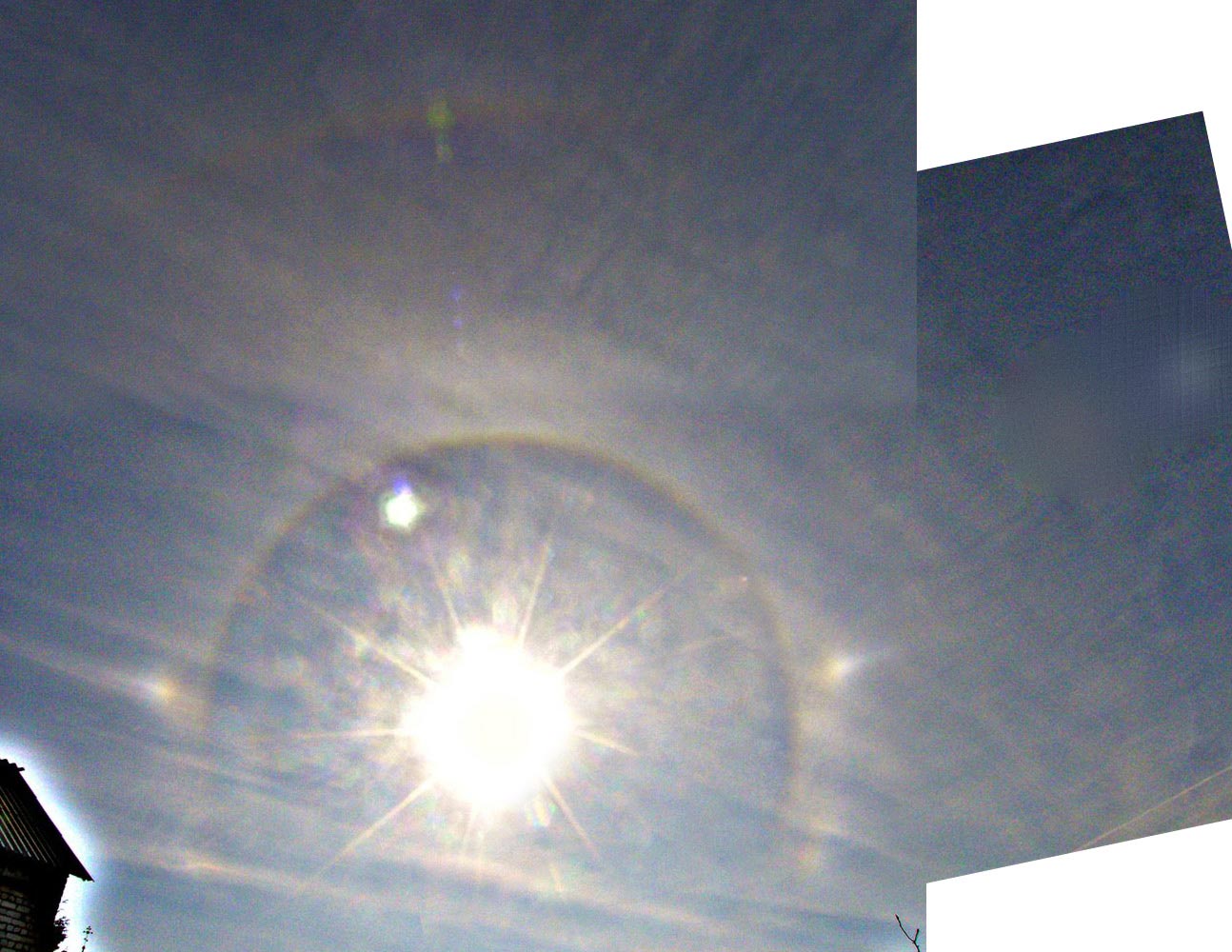
Odd radius display from Kiev

2010. május 14., péntek
Odd radius column arcs from Joensuu

There is also, before the odd radius started, photo of parhelia with sun elevation of 33 degrees ( 2 ). Do you think there is something strange? To me they seemed not be on a same level. Although in the photo it may look like the right one is abnormallly high, it was actually the left one that was abnormally low. Or at least that's how it looked. I knew this is hard to photograph because of the lens distortion. Maybe it was illusion. I have seen these things also before, at least in 30.9.1987 display. Also that time it got me rushing to photograph it. But that photo is not conclusive either.

Marko Riikonen
2010. május 10., hétfő
Simulations on the possible new arc from Moilanen crystals
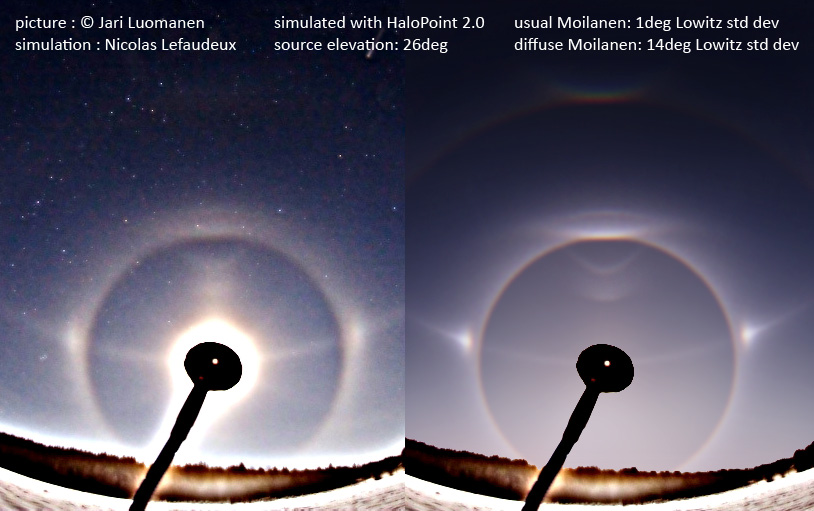
Here are some simulations to follow up with the possible new arc from Moilanen crystals ( 1 ). As suggested by Marko, I did some “photo quality” simulations with the two Moilanen arcs using Jukka Ruoskanen software. The Moilanen crystals are simulated using 34deg prisms pointing up.
First I simulated Jari Luomanen’s picture ( 2 ) which shows best the two arcs. I found that two Moilanen population tumbling with 1° and 14° deviation matched well the display.
Then I tried to compare two low source elevation displays from Marko Riikonen ( 3 - 4 ),and Milan Osecky ( 5 - 6 ). I simulated them with the same populations as the one I found from Jari Luomanen picture (1deg and 14deg standard deviation tumbling angle). The differences between the two populations are pretty subtle at this low source elevation. They are mostly in the shape of the outer edge of the Moilanen arc and in aspect which can be either hollow or solid. New arc has a more solid and curved edge. Although it is difficult to know for sure, I think the two pictures show the two different arcs.
Finally, I did some simulations that shows how one arc becomes another when the tumbling angles are increased, and for different source elevations ( 7 - 8 - 9 - 10 ). The limit between the two arcs would be somewhere between 8 and 16deg tumbling angles. The amount of crystals is kept constant in the simulations so brigthness can be compared. The two arcs vanish quickly when source elevation is increased. With the tumbling angles used (up to 64deg standard deviation), no lower component appears for the new arc.
Nicolas Lefaudeux
2010. május 3., hétfő
Sun pillar from Jersey
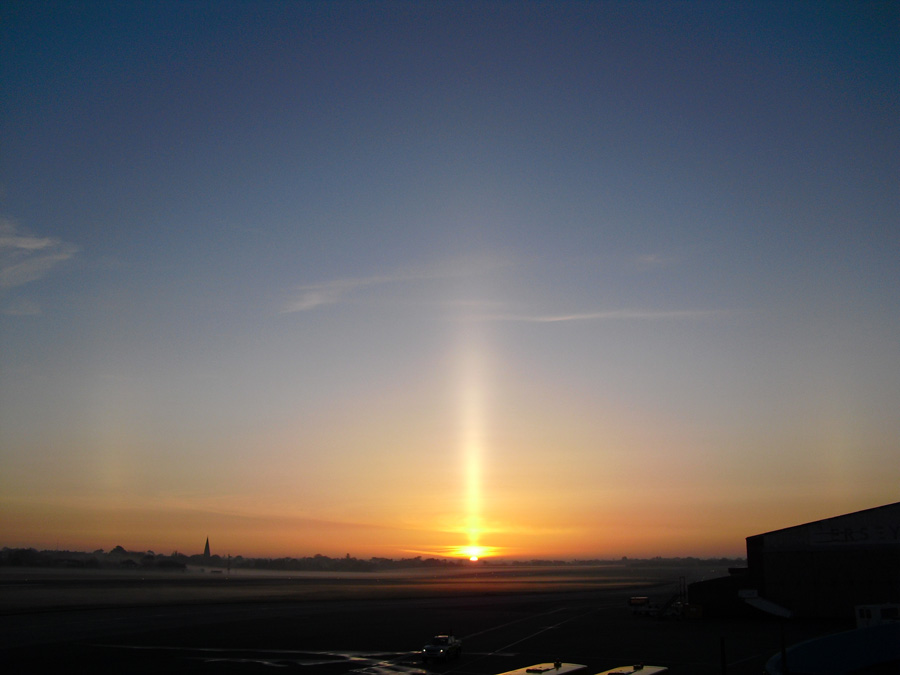
Frank Le Blancq
2010. április 22., csütörtök
Lowitz arcs on old film photographs
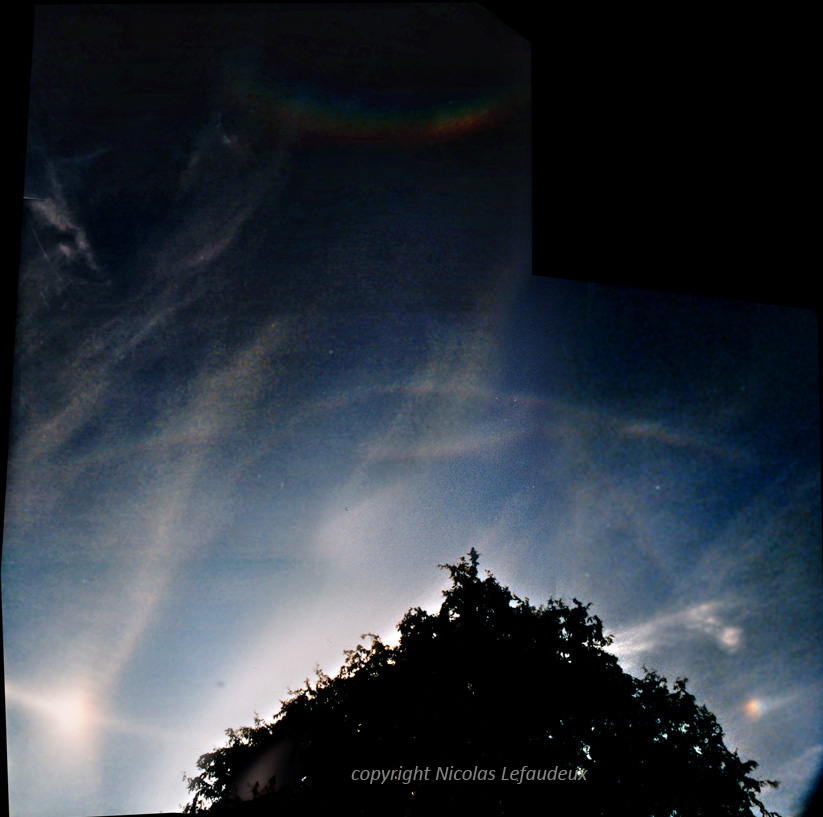
I found my record, sketch ( <a href=" http://www.ursa.fi/blogit/media/blogs/halos/Lefaudeux/18-09-98-17h15-17h55HL_post.jpg">1 ) and pictures ( 2 - 3 - 4 ), and realized there were very prominent Lowitz arcs too!
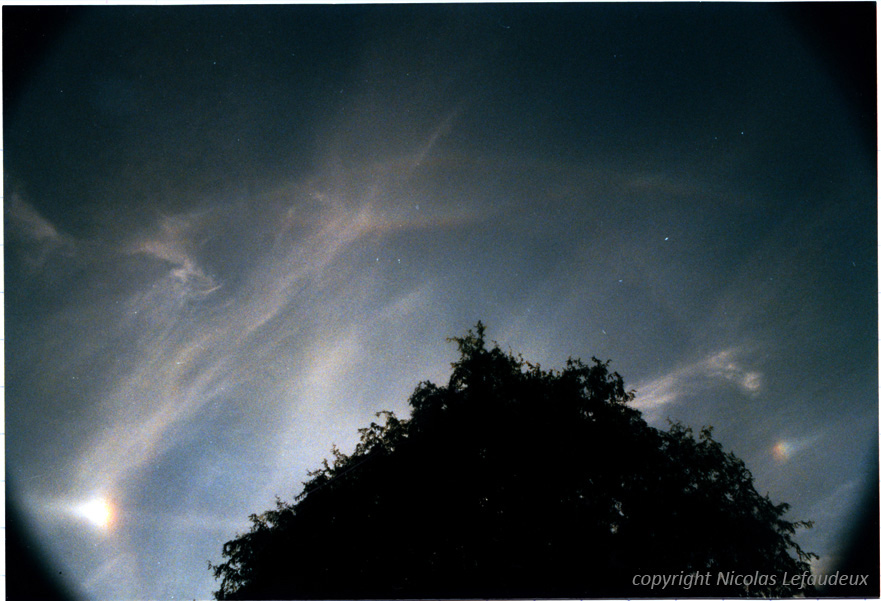
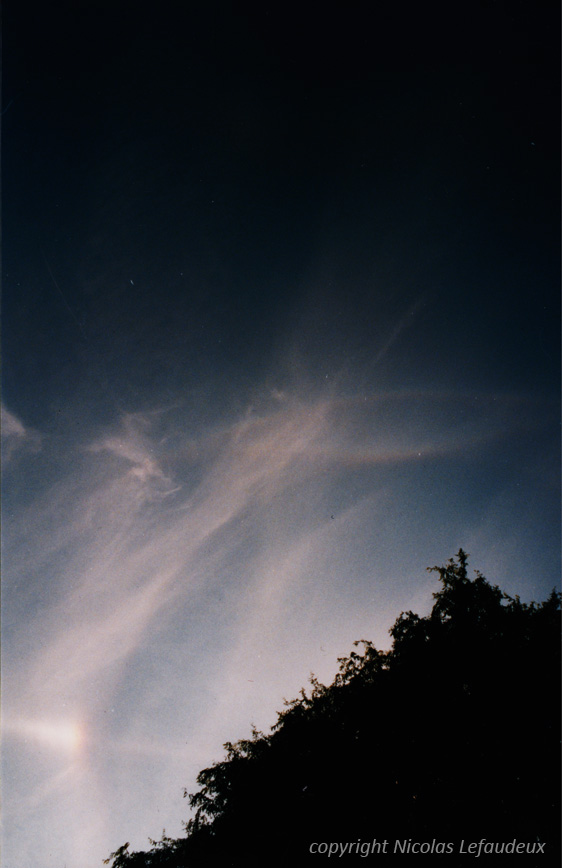

From my notes, the display happened on September 18th, 1998, between 17h15 and 17h55 local time. The sun was at 24 degrees altitude at the middle of the display. At that time, I had little knowledge of the halos. I just knew from astronomy books about parhelia, 22° and 46° halos. I had observed before upper tangent arc (which I called upper 22° parhelion) and circumzenithal arc (which I called upper 46° parhelion), but never Parry arc.
During the display, I was mesmerized by the colourful upper suncave parry arc and by the parhelion brightness. My notes are focused on these arcs, especially the Parry one, with detailed description of its length, width, brightness and colors. Nothing on the Lowitz arcs except the sketch which shows radiating arcs from parhelia.
The stitched picture shows almost complete upper Lowitz arc, very long Parry arc and faint 22° halo. There are also some weird bands on the bright parhelion. I think I have some memories of shadow bands running across the parhelion, a bit like in the video by Anna Herbst ( <a href=" http://spaceweather.com/swpod2010/11feb10/anna-herbst1.mov?PHPSESSID=liolll4f05nuq4m9ascc45gpg5">5 ), but cannot be sure as there is no mention of these in my notes.
I really wish I could observe again such an exceptional display now that I am able to appreciate it to its true worth
Nicolas Lefaudeux
2010. április 12., hétfő
An animated stereo simulation of streetlight halos
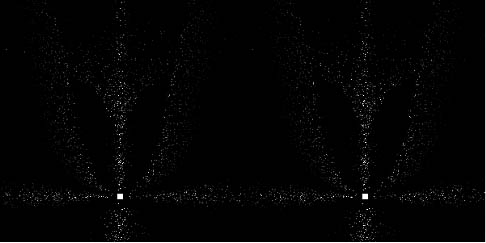
I suggest the following explanation: The ice crystal halo display is not made simply from idealized halo surfaces (or, more general, from an intensity field in space which takes into account all the subtle intensity variations along parhelia, tangent arcs, and so on) rather than from individual crystals that fall down or drift around in space and sample the intensity field pointwise along their trajectories. These crystals are real physical objects and should be perceived stereoscopically at their actual position, if being illuminated externally at equal brightness for each eye. But in case of a streetlight halo they deflect light by themselves to the observer according to the intensity field which lies stereoscopically flat around the lamp. Thus, especially crystals near to the observer should not appear at equal intensity for both eyes. But as long as both eyes receive light without any large difference in intensity the crystal should be perceived at its actual position and not pinned to some plane in the lamp’s distance, and so we get the stereoscopic depth impression of the halo display. This also implies that on a long-exposed stereo photo all contributions form individual crystal trajectories should be averaged, which would lead to a smooth and stereoscopically flat image of the intensity field.
At this point, I had the idea of an animated simulation. Spatial perception is still not fully understood physiologically, and there might also be an influence of dynamic effects from the moving crystals as well. So some kind of stereo animation should be the suitable representation of the problem, and then we can leave the interpretation work to the brain just like in a real display. I started the computation with typically 200000 random crystal positions in a cube between observer and light source that were tracked for 100 time steps. From one step to the next the crystals move a small distance downwards (when reaching the ground, a new position is generated to prevent from loosing the crystals). From geometry, it is quite easy to calculate the intensity for different halo species if the intensity field is provided as some look-up table or analytical fit. This is done separately for each eye. The images linked below show the results for cross-eyed viewing (left image on the right side) and as anaglyph (left image red).
( 2 - 3 - 4 - 5 )
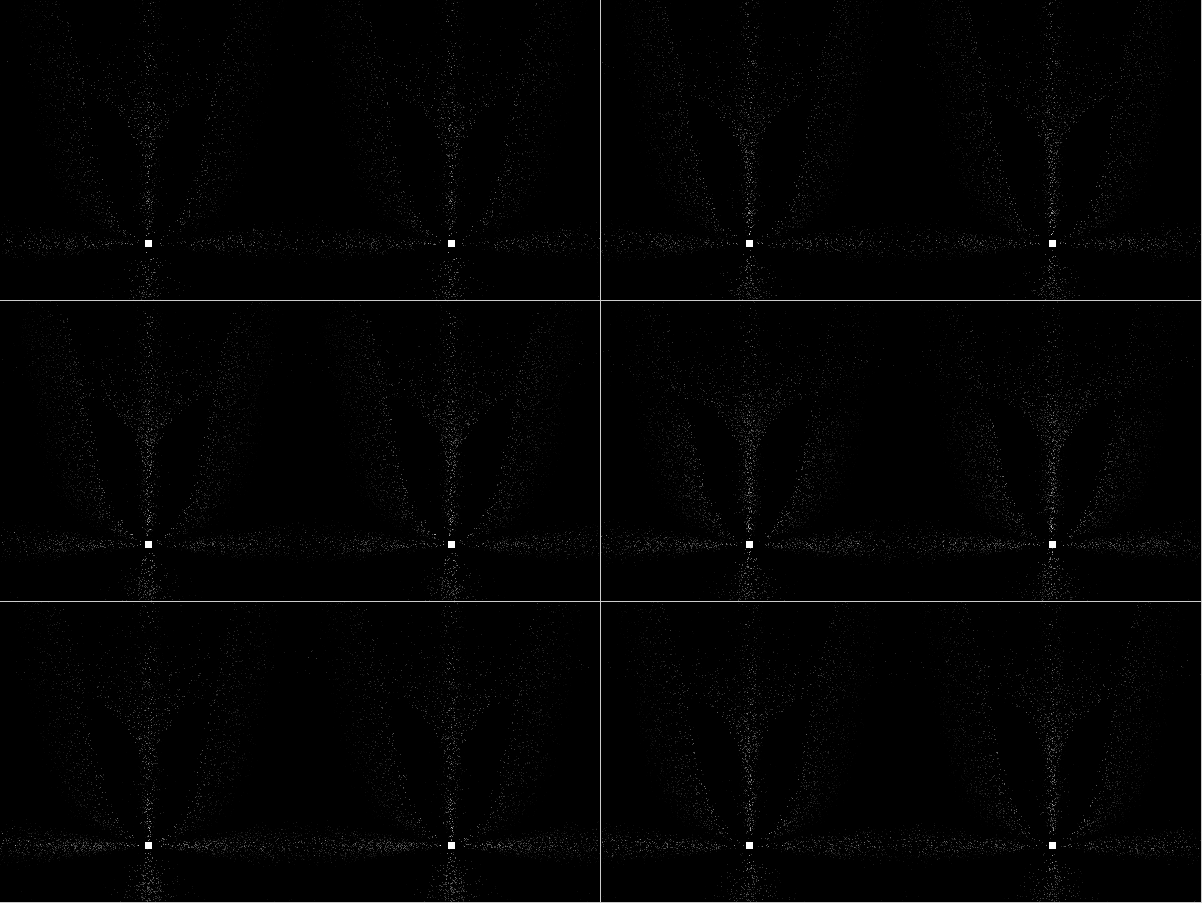
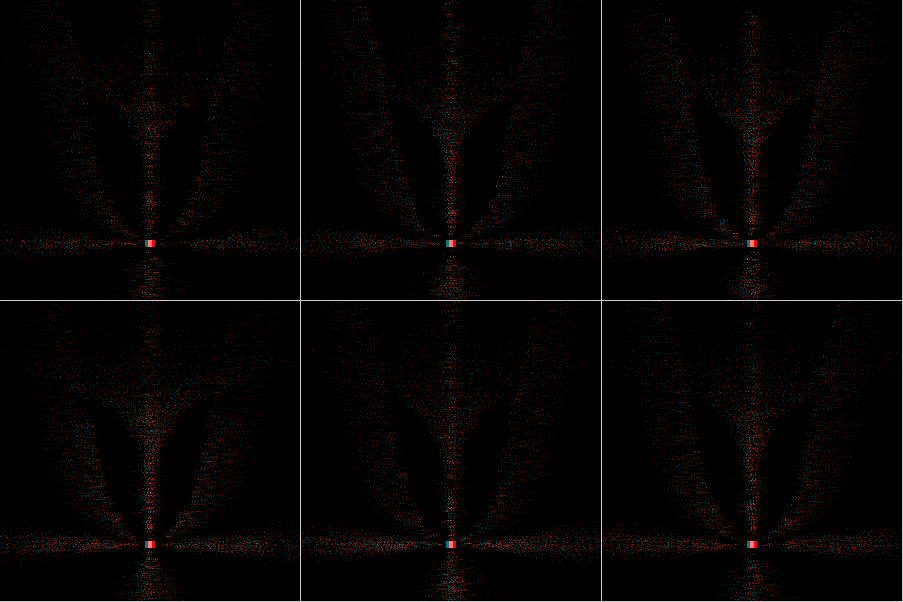
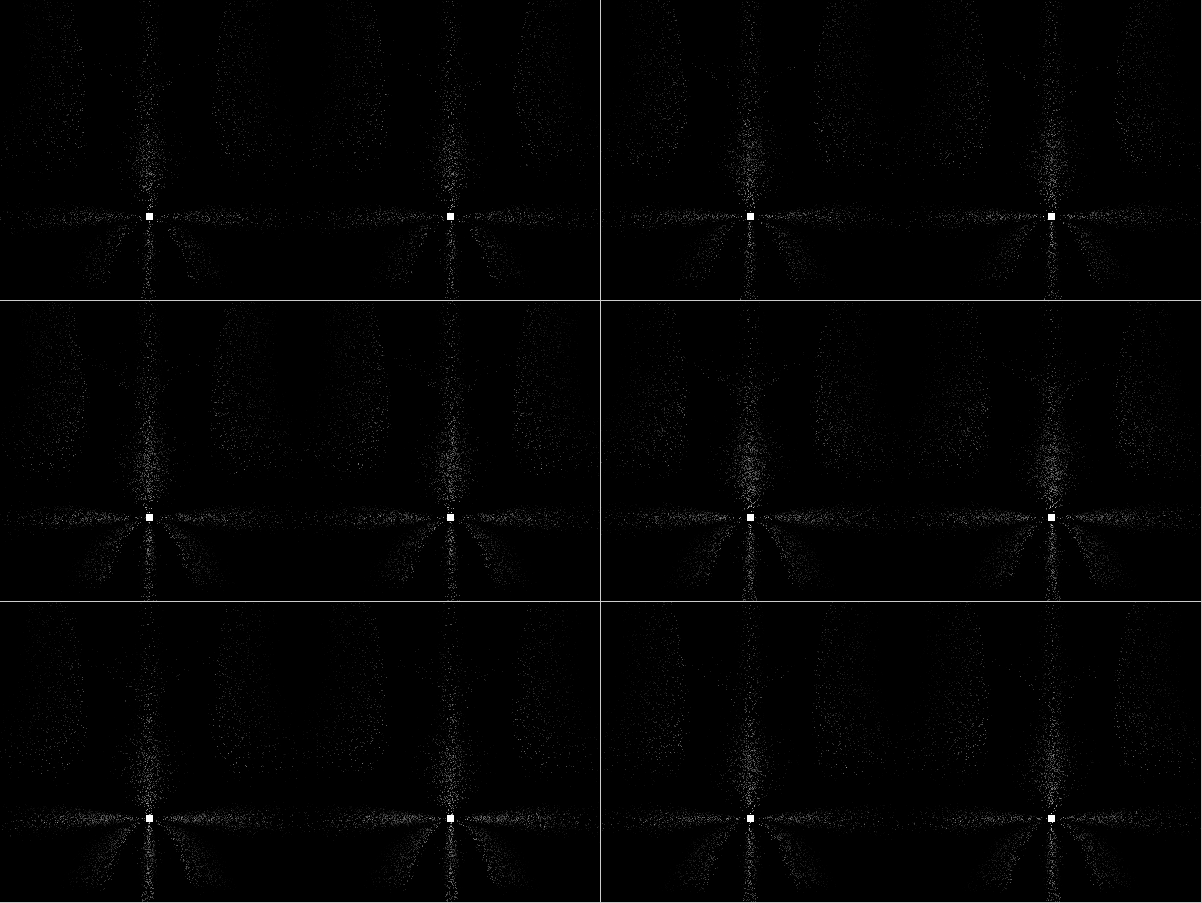
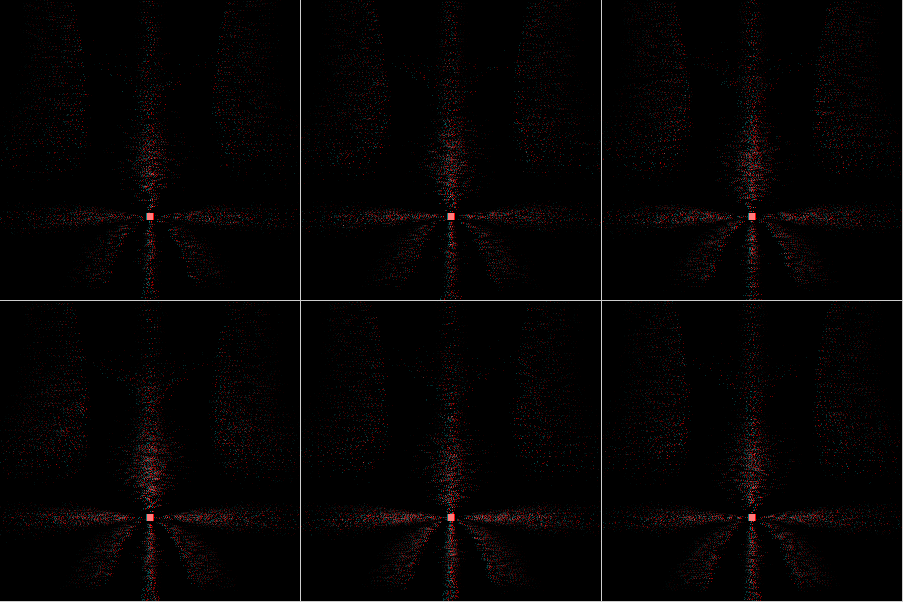
The included halo species are super/sublamps, 22° super/subparhelia, 22° parhelia, and 22° tangent arcs. The distance observer-lamp (in horizontal projection) is 10 m, the lamp elevation is +5° for the first and –5° for the second series. For the first simulation, the field of view corresponds to a 28 mm lens on 35 mm film (cropped to a square area), for the second it corresponds to 20 mm. The histogram had to be cropped at the white edge and the gamma value was increased as well since the original images that were normalized with respect to the brightest pixel would appear much to dark.
There are some simplifications in the model that I don’t want to conceal: No colour dispersion for refraction halos was taken into account, all calculations were done with a fixed index of refraction. Diffraction and defocus blurring were also neglected, each crystal is assigned to a single pixel (but more than one crystal can contribute to the brightness information of one pixel). The intensity ratios between the halo species were set arbitrarily and are not determined by a predefined set of crystals with certain orientations, aspect ratios, and so on. A subtle matter is that remaining degrees of freedom (such as the rotation angle around the vertical axis for parhelia oriented crystals) are already averaged by taking the intensity from a look-up table and not assigning these degrees of freedom to the simulated crystal the same way as it was done with the spatial coordinates. Otherwise the computation time would have increased dramatically. So I did not simulate individual crystals in this sense, or otherwise I have to assume that they are spinning around their allowed axes at quite a high speed in order to do the averaging.
Nonetheless, it can be seen quite nicely from the animations that eye-connected halos (parhelia, upper tangent arc for positive lamp elevation, “super”parhelia at negative lamp elevation…) near their classical positions – when crystals close to the observer are involved – seem to pop out of the screen and show a distinct stereoscopic depth impression.
Kind regards,
Alexander Haußman
2010. április 11., vasárnap
Three days of odd radius in a row
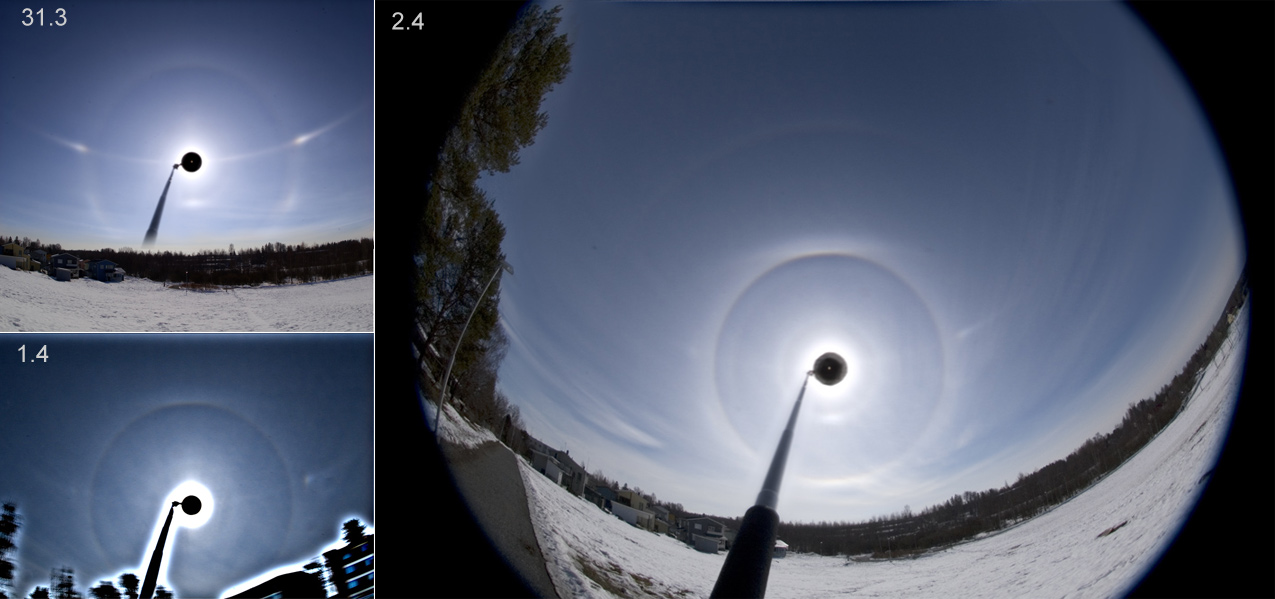
The three displays shown above were seen on successive days in Tampere on the period of 31 March to 2 April this year ( 1 ). Abundant start of odd radius halos may indicate a good year of high cloud halos coming. 1987 and 1996 were the best high cloud halo years in Finland.
Other displays from this spring:
- odd radius by Patrik Trncak in Holesov on 9 April
- odd radius by Patrik Trncak in Holesov on 1 April
- odd radius by Nikita Kulanov in St. Petersburg on 30 March
- odd radius by Jukka Ruoskanen in Kotka on 27 March
- Wegener by Ágnes Kiricsi in Budabest on 27 March
Feliratkozás:
Bejegyzések (Atom)