A következő címkéjű bejegyzések mutatása: Displays. Összes bejegyzés megjelenítése

2010. november 10., szerda

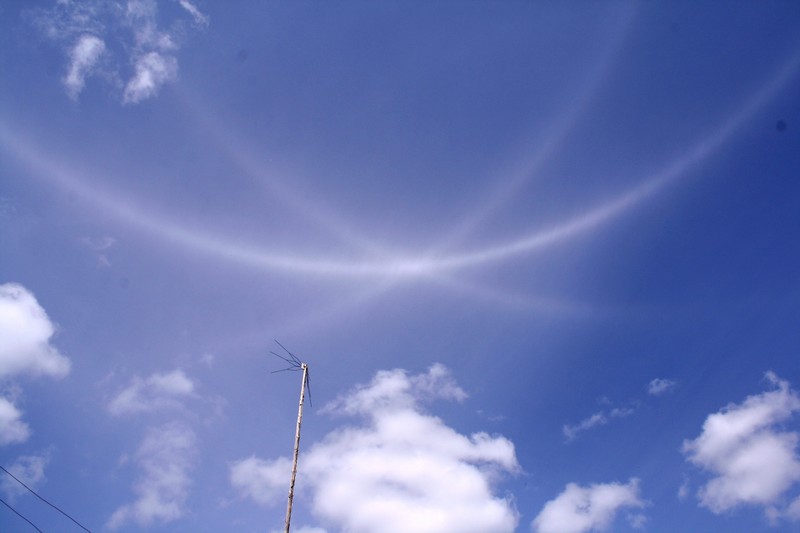
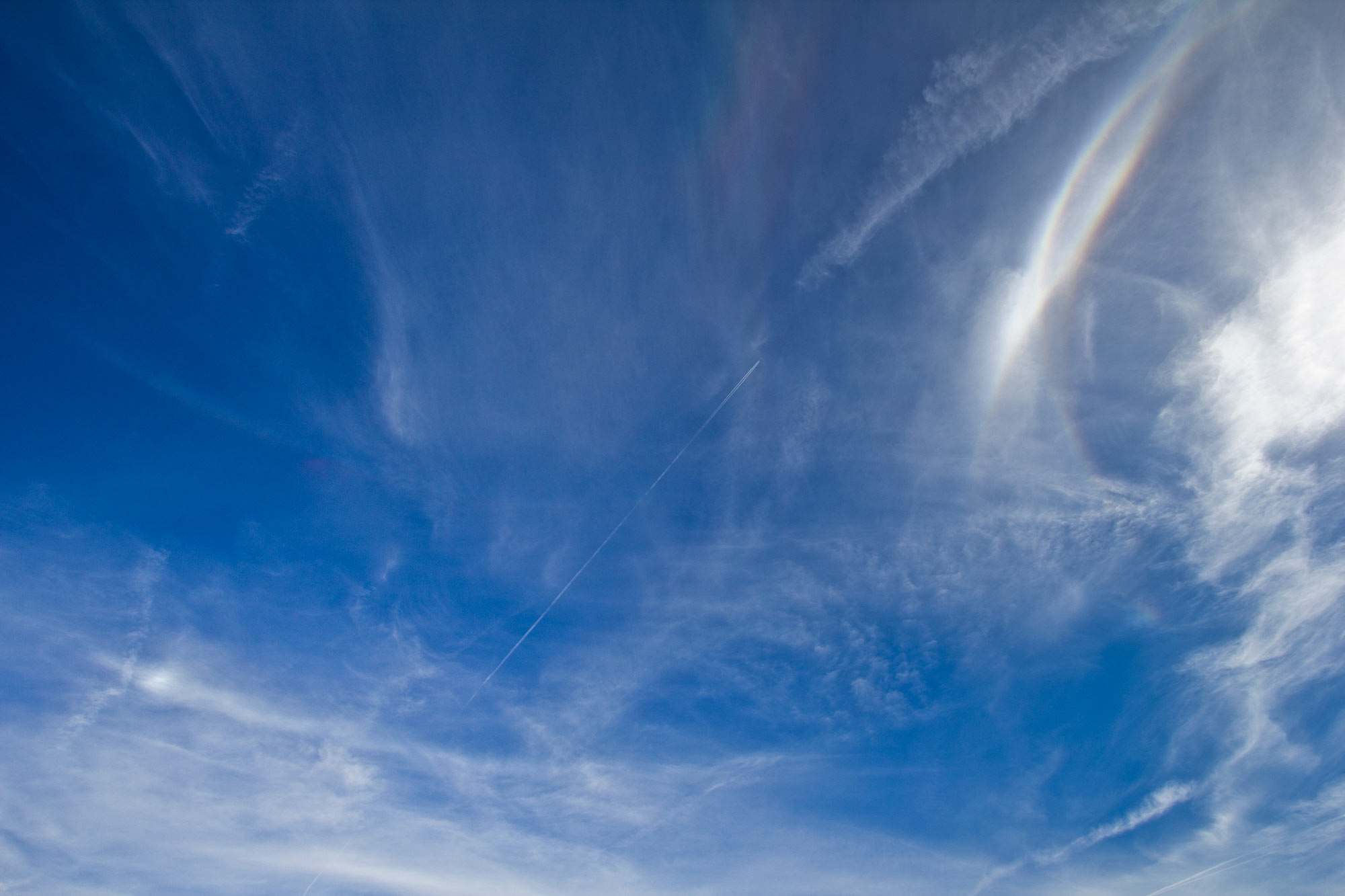
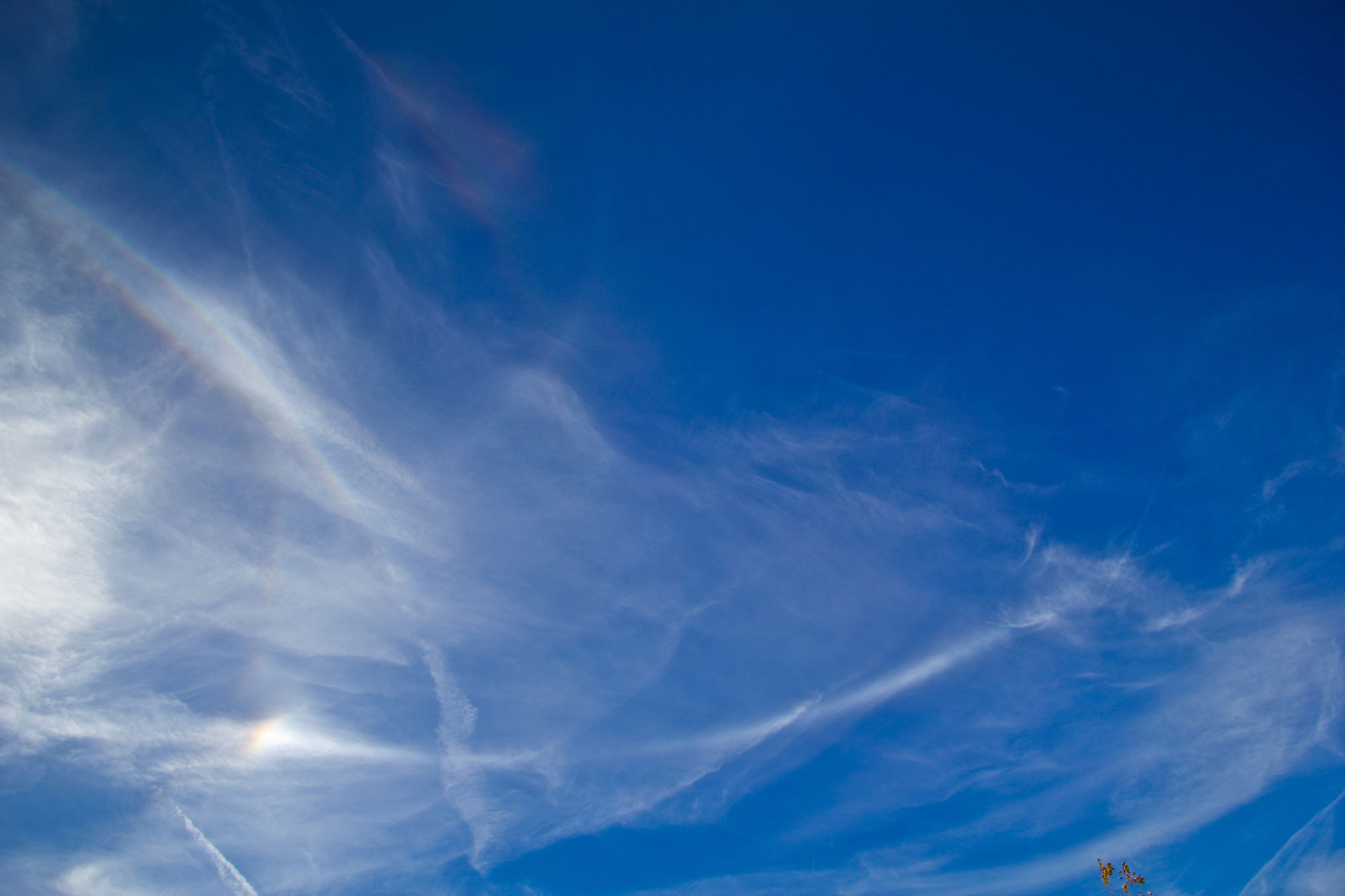
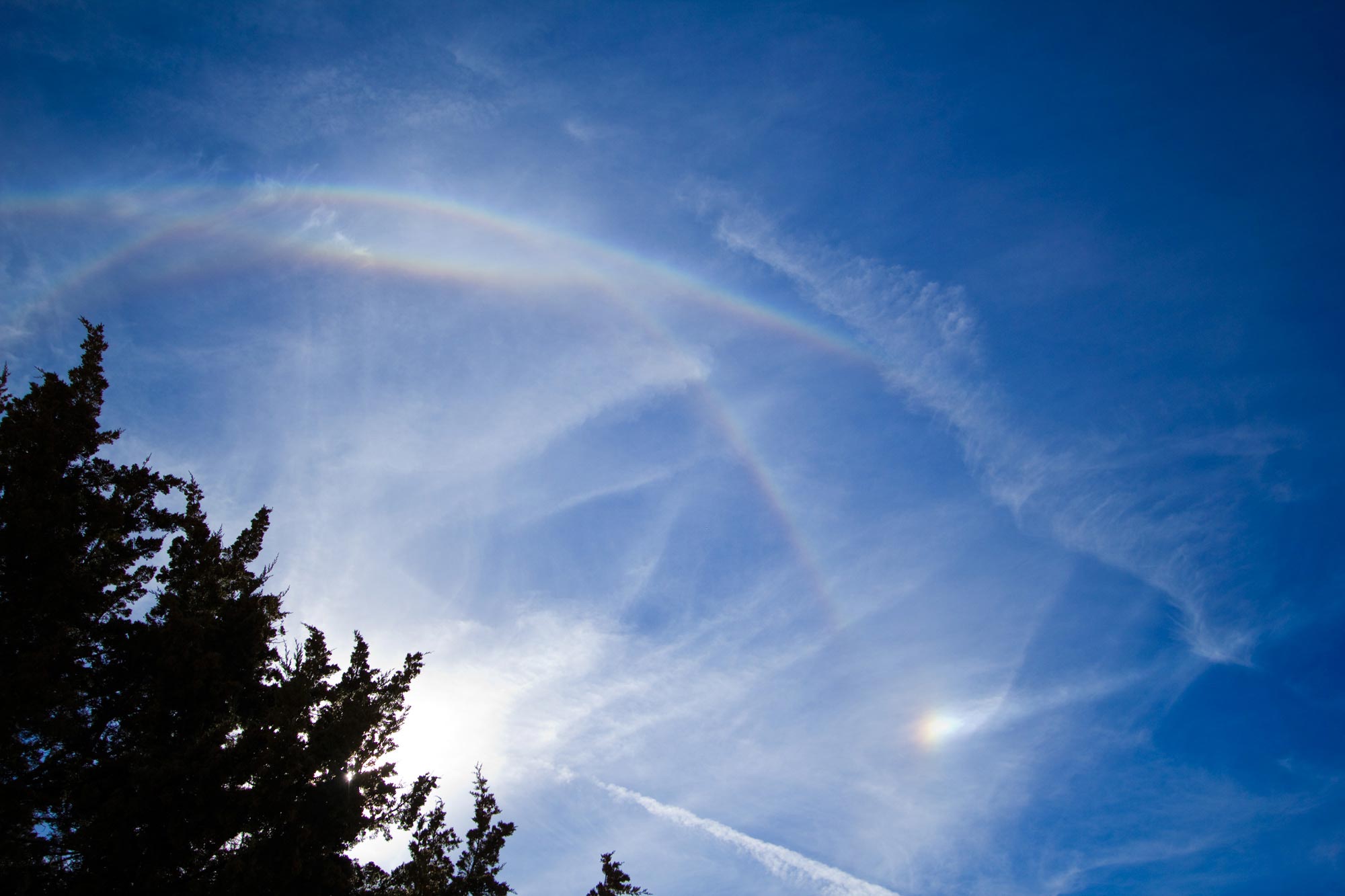
Superb Lowitz and helic arcs from the USA

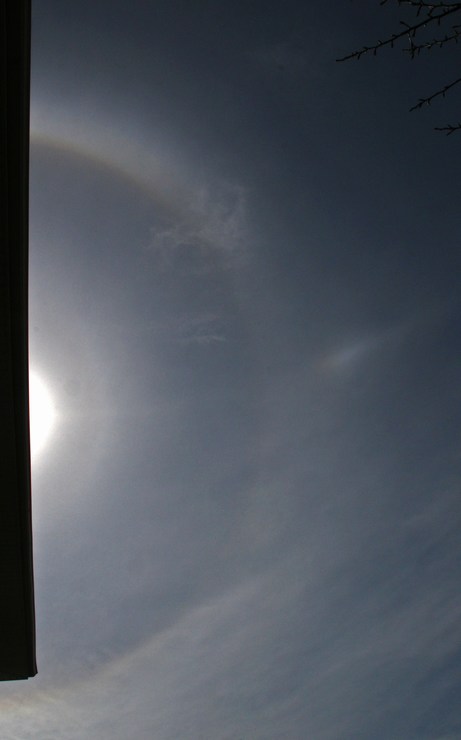
The display was seen at and/or just after high noon from eastern Nebraska about 41 degrees north, on November 7. My sister had called about some geese at a refuge nearby and wanted to go photograph them. I was going to visit my parents, like I often do, and decided I may as well take my camera gear with so if I went to the refuge I'd not have to stop back home. This is the only reason I even had photo gear with me. I stepped outside to do something, and right away saw the parhelic circle extending out a ways, something I've never seen before and I have at least seen a number of optics displays now (lunar fog bows, light pillars, lunar vivid coronas, etc)....so I look often enough for stuff. I pointed it out to my uncle as I sprinted for my car to get my gear and he thought, "it's not just a cloud". I said no, it's an arc, watch. I took my camera and sprinted up the hill behind the house.

I soon was seeing "sun dogs" on the parhelic circle. I then was clearly seeing the Wegener arc inside the parhelic circle. It was very vivid as with my eyes I could clearly see the rainbow colors. To be honest I never did see the Heliac arc before. I was flipping through pictures inside later and it simply jumped out. I was like, what is that arc..then looked it up.

The top of the 22 degree halo visually looked crazy most of the time. Very clear and colorful and odd arcing. I thought it was just an intense circumscribed arc in there but it didn't look placed right and like more was happening. ( 1 - 2 - 3 - 4 - 5 )

The show only lasted 30-40 minutes I'd guess. Then it was pretty hard to get any optics at all. What was strange was visually nothing much was changed about the sky. I was watching for hours so there were different periods of less contrail garbage blocking out the sun. I had friends in Omaha, 20 miles south, and Lincoln another 45 miles south of that, looking too. They never saw anything good. They watched till sunset too, but they also didn't get out as soon as I was and that was the best part. I wonder what I missed before I got out.

The satellite loop for that day may give the key ( 6 ). I'm located in eastern NE which is at the top center. It was much like the crystals you get right behind a blizzard in air just where it is clearing behind the storm. You can see a more puffy nature to the clouds, they pass and the ice crystals are left in the air. That stuff on satellite is below typical cirrus level/flight level...but still up there. It for sure was different than normal cirrus. A lot of that "cirrus" in the shot is left over form all the contrails. Once the sun got lower you could see the moisture/clouds clearly below the contrails. So anyway, probably worth noting the clouds coming across at the time were more along the lines of mid-level clouds/moisture.

Mike Hollingshead

2010. október 30., szombat

Superb diamond dust display in Austria


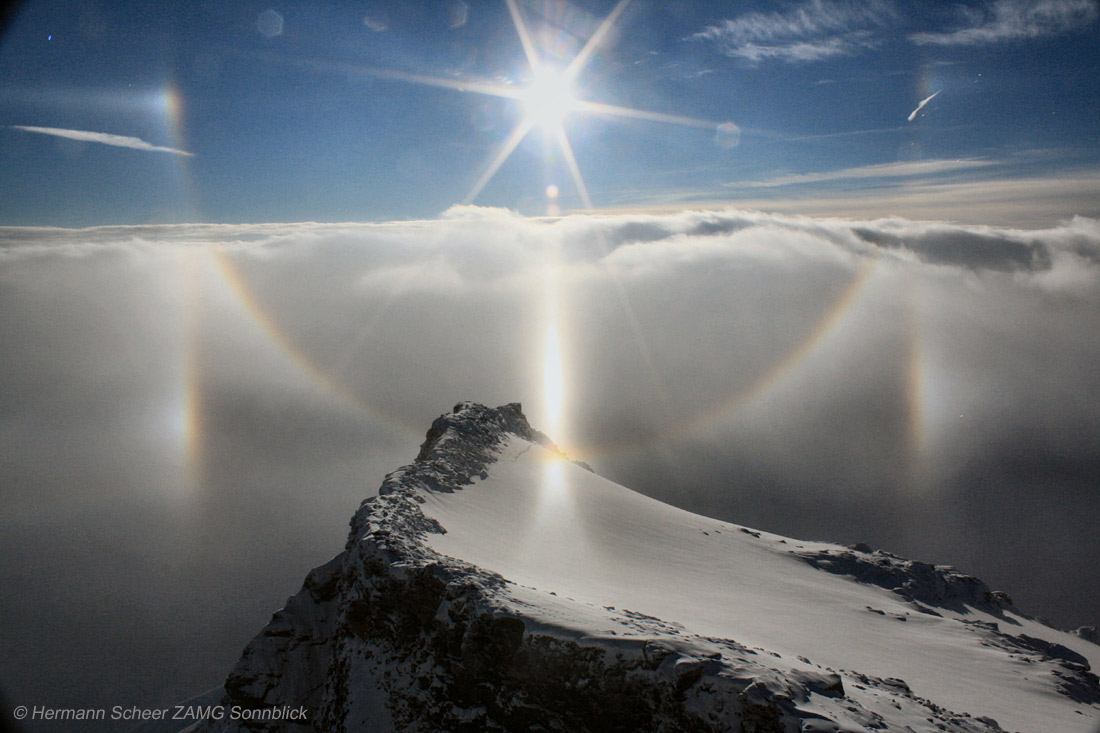
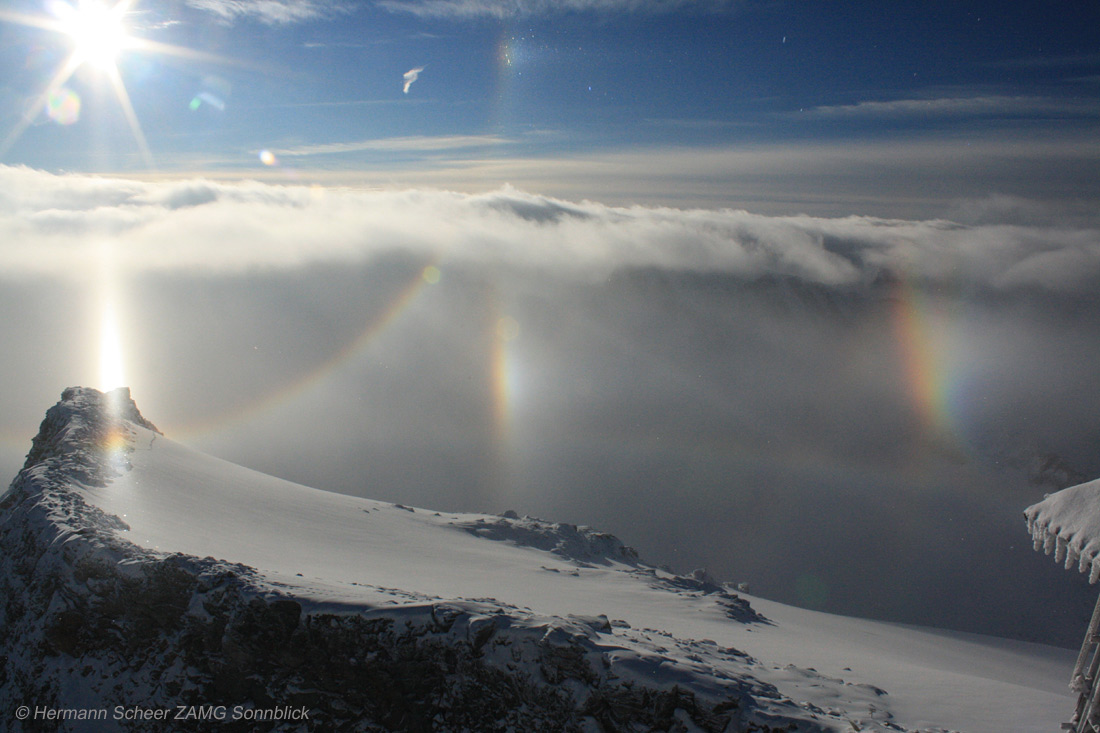
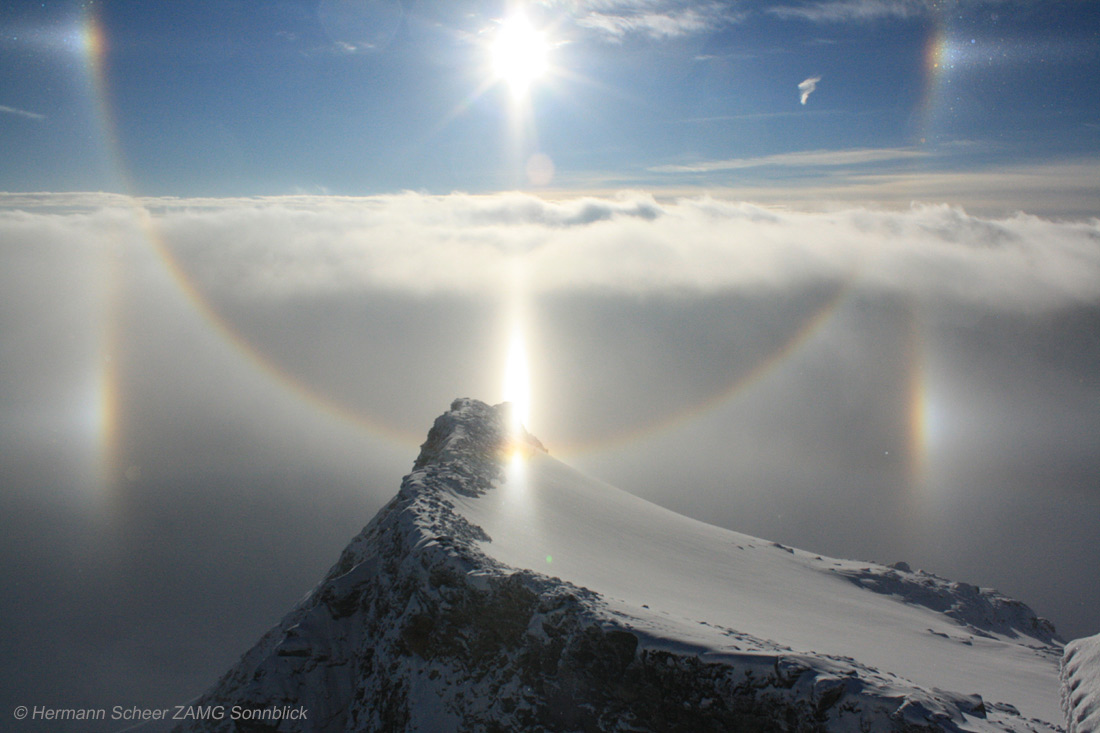
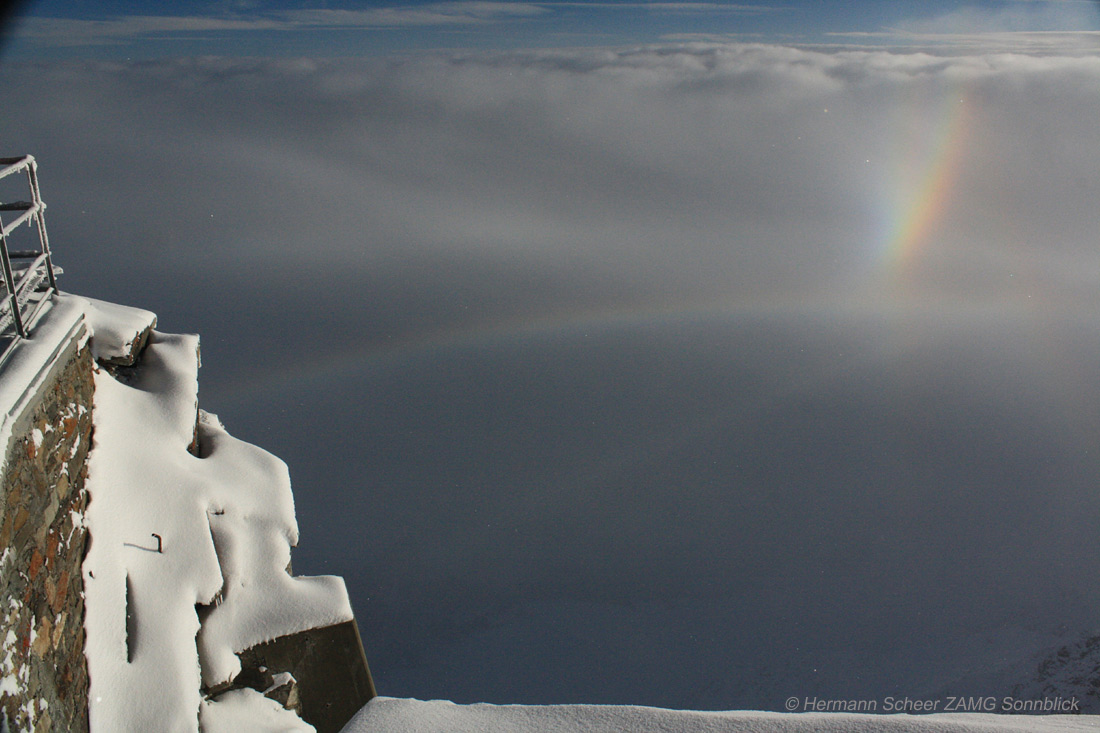
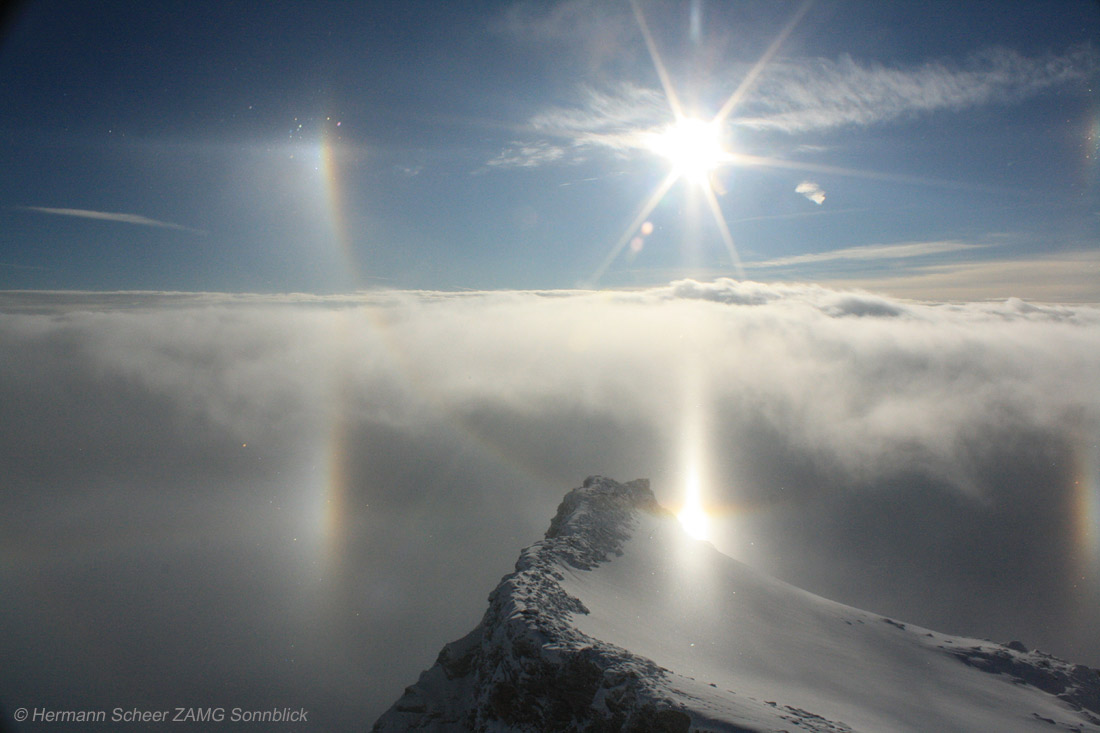
On 18 October 2010 a superb diamonddust halodisplay was observed at the meteorological station Sonnblickobservatorium ( 1 ) in the Austrian Alps (3106 m, 12°57’ E, 47°03’ N). Hermann Scheer, member of the meteorological team at the observatorium, took images of 13 different haloforms between 08:30 and 09:00 CEST (06:30 and 07:00 UT): parhelia, 22°-halo, 46°-halo, lower tangent arc, subsun, subparhelia, infralateral arc with Parry-infralateral arc, supralateral arc, parhelic circle, subparhelic circle, subhorizon Wegener arc and helic arc. ( 2 - 3 - 4 - 5 - 6 ) The images were taken at a sun elevation of 8,9° to 10,3° between 08:31 and 08:40 CEST, the file names indicate the exact time.

The brightness of the Wegener arc was incredible. Very interesting is the combination of Parry-infralateral arc with infralateral and faint supralateral arc. This part of the phenomenon is similar to an observation in the Czech Republic (26th of December, at Lysa hora in Krkonose (Giant Mountains)), described at Optické Úkazy v Atmosférè ( 7 - 8 ) Thanks to Tomas Trzicky for the links. And also in Ice Crystal Halos ( 9 ). In this very small area of the display we can see a 46°-halo, Wegener arc, helic arc and the subparhelic circle too.

The display was observed at the upper boundary of the stratiform layer; weather conditions: 06:00 UT - air temperature -6,8°C, air relative humidity 96%.

Credit to Hermann Scheer for giving the permission to show his images at Crystal Halos Blog under this licence: ( 10 ). Homepages of Hermann Scheer: ( 11 - 12 - 13 ). This diamond dust display is described on the page "Atmospheric phaenomenons observed in Austria" too: ( 14 )

Karl Kaiser

2010. szeptember 22., szerda

Wegener from Altai Krai

The photo of these Wegener-arcs was taken in the Siberian Altai Krai by Alexander Kostenko on 12 August 2010. Further images can be seen in his album ( 1 )

2010. augusztus 4., szerda

Hungarian odd radii

These odd radius rings and arcs were photographed on 24 July 2010 by Róbert Rosenberg in Adony, Hungary. The photos were taken a few minutes after 14:35 CEST, and about two hours later. ( 1 )

2010. július 24., szombat

Moilanen arc without snowguns

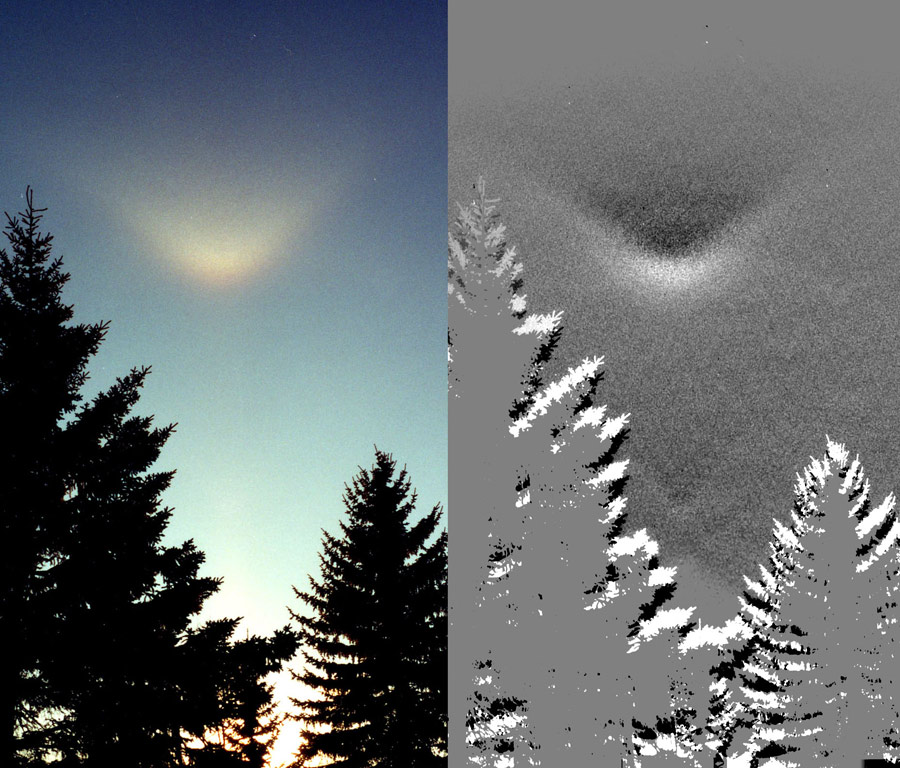
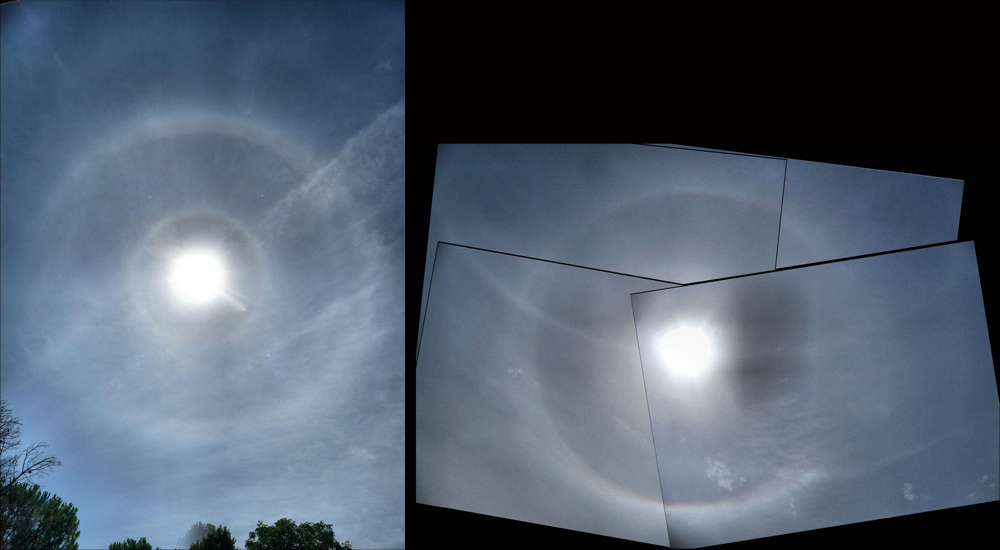
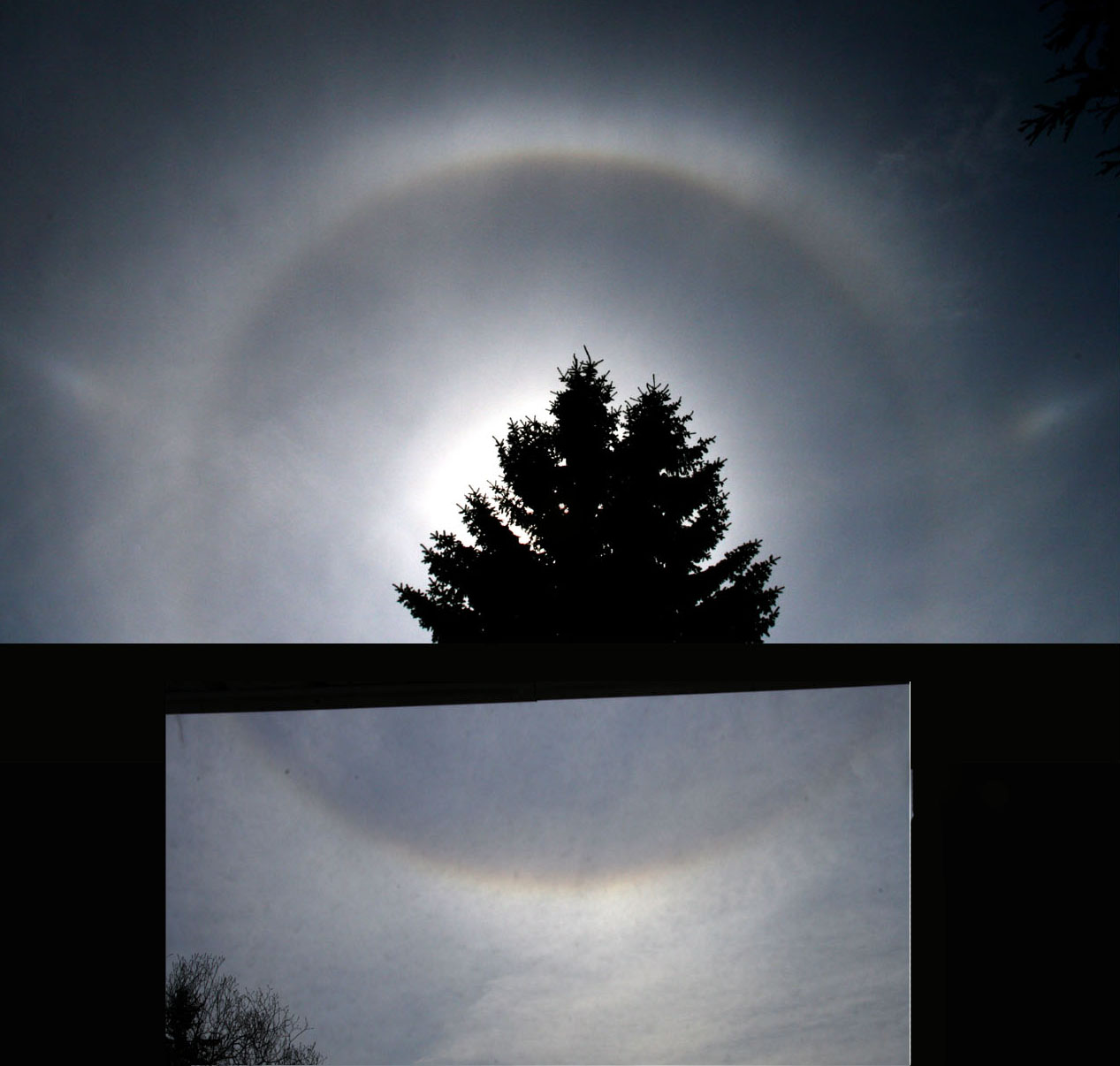
I was recently filing images digitized from somewhat older slides and came across this upper tangent arc image from many years ago, in the early morning from here in Calgary. I decided to subject this image to some processing, in particular, embossing the image in Photoshop and low and behold, a faint Moilanen arc showed up, as you see in this composite image!

I certainly do not live anywhere near to a ski slope or factory chimney that would produce lots of ice crystals. There is no evidence on the photo of local ice crystals as we see often in diamond-dust displays. The climate here is very dry and we often find low-lying layers of diamond dust particularly over our river.

Thus, I hesitate to claim that this is a "natural" Moilanen arc but it was not taken near to ski slopes. Maybe our furnaces produce the requisite crystals sometimes, in which case I will be on the lookout next winter for a repeat of this display.

Alan Clark

2010. július 2., péntek

Odd-radii again

Alan Clark sent the above image, which shows the same display that Elmar Schmidt saw from Virginia, and which can be read about in the previous post. Alan photographed the halo from Dulles Airport, about 120 km NE of Elmar's site. The Sun elevation was about 58 degrees, and it was between 15:00 to 16:00 local summer time. As Alan says: "The display was not perhaps as clear as Elmar's in that some components of the odd halo were not distinct." ( 1 )

Alan has sent another pair of odd radius halo images. These were taken from Calgary, Alberta, Canada in May, 2009. ( 2 - 3 )

2010. június 29., kedd

Pyramidal halos in central Virginia

Elmar Schmidt was travelling southwards after the 10th Conference on Light and Color in Nature in Maryland. He observed this spectacular pyramidal halo display in central Virginia on 22 June. The display lasted for at least 2 1/2 hours and showed several odd radius halo rings and their tangent arcs.

As Elmar Schmidt tells: "All in all the phenomenon looked spectacular and eery with the broad belt starting at the 18-deg-radius. Of note is also its quite southerly location and the longevity, which might be interesting to compare with simulations, especially at the sun's elevation of 57 degrees." ( 1 )
Further images of the display between solar altitude 54 and 29 degrees are also available ( 2- 3- 4- 5 )

2010. június 20., vasárnap

Odd radii from Italy

Marco Candotti sent these photos from Italy. The images were taken on 15 June. The 22 degree halo lasted about an hour, while the pyramidal crystal halos only a few minutes. For a short time, a 120 degree parhelion was also observed

2010. június 12., szombat

New version of Streetlight Halos

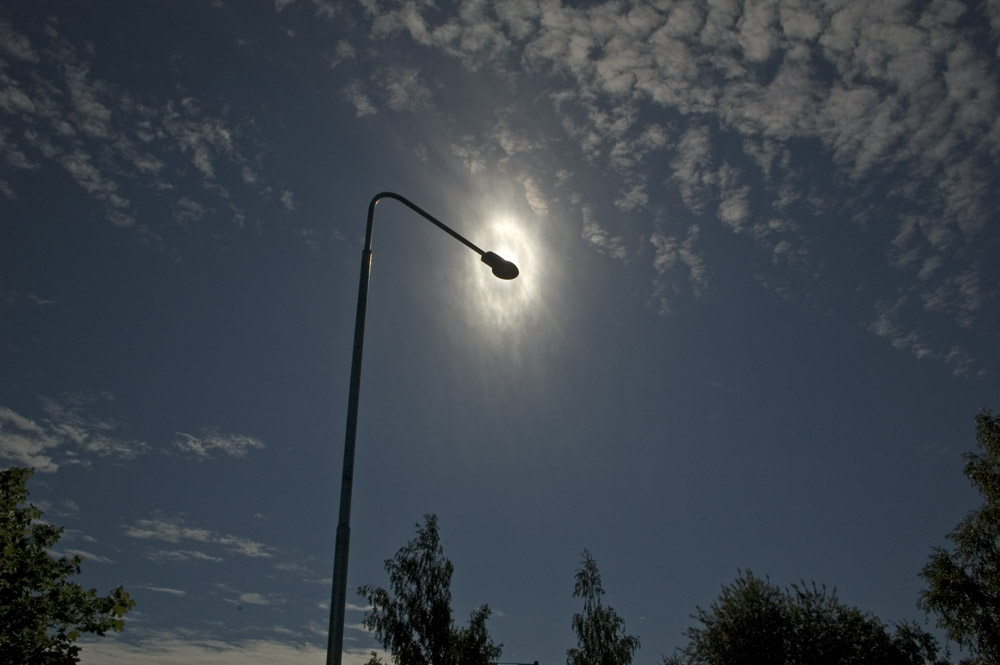
A new version of Streetlight Halos is available ( 1 ). The project took on a life of its own, to the point where it is now a monster, more than anyone will want to read in totality. There are nevertheless lots of pretty pictures and quite a few suggestions for observers for next winter.

Walt Tape

2010. június 4., péntek

Tampere Ellipse


The elliptical halo display observed yesterday by Marko Riikonen and Jari Luomanen was formed - as usual - in Ac virga. Marko had been paying much attention to Ac virgas for some time, and could therefore observe the whole display from beginning to end. From his perspective the display lasted six minutes between 10:18 - 10:24 and was uniformly good during the whole period. From Jari's place of observation, the best phase lasted a couple of seconds only.

More photos of the observation can be seen in their galleries ( 1 - 2 ).

2010. május 17., hétfő

Odd radius display from Kiev

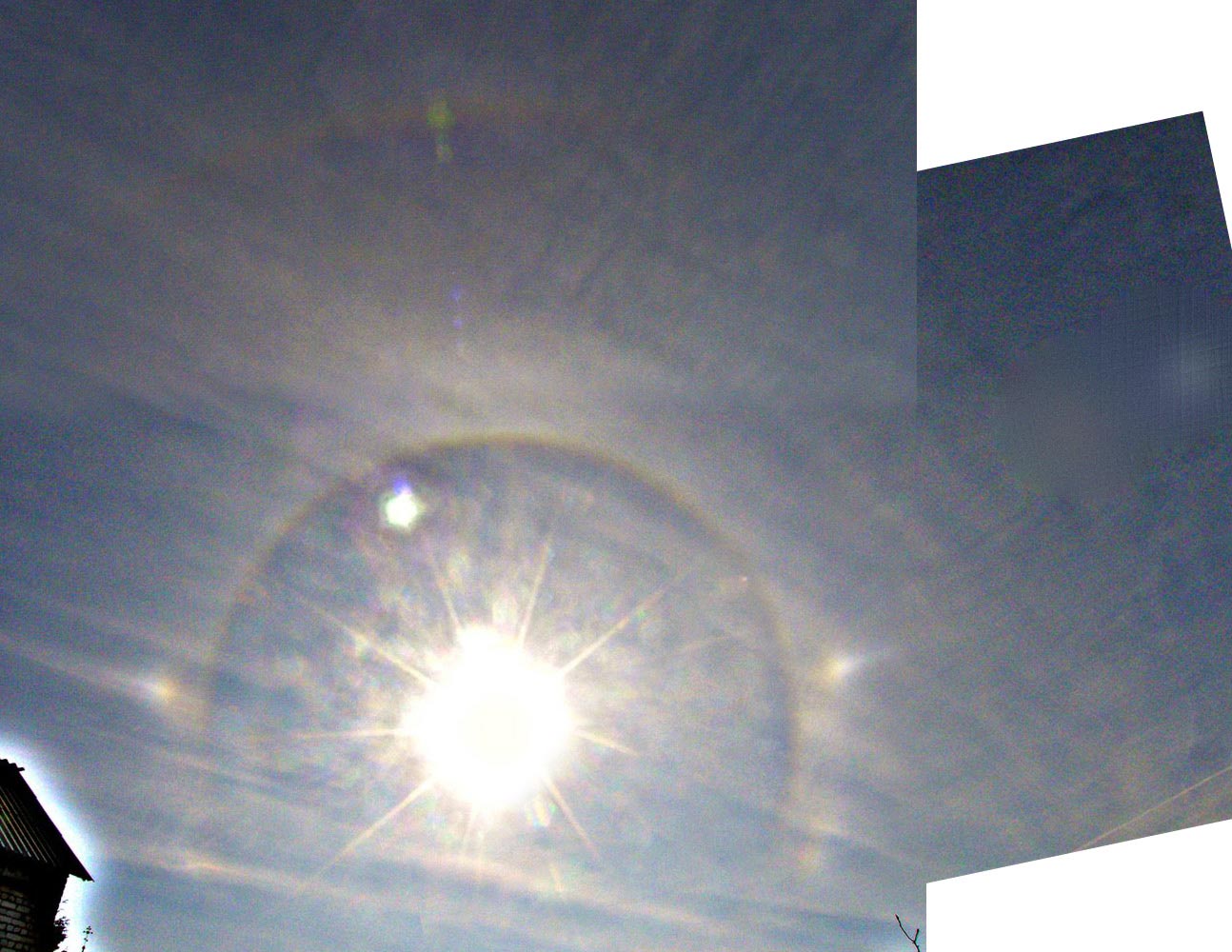
Alexandr Shinder made the above panorama of the odd radius display he observed in Kiev, Ukraine on 31 March 2010. Further images can be viewed on his blog ( 1 ).

2010. május 14., péntek

Odd radius column arcs from Joensuu

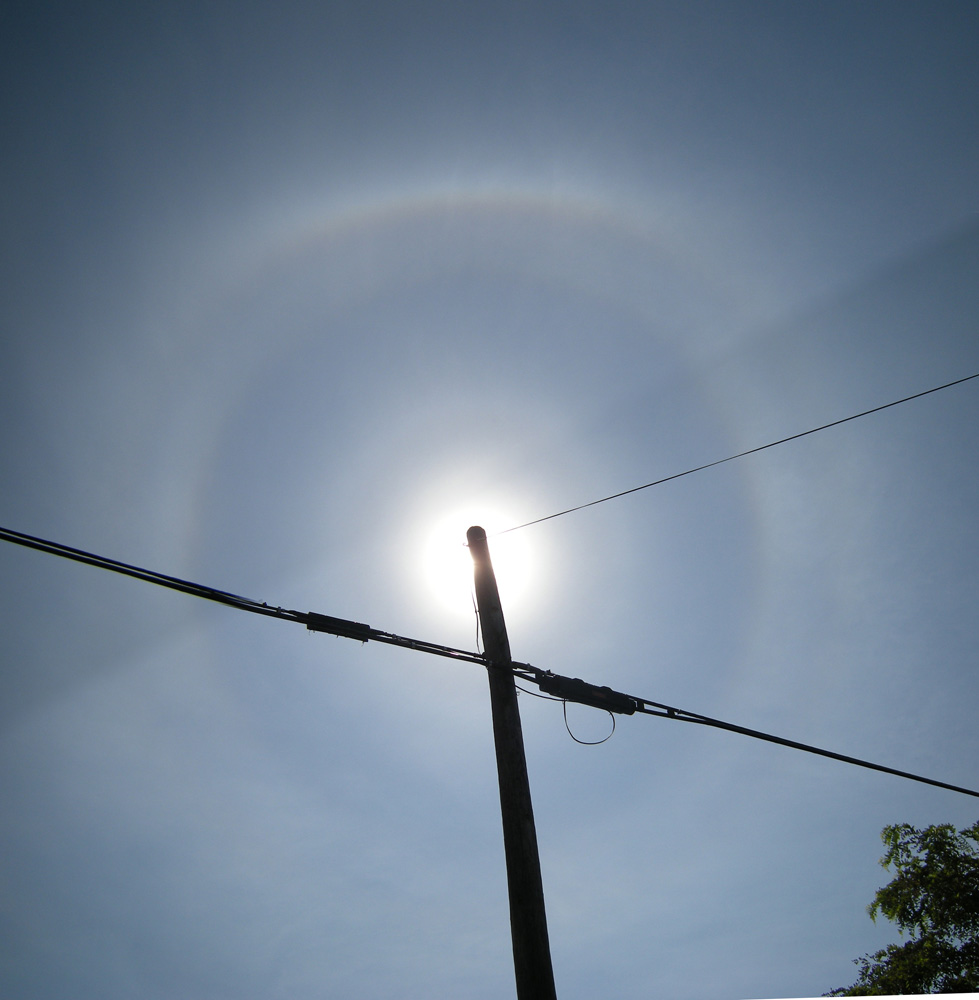
Summer's first hot weather spell started on 12 May in Finland, and along came solitary 23° plate arc. Yesterday it got warmer (+24°C) and also the halos got warmer. Odd radius column arcs! In addition to 9° and 24 column arcs (the latter of which always shows as a circular halo) I recognized the 18° column arc in the field, which gave me some satisfaction. 35° halo was visible only through mirror. The 24° column arc was clearly separated visually, but fisheye compresses it close to 22° halo. Should photograph these with normal lens. Click on the above image to see 18° and 20 column arcs marked. There are other images also available; those where sun is behind the lamp are max two minutes stacks, and the sun is not tracked ( 1 ).

There is also, before the odd radius started, photo of parhelia with sun elevation of 33 degrees ( 2 ). Do you think there is something strange? To me they seemed not be on a same level. Although in the photo it may look like the right one is abnormallly high, it was actually the left one that was abnormally low. Or at least that's how it looked. I knew this is hard to photograph because of the lens distortion. Maybe it was illusion. I have seen these things also before, at least in 30.9.1987 display. Also that time it got me rushing to photograph it. But that photo is not conclusive either.


Marko Riikonen

2010. május 3., hétfő

Sun pillar from Jersey

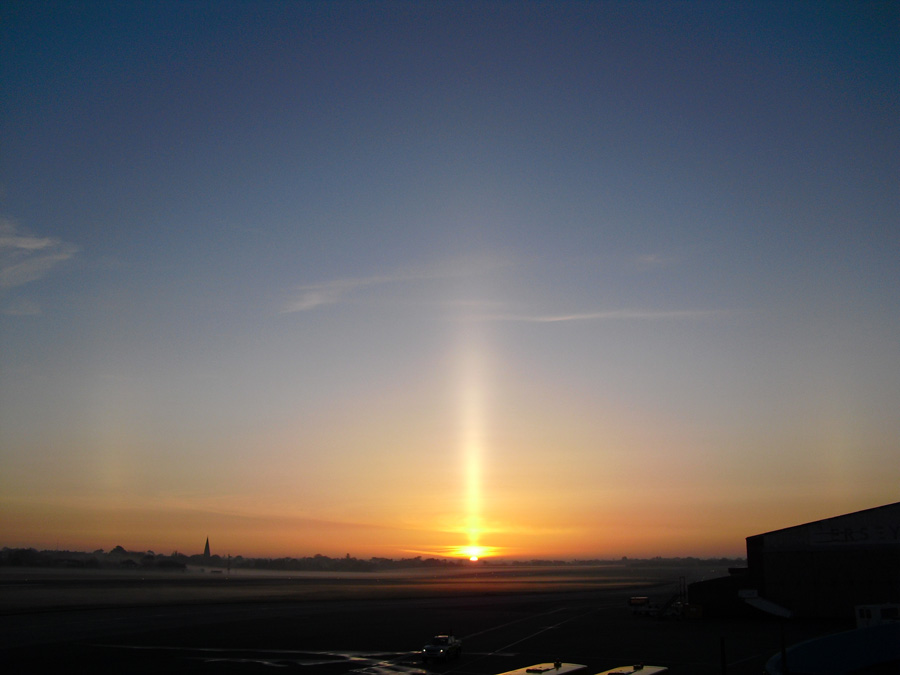
The phenomena began about 30 minutes before sunrise (which was at 5:58am local time) and faded completely about 30 minutes after sunrise. Apart from the main sun pillar you can see faint pillars to the left of the church and also over the hanger building on the right hand side.

Frank Le Blancq

2010. április 22., csütörtök

Lowitz arcs on old film photographs

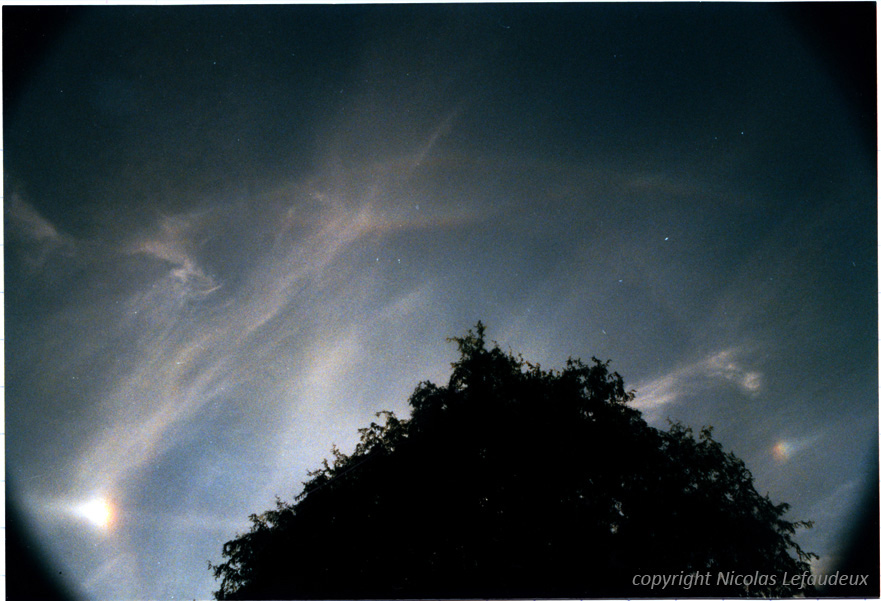
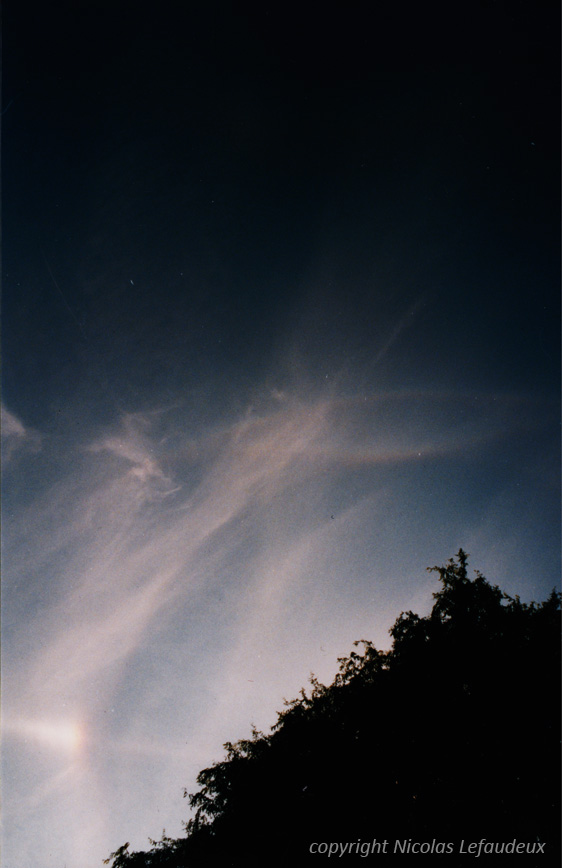
Last weekend, I visited my parents in Normandy. I took advantage of my visit to dig through my old astronomy journals of observations and pictures. I was looking for my records of what has been my best halo display. In my memories, it consisted in extremely bright left parhelion, bright circumzenithal, and a combination of suncave Parry and upper tangent arc.

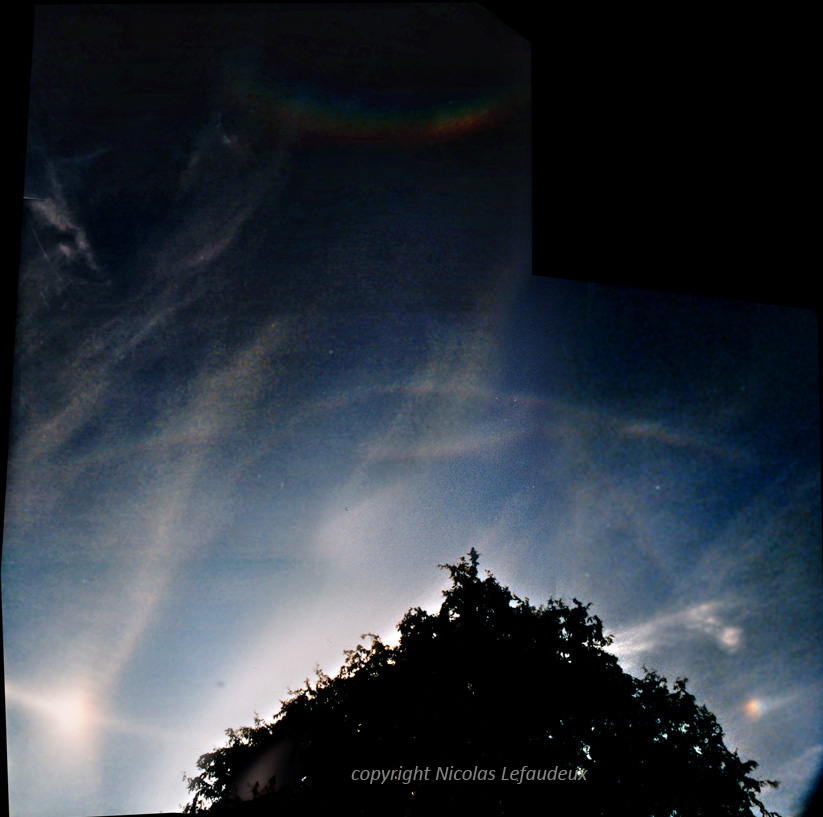
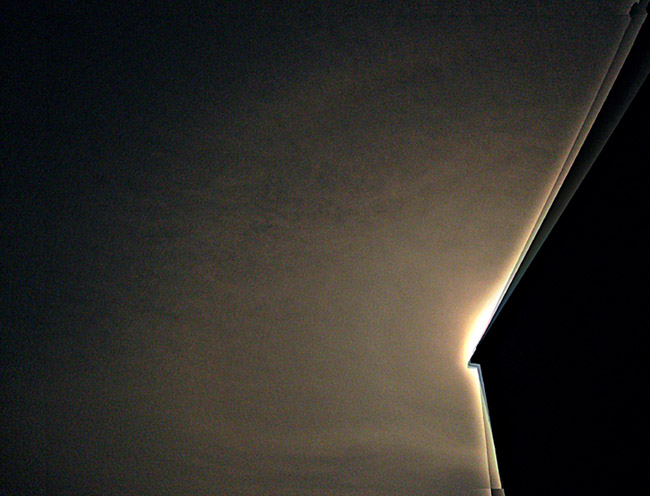
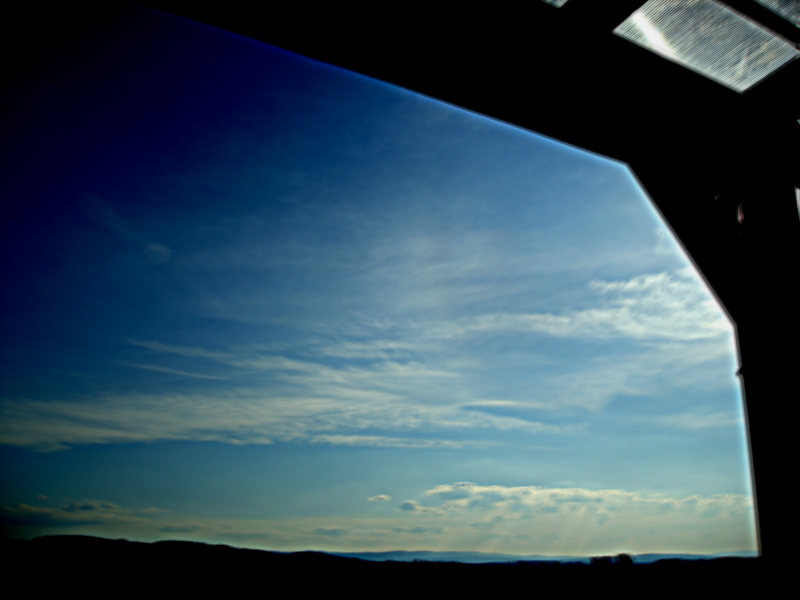
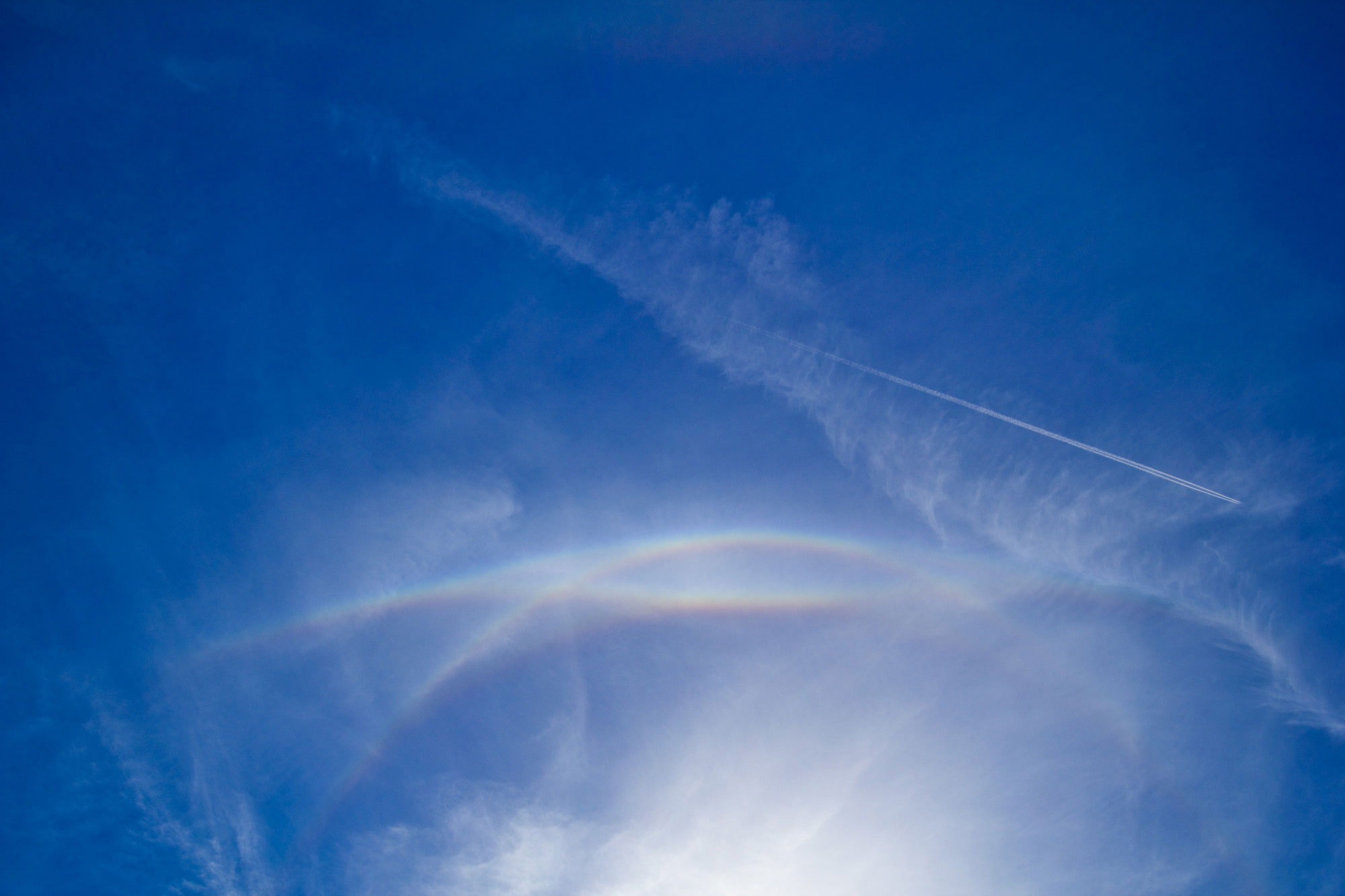
I found my record, sketch ( <a href=" http://www.ursa.fi/blogit/media/blogs/halos/Lefaudeux/18-09-98-17h15-17h55HL_post.jpg">1 ) and pictures ( 2 - 3 - 4 ), and realized there were very prominent Lowitz arcs too!

From my notes, the display happened on September 18th, 1998, between 17h15 and 17h55 local time. The sun was at 24 degrees altitude at the middle of the display. At that time, I had little knowledge of the halos. I just knew from astronomy books about parhelia, 22° and 46° halos. I had observed before upper tangent arc (which I called upper 22° parhelion) and circumzenithal arc (which I called upper 46° parhelion), but never Parry arc.

During the display, I was mesmerized by the colourful upper suncave parry arc and by the parhelion brightness. My notes are focused on these arcs, especially the Parry one, with detailed description of its length, width, brightness and colors. Nothing on the Lowitz arcs except the sketch which shows radiating arcs from parhelia.

The stitched picture shows almost complete upper Lowitz arc, very long Parry arc and faint 22° halo. There are also some weird bands on the bright parhelion. I think I have some memories of shadow bands running across the parhelion, a bit like in the video by Anna Herbst ( <a href=" http://spaceweather.com/swpod2010/11feb10/anna-herbst1.mov?PHPSESSID=liolll4f05nuq4m9ascc45gpg5">5 ), but cannot be sure as there is no mention of these in my notes.

I really wish I could observe again such an exceptional display now that I am able to appreciate it to its true worth

Nicolas Lefaudeux

2010. április 11., vasárnap

Three days of odd radius in a row

Sometimes odd radius halos come day after another. In April 1987 I observed three consecutive days of odd radius halos and in April 1996 Jarmo Moilanen had four days in a row. On both periods there was also one night with moon odd radius halos.

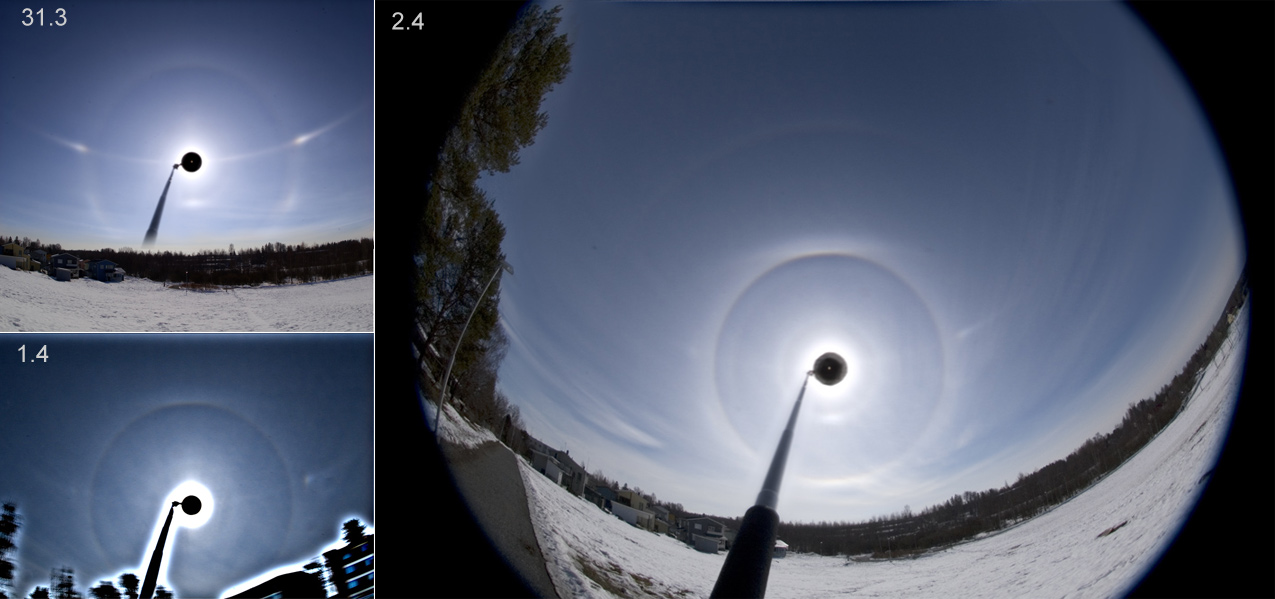
The three displays shown above were seen on successive days in Tampere on the period of 31 March to 2 April this year ( 1 ). Abundant start of odd radius halos may indicate a good year of high cloud halos coming. 1987 and 1996 were the best high cloud halo years in Finland.

Other displays from this spring:


  • odd radius by Patrik Trncak in Holesov on 9 April

  • odd radius by Patrik Trncak in Holesov on 1 April

  • odd radius by Nikita Kulanov in St. Petersburg on 30 March

  • odd radius by Jukka Ruoskanen in Kotka on 27 March

  • Wegener by Ágnes Kiricsi in Budabest on 27 March

2010. április 10., szombat

High sun parhelic circle

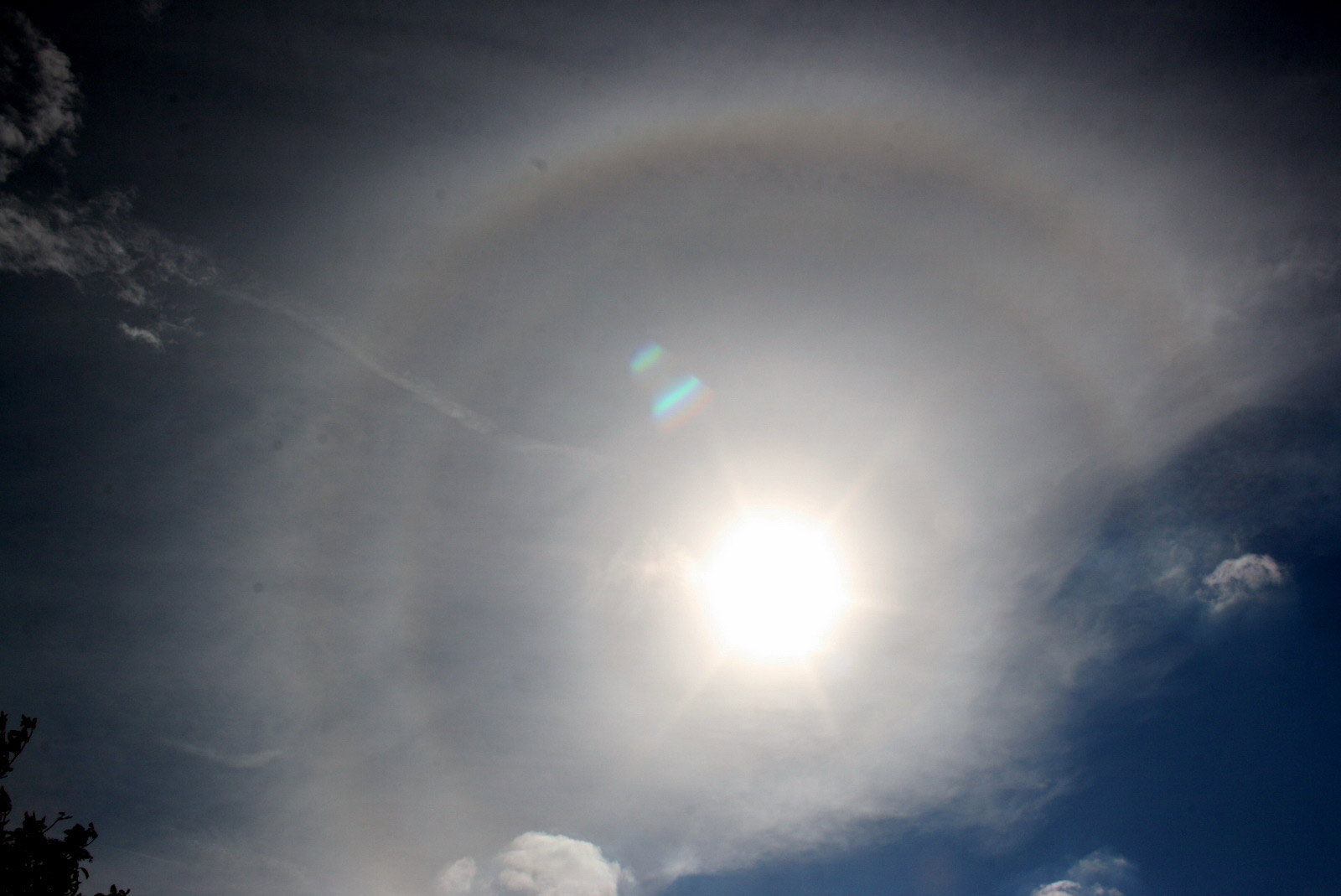
There are not much around photos of parhelic circle that fits inside the 22° halo. Here is one, seen over La Silla astronomical observatory in Chile on 27 January 1990. Sun is at 79 degrees elevation. Damien Hutsemekers, who took the photo, wrote also a report of the display ( 1 ). See some more photos ( 2 ).

2010. április 9., péntek

Possible new arc from Moilanen crystals

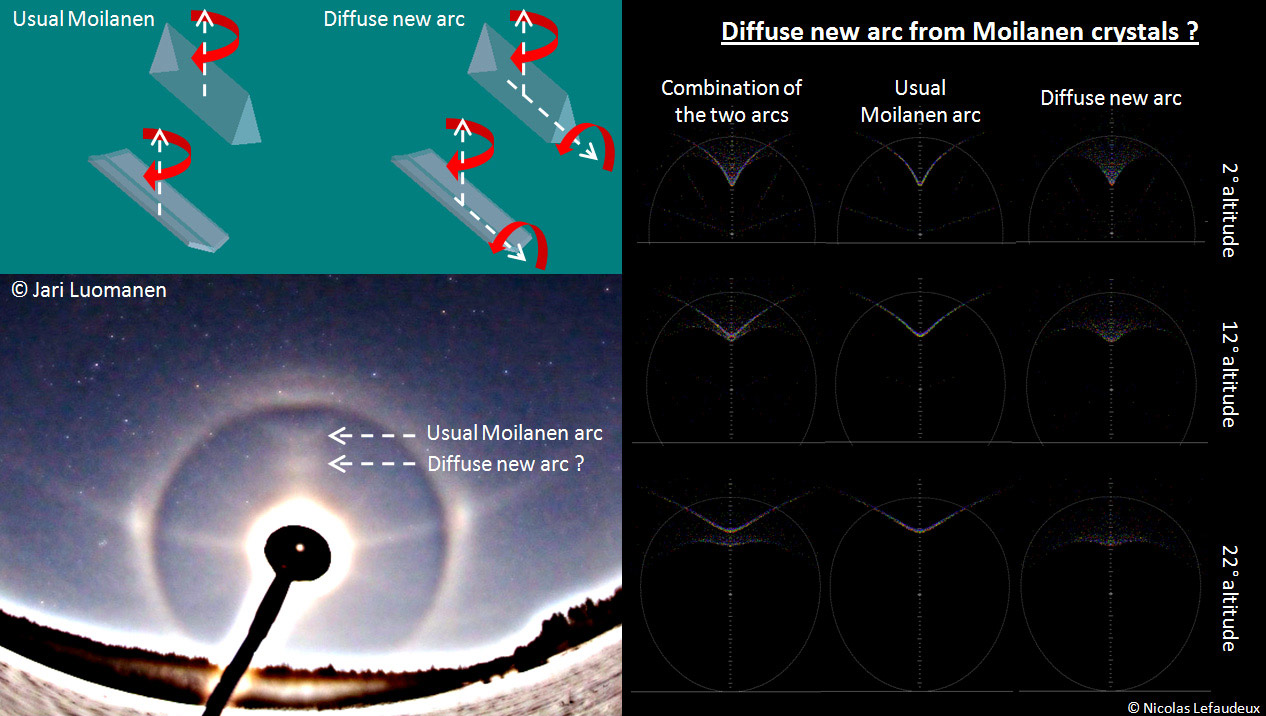
I would like to share some thoughts about a possible new arc. This arc seems to be present on the two observations of Moilanen arc at high source elevation from Jari Luomanen ( 1 ) and Marko Mikkilä ( 2 ). It appears as a diffuse glow below Moilanen arc. This arc can be simulated using any crystal producing Moilanen arc like 34deg prism pointing up (which is not aerodynamically stable) or crystal plates twinned at 34deg (which does not look like a possible twinning) tumbling with large angles along their horizontal axis. As a consequence, this new arc does not help a lot on identifying what crystals cause Moilanen arc.

At lower source elevation, the new arc would mix with the usual Moilanen arc so it is difficult to make the distinction between the two arcs. The main difference is that usual Moilanen appears as a hollow “V” while new arc would be more like a solid wedge. This new arc could be responsible of some appearance of the Moilanen arc when it appears as diffuse ( 3 ) compared to more usual sharp arc ( 4 ).

To draw a parallel, the usual sharp Moilanen is a bit like the upper sunvex Parry arc while the new arc is more like the upper tangent arc. To the extremes, if the crystals take all the rotational angles, there would be a lower component like the lower tangent arc, or if the source is very high, there would be a complete circle like the circumscribed halo.

More observations are needed to confirm the existence of this arc especially at high source elevation when it is clearly separated from usual Moilanen arc, so monitoring about this possibility is encouraged!

Nicolas Lefaudeux

2010. április 7., szerda

Liljequist parhelion does not exist


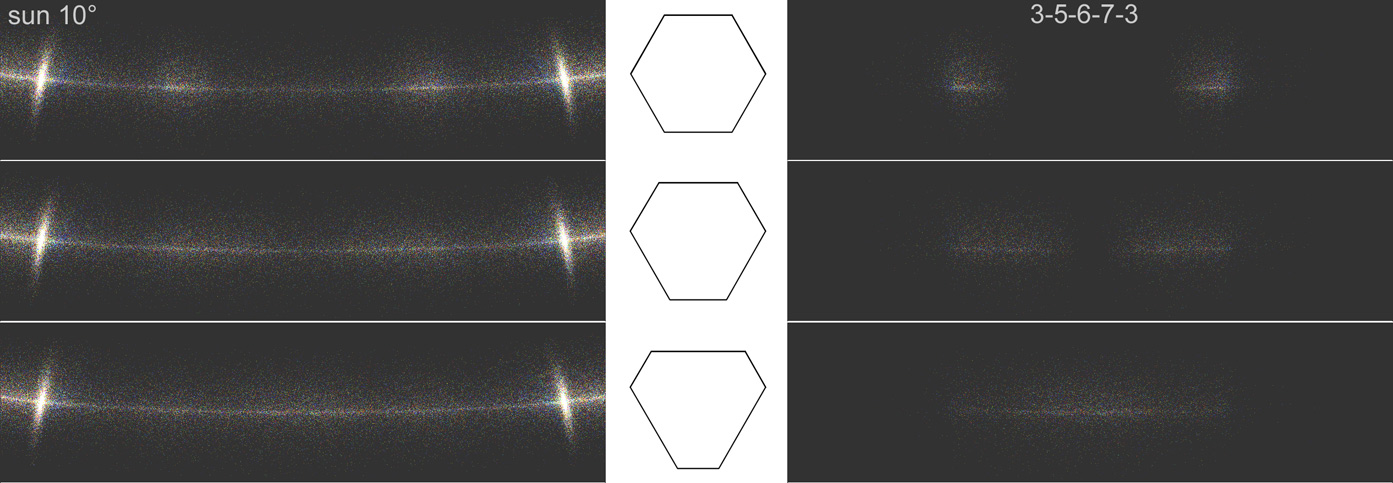
Changing crystal shape causes surprising behavior with Liljequist parhelion, casting doubts on its identity as a halo form. Look at the simulations above, larger image opens by clicking.

I have simulated (software: HaloPoint2.0) the anthelic side of the plate parhelic circle with three crystal shapes. On the left are all rays, on the right only the 3-5-6-7-3 rays that I have often referred as the main contributor to the Liljequist parhelion. But the shape of light stripe created by the 3-5-6-7-3 rays depends on the crystal shape. This means that the definition of the Liljequist parhelion becomes so murky that we might as well forget about it; 3-5-6-7-3 rays are just rays that light the parhelic circle, nothing more.

The other ray that I have mentioned of being responsible for the Liljequist parhelion is the 3-5-6-7 ray. Its product does not change with crystal shape, but it is probably too weak alone to produce any visible brightening on parhelic circle. I think it was me who originally brought up the Liljequist parhelion. I apologize for the mess. I guess we should let go of Liljequist, but it has been around for a while, so that may be easier said than done.

2010. április 6., kedd

Reflection subsun, Salt Lake City

This reflection subsun was photographed on 21 April 2006 in Salt Lake City and has been on display in the Flickr since then ( 1 ). The photographer, Heron, correctly suspected that sun's reflection from the Great Salt Lake might have been behind the formation of the phenomenon.

Three earlier observations of the reflection subsun are known, two of which have been shown in this blog ( 2 - 3 ).

2010. április 1., csütörtök

Halo display from Ghana


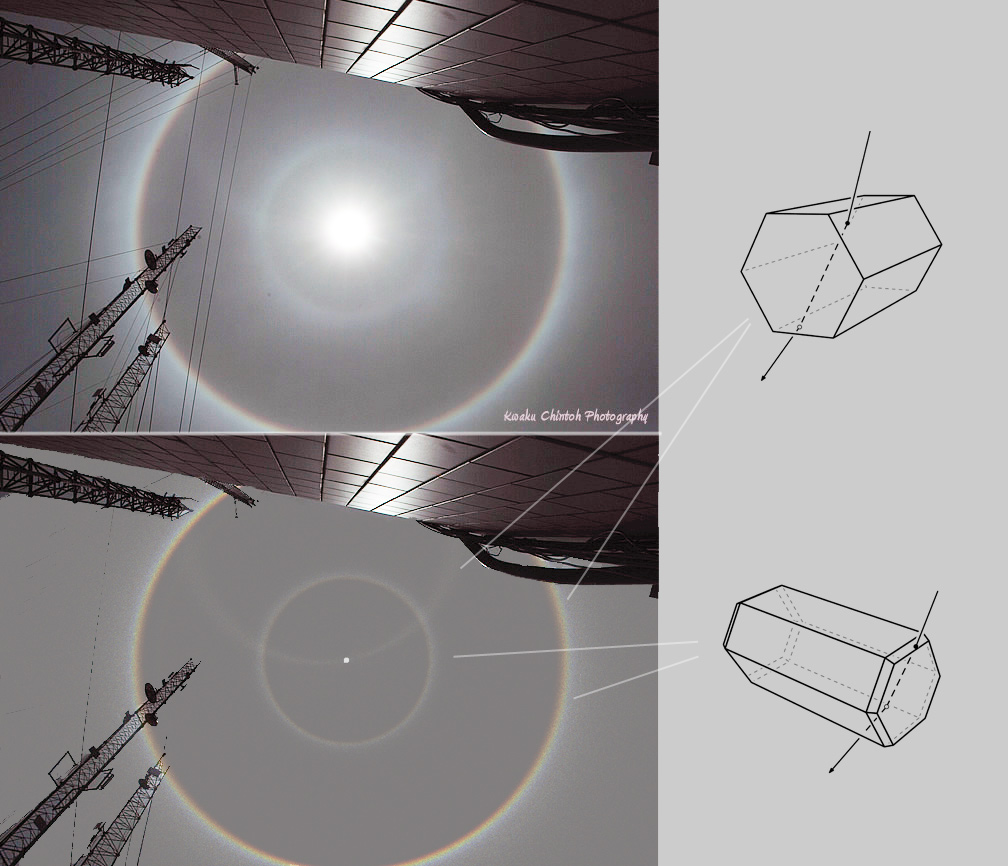
For a change a display from Africa. This was see in Accra, Ghana, on 10 March this year. The photo was taken by Kwaku Chintoh.

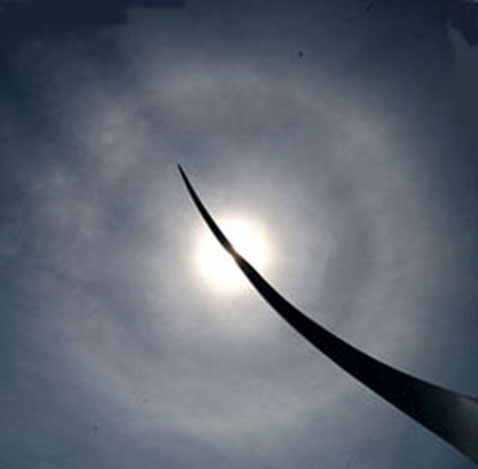
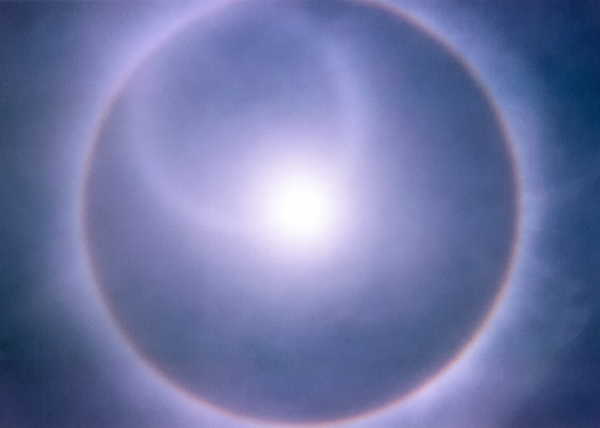
Sun is at 75.5 degrees elevation. The two sun concentric halos are rather 9° column arc and circumscribed halo than 9° and 22° halos. That is because of their sharpness - circular halos from randomly or very poorly oriented crystals are expected to be more diffuse. There is also parhelic circle.

In the simulation column oriented prismatic and pyramidal crystals were used. Pyramid crystal tilts are 7 degrees. Simulation was made with HaloPoint2.0 -software. Parameter-file is available ( 1 )