2008. október 18., szombat

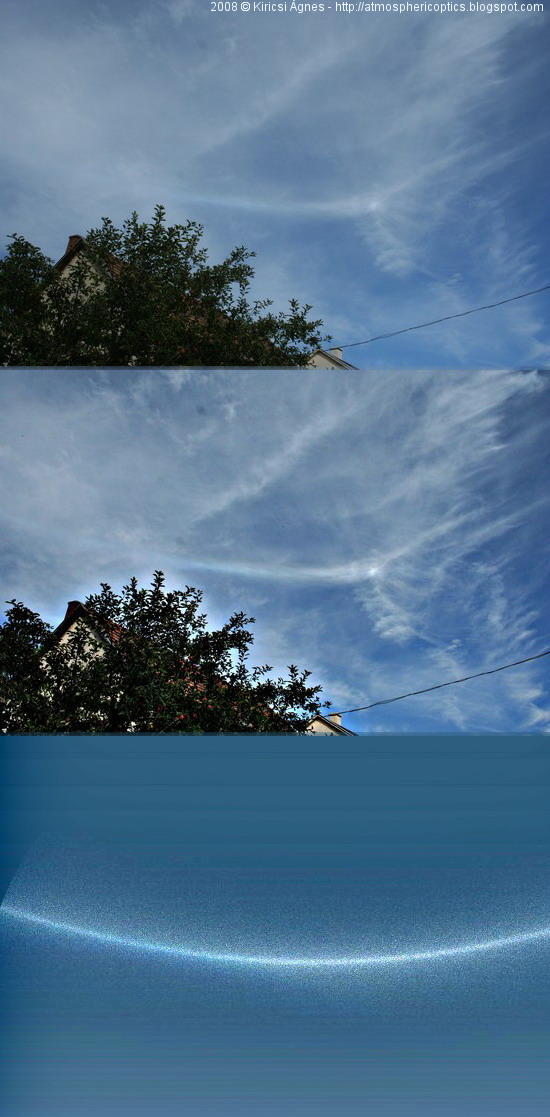
Long lasting column and plate halos with Lunar Wegener arc

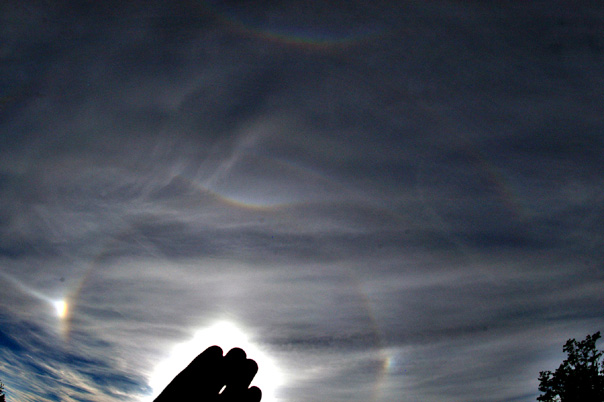
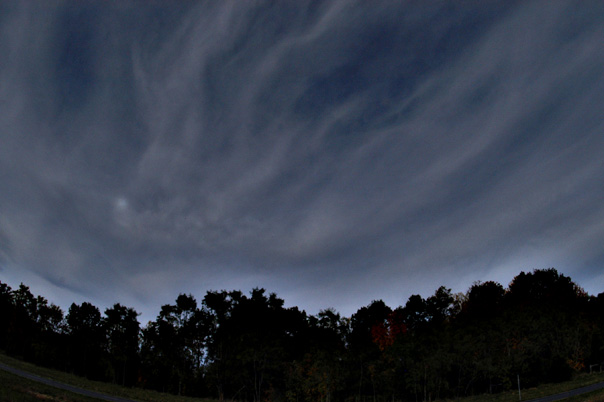
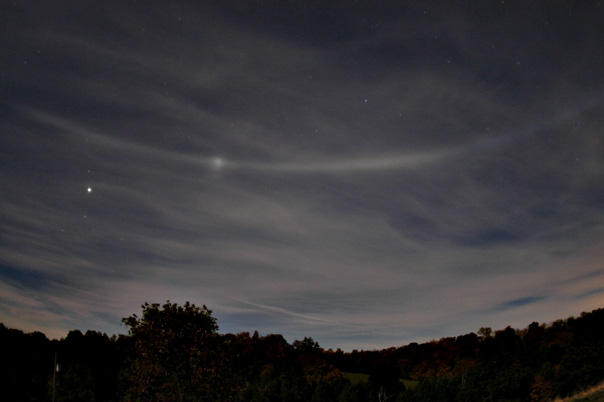
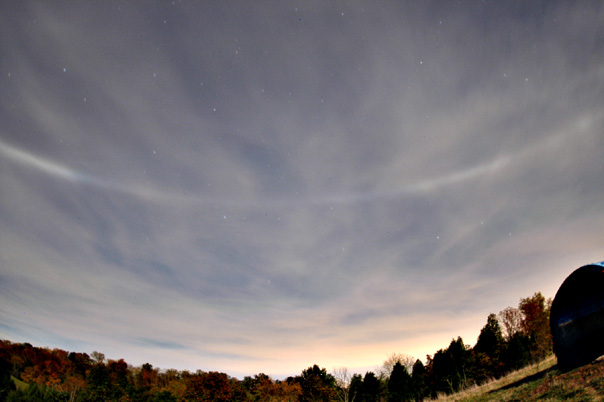
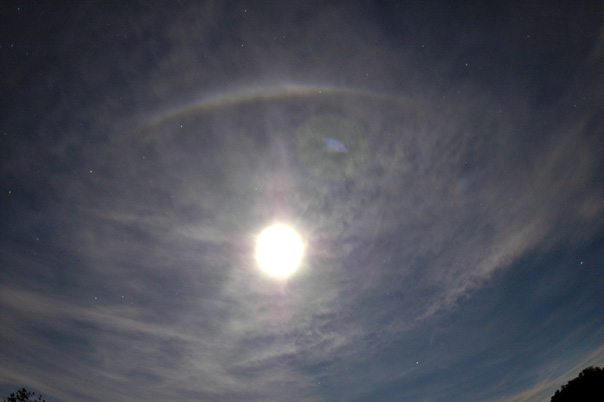
After over a month of no halos I got bombarded by a serious halo series that started after I clocked out of work to go home, and before getting into the car I started firing away with my Nikon D-100. Through the duration the halos observed were 22° halo, upper and lower tangent arcs, fine upper suncave parry arc, bright parhelia with lowitz arcs, very long parhelic circle, 120° parhelia, a fine CZA, supralateral arc, and infralateral arcs ( 1 - 2 - 3 - 4 ). At sunset upper sunvex parry arc was observed and ended with a bright red tangent arc after the sun had set.


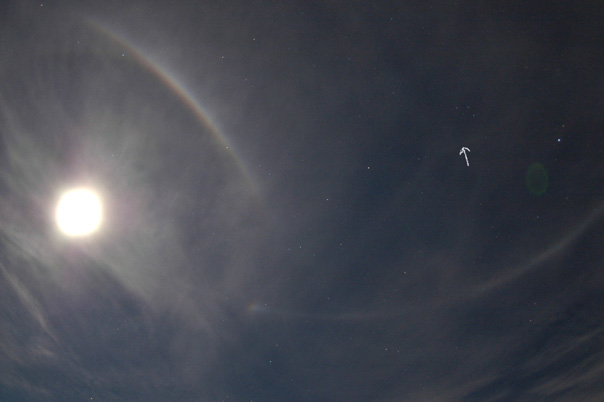
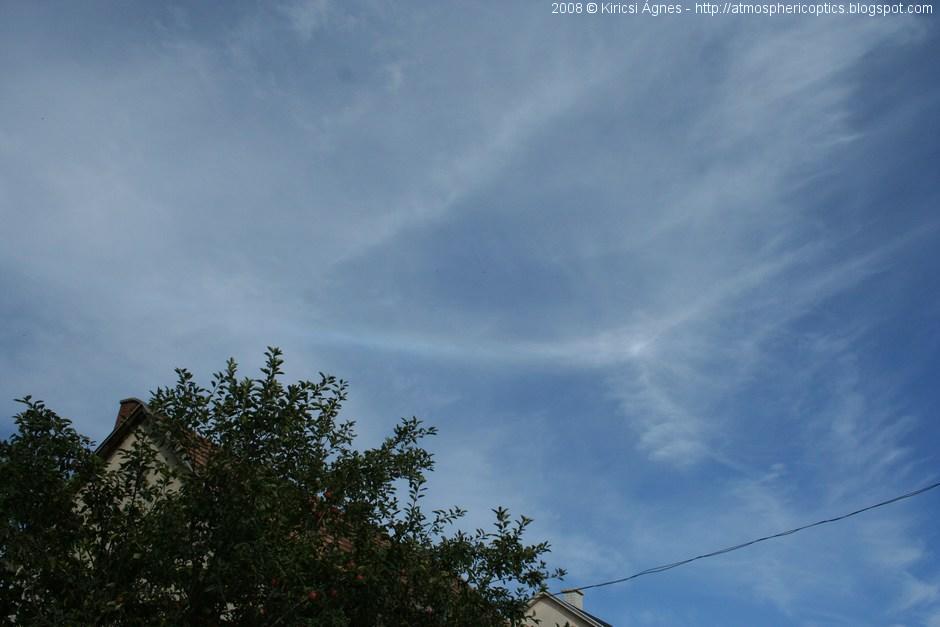
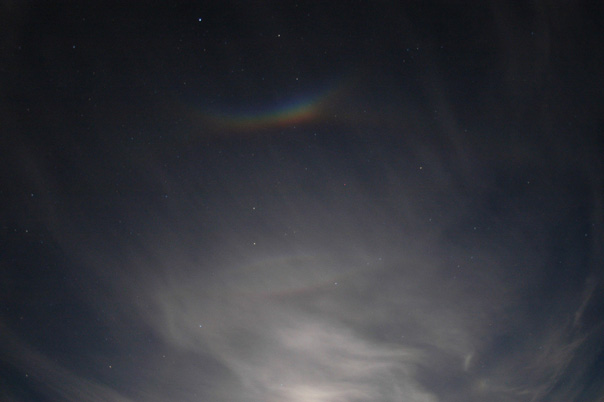
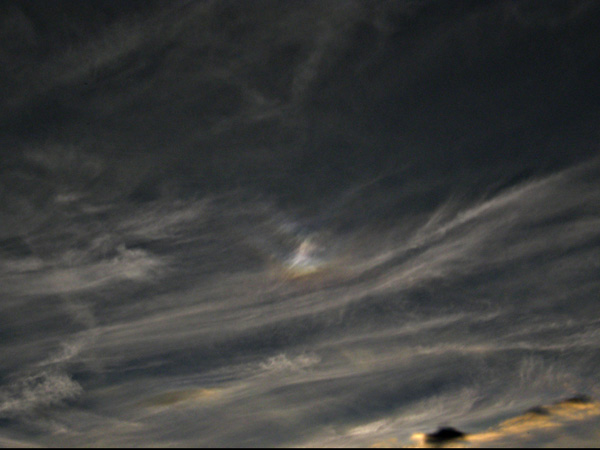
The show was not over yet because the Moon came up and there was 22° halo, upper tangent arc with parry arc, supralateral arc and CZA ( 5 ). Later on I looked away from the Moon to see bright and complete parhelic circle and very bright 120 degree parhelia ( 6 ). I also got to see blue spot very clearly ( 7 ). When the Moon got high enough for the circumscribed halo and Parry to merge I continued to shoot photos. Now here's the real shocker: the next day I looked at the batch of these lunar halo photos and I found a Wegener arc ( 8 )! I could not believe it. I also looked for heliac because the Parry arc got quite bright ( 9 ) but it was not to be found.

2008. szeptember 18., csütörtök

Odd radius halos on 8th May


The photos of this diplay got lost somehow and then found again deep inside my harddrive.

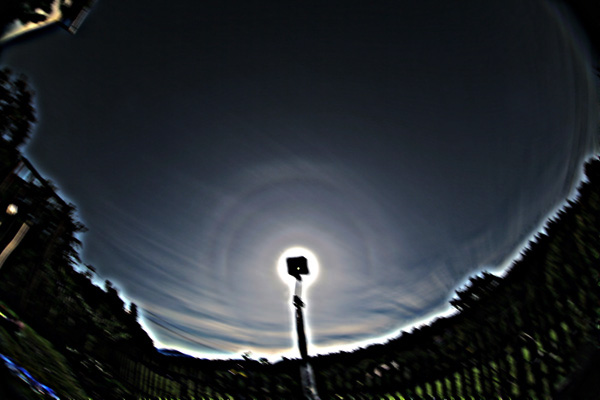
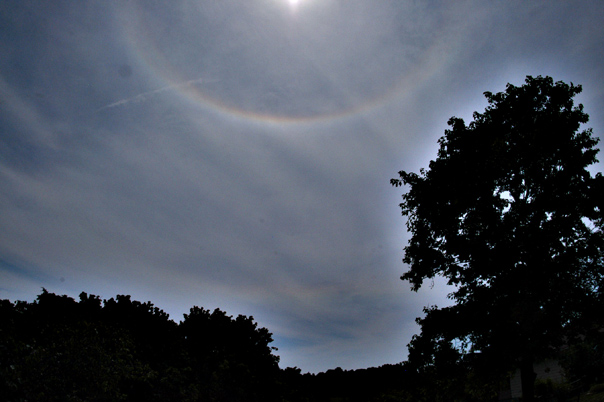
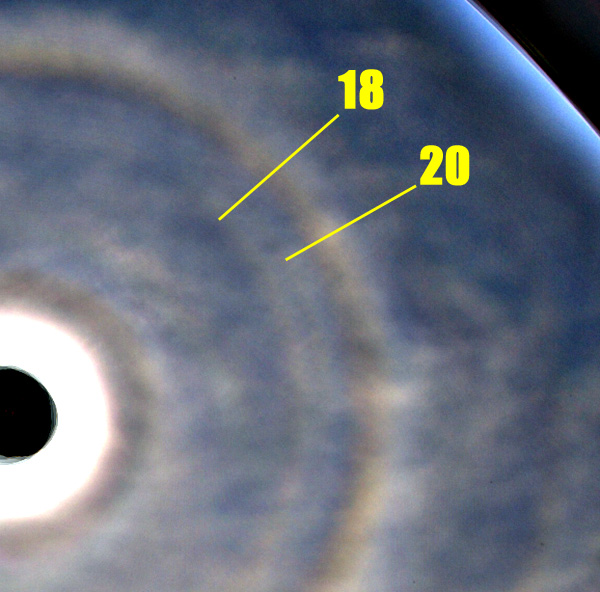
The display shows 9, 18, 20, 22 and 24 degree halos, also 9, 20 and 24 column arcs.

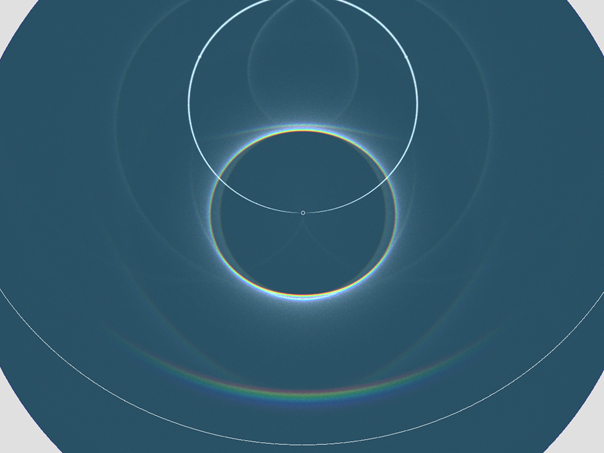
This photo is 9 image stack shot at solar elevation of 46.7 degree and the simulation provided by M.Riikonen is made according to this. Pyramidial columns were used with 14 degree tilts plus crystal populations for 22 halo and its tangent arc.

2008. szeptember 14., vasárnap

Blue spot from Vecsés, Hungary


The image above shows the blue spot on the parhelic circle, photographed on 1 September in Vecsés, Hungary. Click the picture to see the colours in the original version. Its hue seemed almost electric blue compared to the white parhelic circle, and was really conspicuous even to the naked eyes ( 12 ).

The blue spot can only be observed when the Sun is lower than 32°. It is a halo phenomenon that changes its position and length with solar altitude. When the Sun is 5° high, the blue spot is at 115° azimuth and only 2° long. At solar elevation 25°, it moves to 135° azimuth, and when the Sun is at 32°, the blue spot is positioned in the anthelic region, reaching 180° azimuth and 10° length.

My images were taken between 16:06 and 16:10 local time. The solar altitude in this period was between 32-31°, meaning that the blue spot was in its longest phase and exactly opposite the Sun. The simulation made with HaloSim reveals the position of the blue spot as compared to the 120° parhelia. The crystal population I used was hexagonal plates with 2° tilting angles ( 3 ). The composite image shows the original photo with unsharp masked image and simulation ( 4 ).

The 1 September display lasted a couple of hours. Besides the full parhelic circle, and other, more common halo forms, there was a long-lasting stage with Parry oriented crystals, and another stage with a 46° halo – this latter one was observed by Alexandra Farkas. For further images of the diplay, see Alexandra Farkas’s and my website ( 56 )

2008. szeptember 13., szombat

Odd radius halos in Nydek

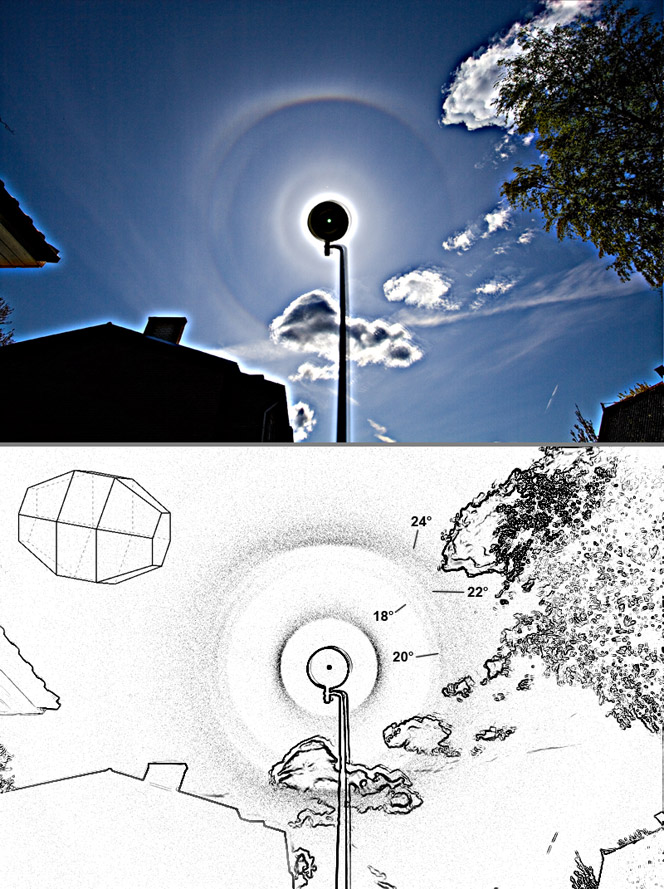
After a year of non-pyramidal halo complexes, finally a pyramidal one appeared. On 10 September, I (Martin Popek) observed 9°, 18°, 20°, 23° and maybe a 24° halo, together with weak 9°, both 18° and 23° parhelion, which was separated from the 23° halo. 50 images were stacked using RegiStax. Notice the bad anomalies which are created by Bishop's ring ( 1 - 2 ).

The phenomena formed in thick cirrostratus clouds before the arrival of a warm front. Some meteorogical data are also provided ( 3 - 4 ).

Text: Martin Popek, Matej Grek

2008. szeptember 2., kedd

Halo Meeting 2009, Hungary


*** addition 7 December: please note that the date of the meeting has been modified! ***

After the 2006 Artjärvi halo meeting ( 1 ), the next one is to be organised in Hungary. The date of the event is at the end of the summer between 30 August - 1 September 2009. A homepage has been designed for the gathering by Alexandra Farkas and me ( 2 ). In the future this will be the primary site for news and updates.

So far quite a few people have signalled that they’d like to participate, but in order to find out about how many people to expect, please, let me know if you think you’d like to come. Of course, this list will serve now only as an approximation. Also, if you’d like to receive emails about the meeting, or you already have an idea what presentation you'd like to give, let me know about it, too. You can contact me at the following address: ( 3 ).

2008. augusztus 30., szombat

High-sun parry arc in Ohio USA 8-22-08


For the first time since April 10th I have gotten some photoworthy halos. In all I got 22° halo complete circumscribed halo, complete parhelic circle, circumhorizontal arc, and my first high-sun parry ( 1 - 2 ). I saw reports of high-sun parry a couple days before on the blog but when I spotted a faint but clearly visible arc separate from the top of the circumscribed halo I knew that I was looking at a high-sun parry. While taking photos I searched carefully for lower suncave parry arc but it was not to be found. So the concentration of parry falling crystals was small. While I was unloading groceries from my mother's truck I held very still and took a bunch of photos to make a stack set which I stacked that day. I also did a simulation with HaloSim and using the gap between upper parry and the circumscribed halo as a reference the elevation was 61 degrees( 3 ).

2008. augusztus 27., szerda

Report of the Czech 'Halo Observe Project' (HOP) about the past three months


Photographs above by Patrik Trncak and Martin Popek.

16th June 2008 - 120° parhelion

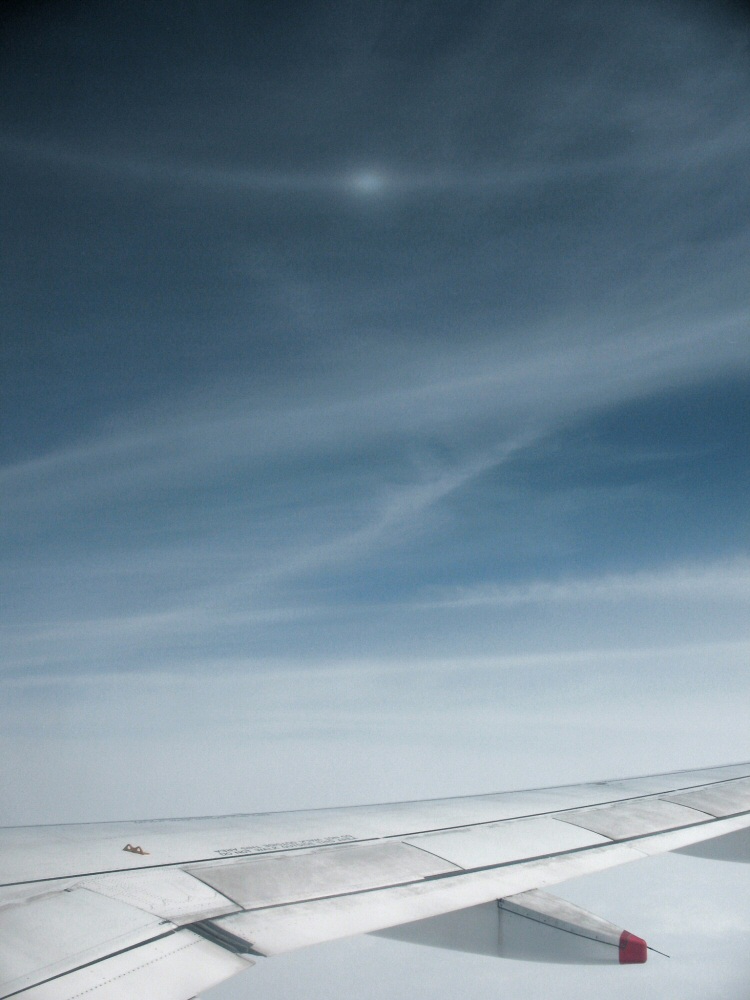
Tomas Trzicky observed a 120° parhelion during a flight over the Czech Republic. It was seen only briefly somewhere over the western part of the country while flying through cirrus clouds ( 1 ).

17th June 2008 - Elliptical halo in Holesov

Patrik Trncak, who observed the phenomenon in Holesov wrote: "It lasted a short time, a couple of seconds. The ellipse was complete, but the bottom quickly disappeared. It was observed on Ac virga, and irridescent clouds were seen, too." ( 2 )

20th June 2008 – Sunvex Parry arc in Prague

Monika Pacltova, who observed the phenomenon in the centre of Prague (Karlov) wrote: "Late afternoon I decided to make a time lapse video of the sunset with a 22° halo, bright parhelia and nice upper tangent arc. But... oh, damn! This simple and well-arranged display was all of a sudden 'badly spoilt' by a strange smudge above. Yeah, I saw the first Parry sunvex in my life". ( 3 - 4 - 5 )

24th June 2008 - Pyramidal halos in Prague

Stepanka Kosova observed in Prague-Uhrineves relatively strong 9° halo. Stacking a few pictures has shown other possible odd radius halos as well ( 6 - 7 - 8 ).


3rd August 2008 – Bottlinger's ring during a Prague-Moscow flight

Martin Popek wrote: "In the middle of the journey I observed a clear subsun. It was in a very low position almost beneath the plane. Nevertheless, I succesfully photographed a series of pictures which I stacked in Registax. Then the elliptical figure, similar to Bootlinger's ring was visible. By naked eye the phenomenon was seen as a veil around subsun. The phenomenon was observed on cloud type Ac translucidus perlucidus." ( 9 )

11th August 2008 – Suncave Parry arc and 120° parhelion in Morava

A number of observers saw a quite clear suncave Parry arc in the Czech Republic. This followed the previous observation of Parry arcs in Germany by the same cloud front. Martin Popek photographed 50 pictures, stacked in Registax ( 10 ). The suncave Parry arc was observed by Jan Kondziolka in Karvina as well ( 11 ). Martin Jankovic saw a nice 120° parhelion in Brno ( 12 ).

15-17th August 2008 – Halo meeting in Holesov

After two years, halo-phenomena observers in the Czech Republic held a meeting again. This time it was organised by Patrik Trncak in Holesov. Ten observers arrived during the weekend, and although the weather was not too favourable for halo observation, we spent the time successfully: we had lectures on rare halo phenomena and Registax, slide shows and consultations about photo-editing and the future of the Czech HOP project. Here are some photos at IAN.cz and the magazine Parhelium ( 13 - 14 ).

Text: Martin Popek, Monika Pacltova