2008. május 24., szombat
Pyramidal crystal halos from 15th to 17th May
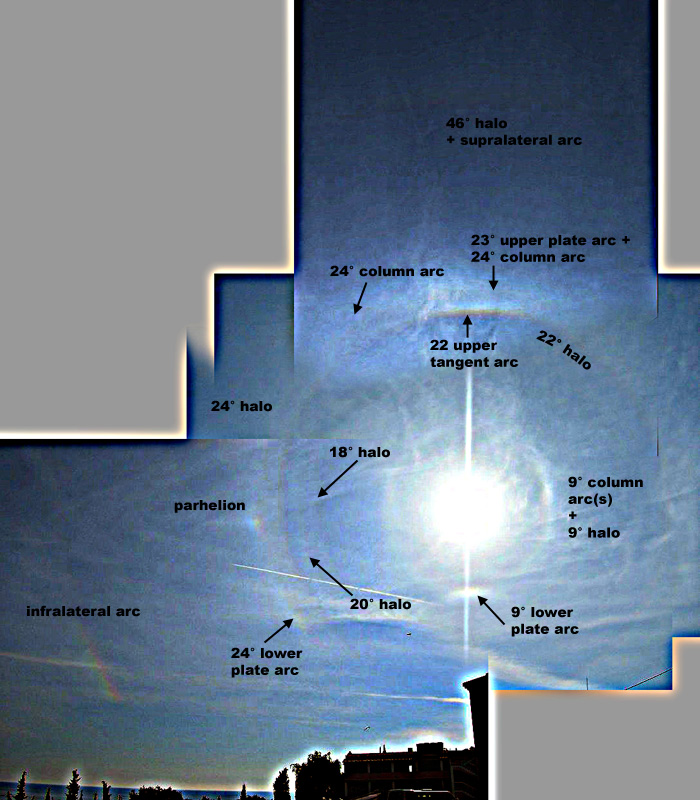
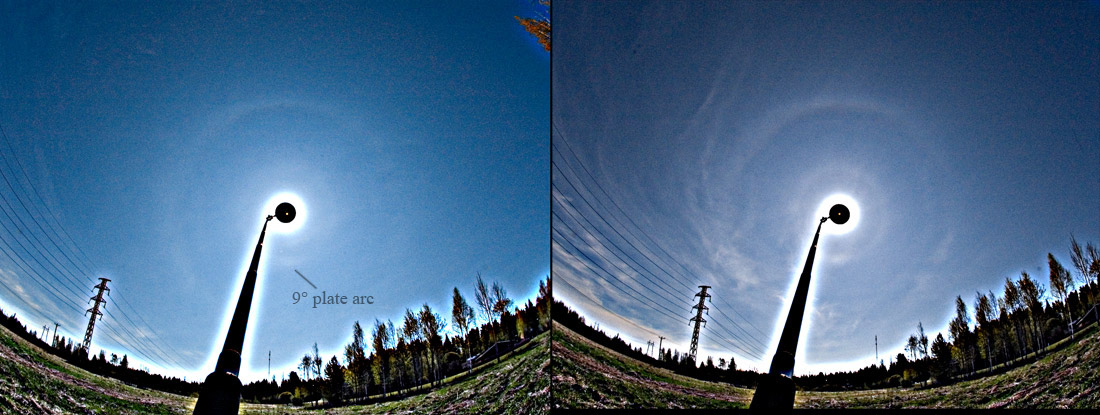
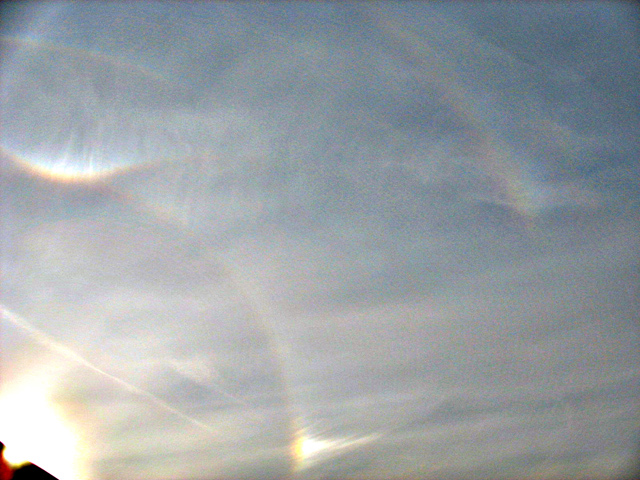
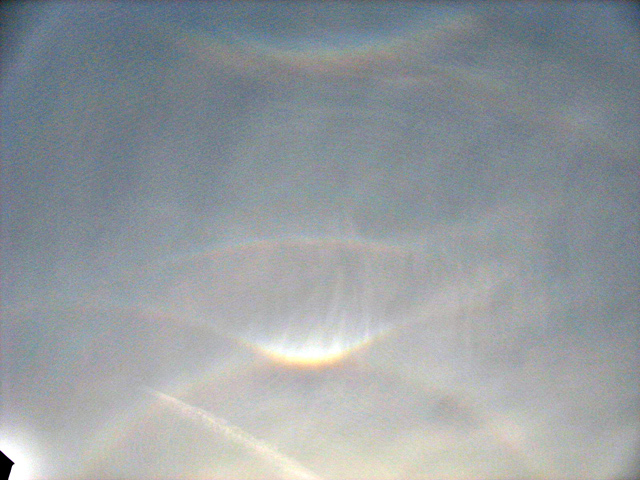
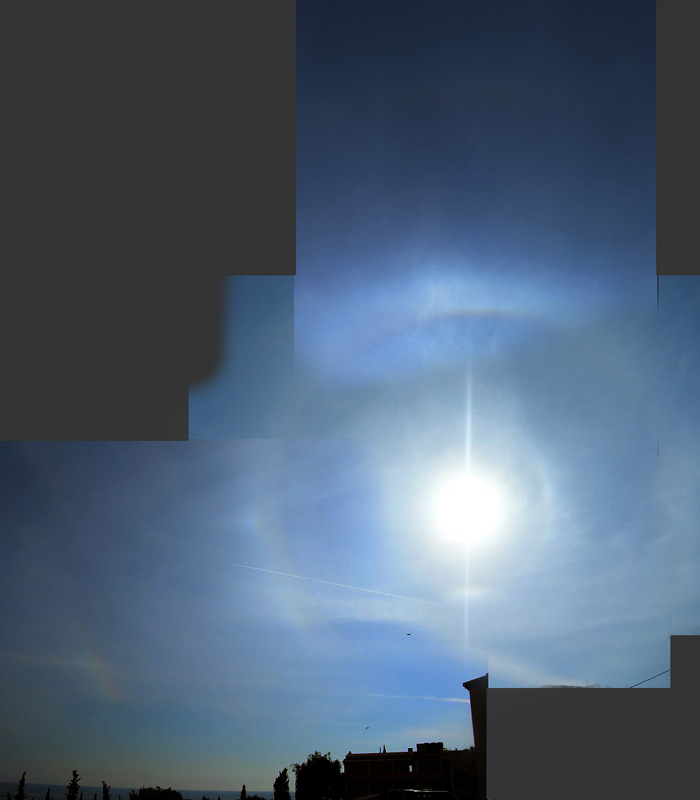
In the evening of 15th May Bernard Hulshof witnessed a fine halo display in Agios Gordis on the Greek island Corfu (composition of Bernard's photos above). The display was dominated by pyramidal crystal halos including 9° and 24° plate and column arcs ( 1 ). Additionally 9°, 18°, 20° and 24° halos and perhaps a 23° upper plate arc can be seen in the photos. The column arcs are not very well defined indicating large tilting angles of the crystals. The large tilting angles are responsible for the column arcs spreading and forming a circular halo -type of appearence.
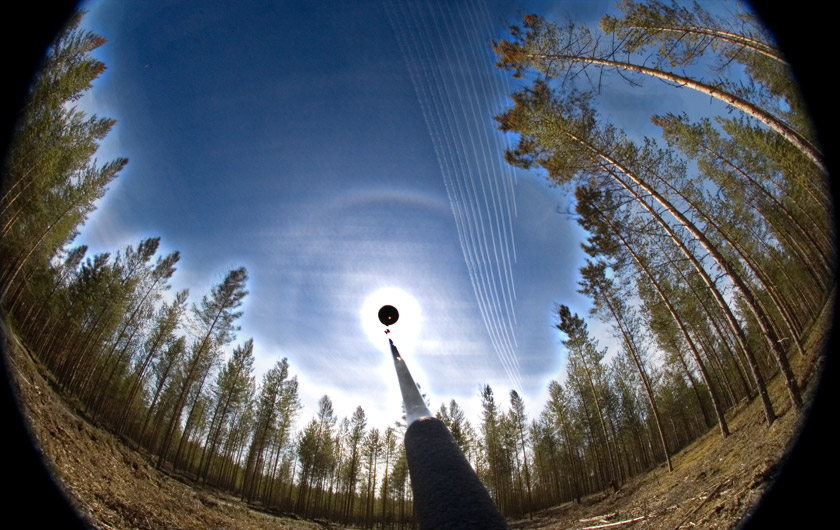
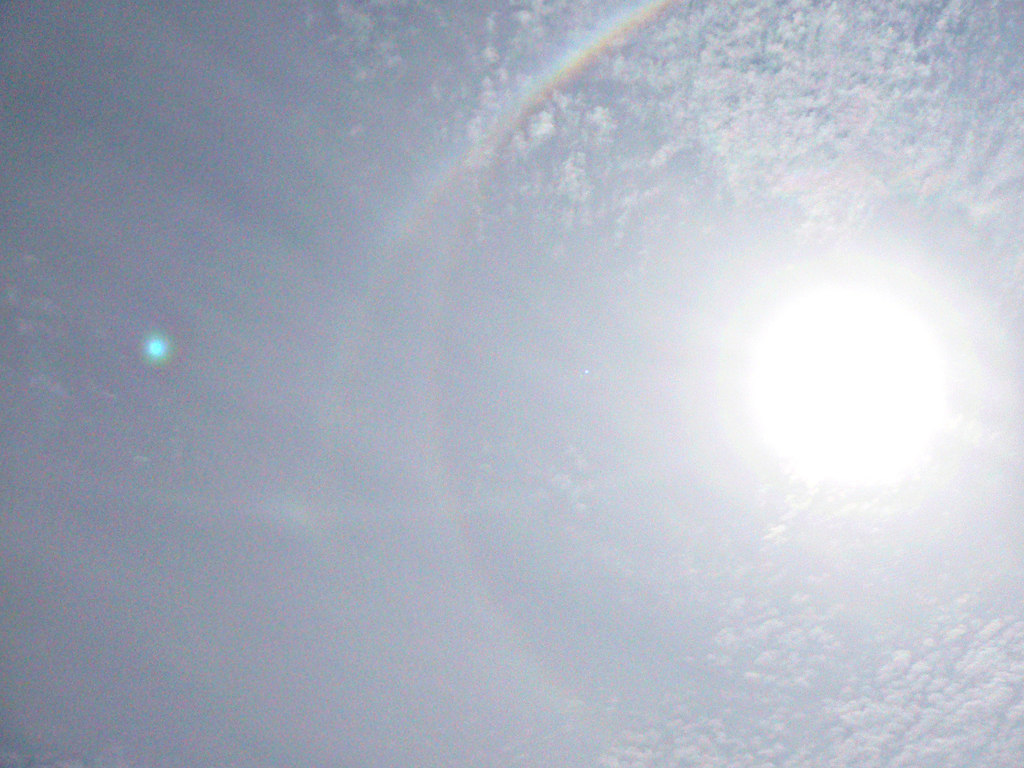
Next day, 16th May, Ágnes Kiricsi saw a short-lived 9° halo in Vecsés, Hungary ( 2 ). After the pyramidal stuff was gone, a circumscribed halo delighted Ágnes for a long period of time.
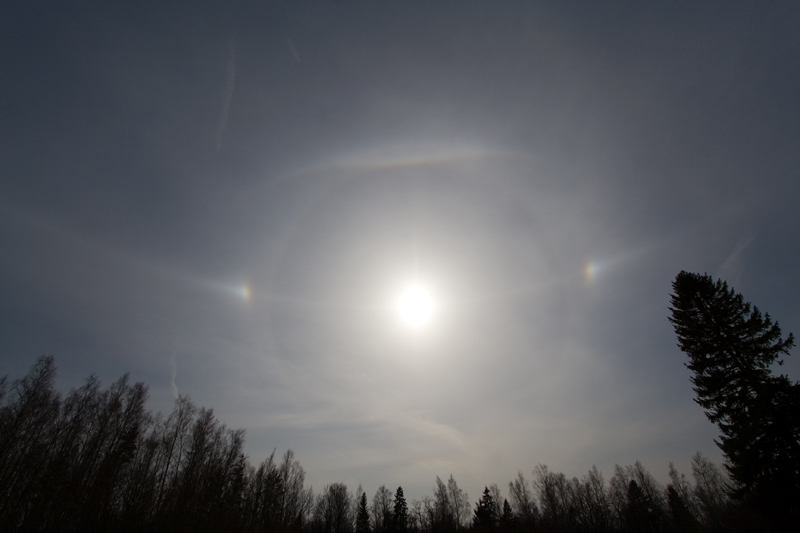
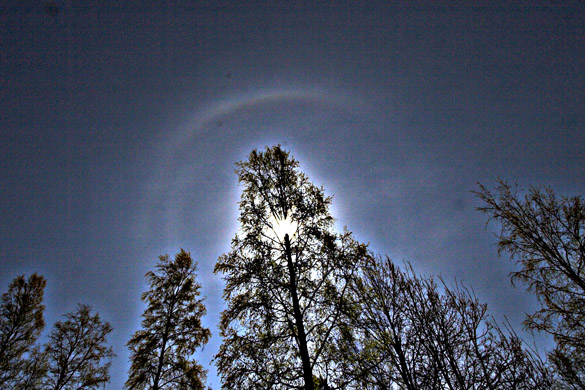
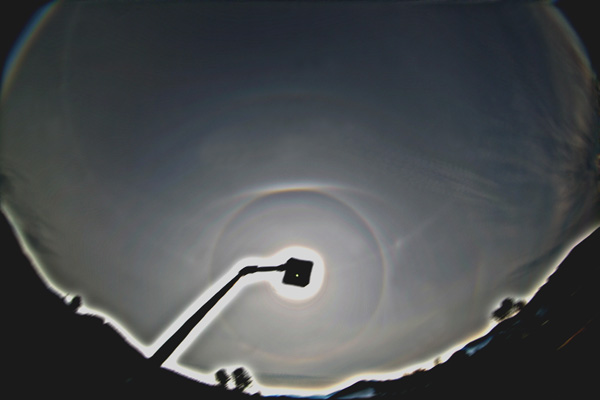
The centre of the action moved to Czech Republic, where on 17th May good halo displays were seen in Holesov by Patrik Trncak and in Nýdek by Martin Popek. Patrik's display was an odd-radii one with 9° and 18° halos and a 23° upper plate arc (61 stacked photos enhanced with an unsharp mask 3 ). Martin's display was dominated by column crystal halos (without pyramidal ends) ( 4 - 5 ). Notice how in the leftmost photo in link "4" the 46° halo is very close to the anthelic point.
2008. május 23., péntek
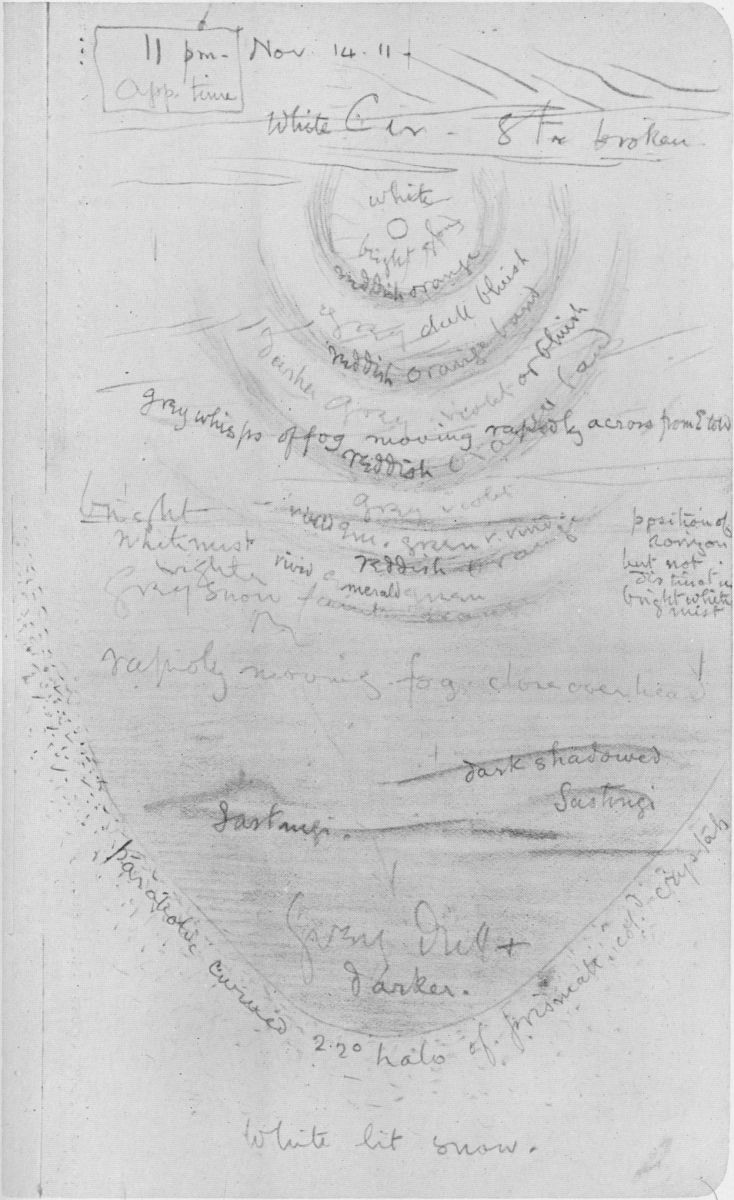
Wilson's 1911 sketch of a snow surface halo
The sketch was made by Edward Adrian Wilson (1872-1912), the English polar explorer. He drew the observation on 14 November 1911 in Antarctica, a few months before he died in Scott’s final expedition. The drawing can be found in The Worst Journey in the World (1922), the memoires of Apsley Cherry-Garrard, a survivor of the team.
The sketch is not that easy to read, Wilson intended it for later use and re-working. From top to bottom, the notes in the drawing indicate that in the sky, there was white, broken cirrostratus ("white Cir. Str broken"), and the Moon was surrounded by a "bright glory". There were "gray whisps of fog moving rapidly across from E to W". Wilson also marks the "position of horizon" in the middle of the picture, which was covered in "bright white mist". In the lower third of the picture we can read "rapidly moving fog close overhead", and then at the very bottom of the sketch, on the "white lit snow" there is the "parabolic curved 22° halo of prismatic col. crystals", the inside of which is "darker".
In the note to Chapter XIV, we can read how the explorers used the snow surface halos for keeping the direction: "It is now that halos may be seen in the snow, almost reaching to your feet as you pull, and moving forward with you: we steered sometimes by keeping these halos at a certain angle to us."
Source: Project Gutenberg ( 1 )
The sketch is not that easy to read, Wilson intended it for later use and re-working. From top to bottom, the notes in the drawing indicate that in the sky, there was white, broken cirrostratus ("white Cir. Str broken"), and the Moon was surrounded by a "bright glory". There were "gray whisps of fog moving rapidly across from E to W". Wilson also marks the "position of horizon" in the middle of the picture, which was covered in "bright white mist". In the lower third of the picture we can read "rapidly moving fog close overhead", and then at the very bottom of the sketch, on the "white lit snow" there is the "parabolic curved 22° halo of prismatic col. crystals", the inside of which is "darker".
In the note to Chapter XIV, we can read how the explorers used the snow surface halos for keeping the direction: "It is now that halos may be seen in the snow, almost reaching to your feet as you pull, and moving forward with you: we steered sometimes by keeping these halos at a certain angle to us."
Source: Project Gutenberg ( 1 )
2008. május 16., péntek
Halo spring in Finland
After several meagre years, the halo spring in Finland has shown signs of revival. Nothing big has been observed, but since the end of April the number of displays with rare halos has been reasonable.
30. April
1. May
2. May
10. May
11. May
15. May
30. April
- In Turku pyramidal display photographed by Ismo Luukkonen ( 1 - 2 ). Odd radius halos and arcs from 9° to 35°.
1. May
- Jukka Ruoskanen was alert in Riihimäki. 35° halo from stacked images ( 1 ).
- In Helsinki also Reima Eresmaa noticed the odd radius halos ( 1 ).
2. May
- Jari Luomanen had an all sky display with Wegener arcs in Tampere ( 1 ).
10. May
- High clouds in two layers in Joensuu. Pyramid halos in the upper layer were shortly observed when gaps in the lower layer allowed ( 1 - 2 ). Photos by Marko Riikonen.
- In Seinäjoki the display was much better ( 1 ). Marko Myllyniemi took the photo.
11. May
- In Turku Ismo Luukkonen captured halos from 9° to 24° ( 1 - 2 - 3 ).
- By Marko Mikkilä in Nivala ( 1 ).
- Faint pyramid halos were observed also in Juva by Jari Piikki ( 1 ).
- In Joensuu pyramidal halos were seen for several hours. In single photos lower 9° plate arc is visible ( 1 ). Stacked images reveal more features ( 1 - 2 - 3 ). Some of the halos are labelled: plate arcs "p" and circular halos "h" (or just the radii).
- In Kuusankoski Eero Savolainen saw very faint pyramidal halos. No photo shown here.
15. May
2008. május 14., szerda
Two diamond dust displays in Finland
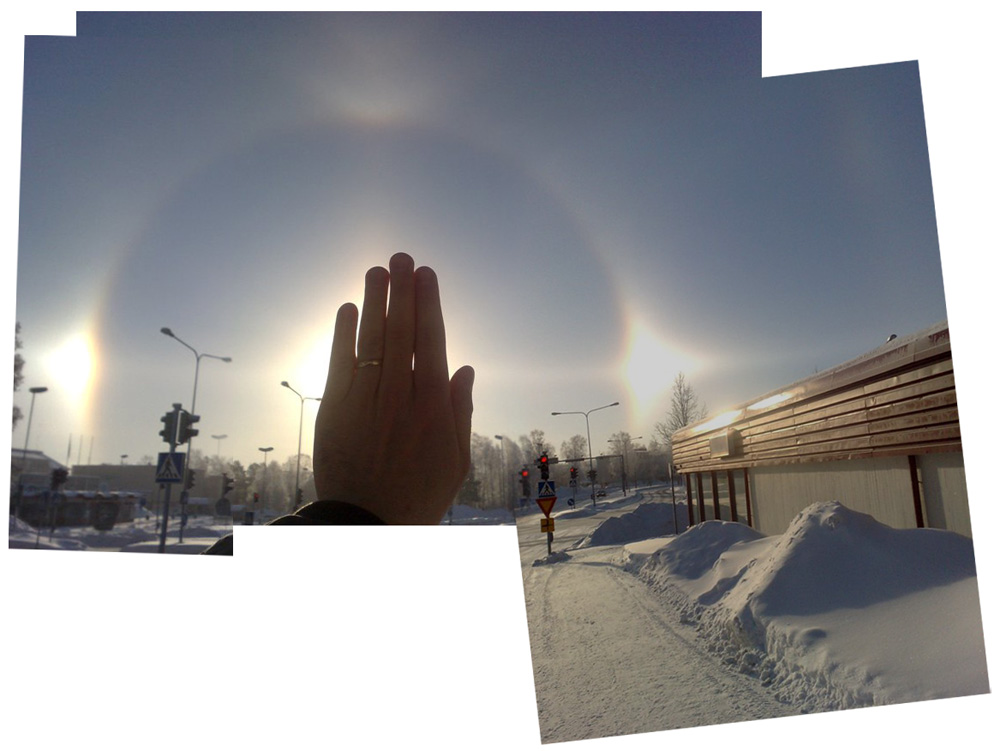
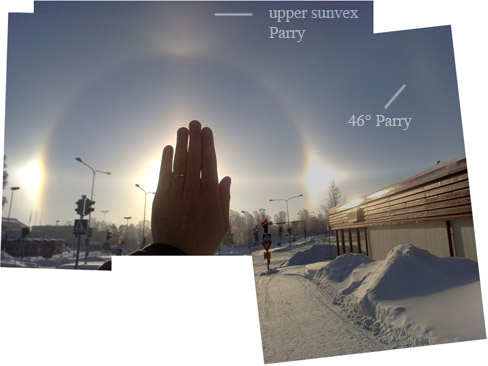
Miika Karppinen photographed this display in the town of Kajaani on 8 March this year. Upper sunvex Parry arc and 46° Parry arc are weakly present ( 1 ).
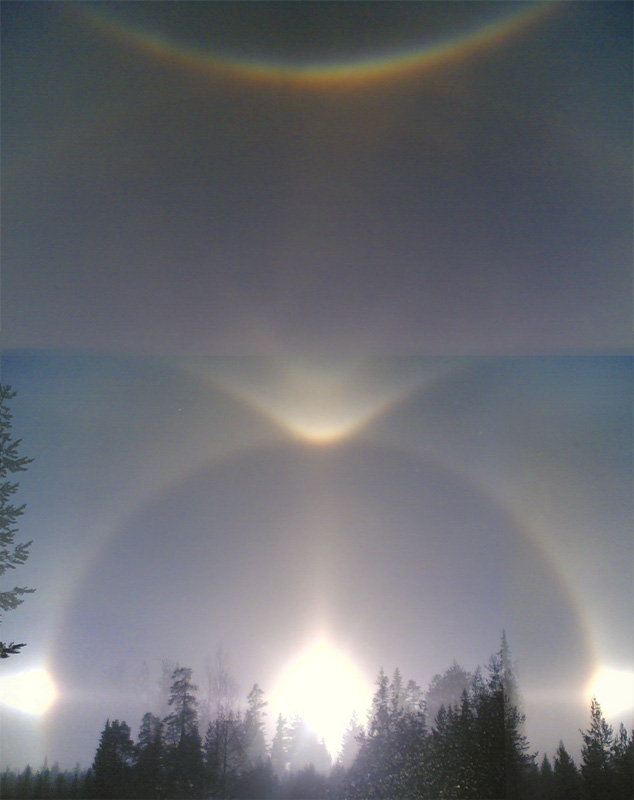
The other display occurred on 26 October 2006 in Salla ( 2 ). Photos were taken by Jani Päiväniemi. Under the circumzenith arc there is a patch of 46° halo, which could be indication of 46° contact arc. First convincing photos 46° contact arcs were taken three days later in Muonio ( 3 ).
Both Kajaani and Salla displays were captured with cell phone cameras.
The other display occurred on 26 October 2006 in Salla ( 2 ). Photos were taken by Jani Päiväniemi. Under the circumzenith arc there is a patch of 46° halo, which could be indication of 46° contact arc. First convincing photos 46° contact arcs were taken three days later in Muonio ( 3 ).
Both Kajaani and Salla displays were captured with cell phone cameras.
2008. május 7., szerda
Wegener Arcs in Finland
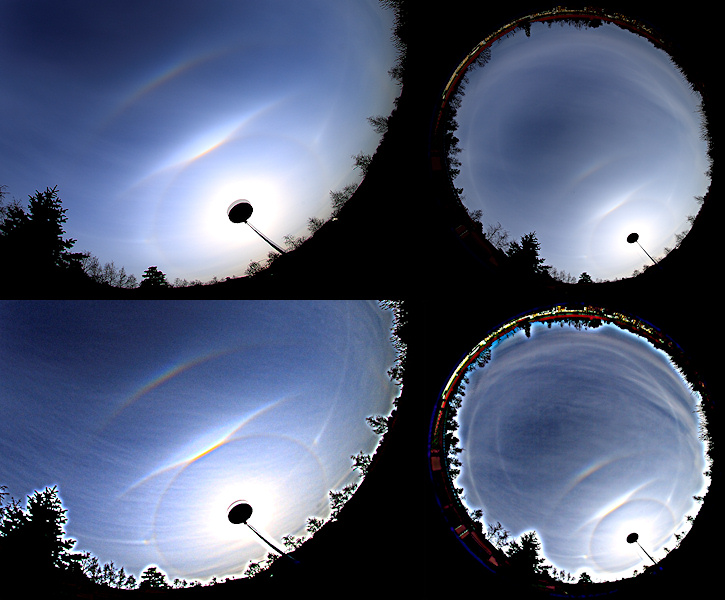
Long absence of rare high cloud halos in Tampere skies was brought to a sudden end by a complex display on 2 May 2008. Singly and Parry oriented columns played the key roles: among the more common halo forms the display featured an upper suncave Parry arc and Wegener arcs.
Sun elevation was ca. 27 degrees. Both photos are stacked images (no longer than 5 minutes' time period for each). Below them contrast enhanced versions are provided. Also, larger images are available online ( 1 ).
2008. május 2., péntek
Complex displays in Eastern Europe
A series of complex halo displays occured in Eastern Europe between 27 March and 6 April. The first display was seen in Vecsés, Hungary (observer: Ágnes Kiricsi). On 27 March, after the appearance of a bright circumscribed halo, a growing stretch of the parhelic circle came to sight ( 1 ) and 120° parhelion showed up on the left ( 2 ). The parhelic circle was complete for about 5 minutes.
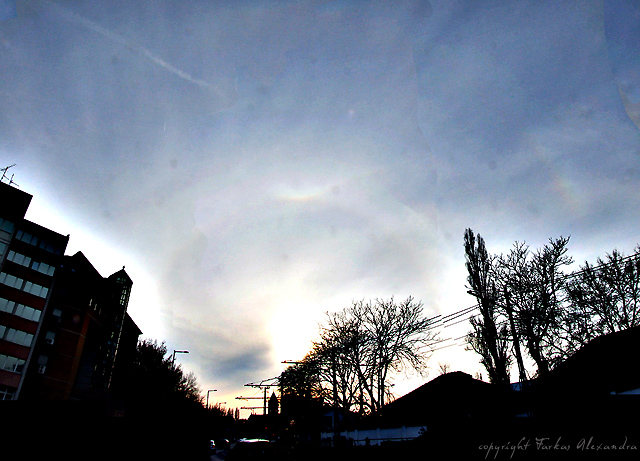
Close by in Budapest, a Tape arc was observed in the evening. Images were taken by Alexandra Farkas and Tibor Hollósy ( 3 and enhanced 4 ). They did not see other halos formed by Parry oriented crystals, but 7 km to the north of them and only 3 minutes earlier, Márk Laczkó had photographed an upper suncave Parry arc ( 5 - 6 ).
The next Hungarian observations of complex displays with complete or almost complete parhelic circles were on 1 April (Ágnes Kiricsi in Vecsés) and on 5 April (Alexandra Farkas, Tibor Hollósy in "Remete" Gorge).
On 2 April, Marko Krusel had an opportunity to observe a complex halo display in Estonia, nearby Keila (see image on top). Besides all the common halos, he got an upper suncave Parry arc, a full parhelic circle and 120° parhelia. A fragment of the infralateral arc was seen on left. The show ended with the parhelic circle and 120° parhelion as the latest leavers ( 7 ).
6 April was a favourable day for the Czech Republic and Poland. The Czech Matej Grek (Ostrava-Dubina) and Martin Popek (Nydek) both photographed complex displays with parhelic circles and bright circumscribed halos. A 46° halo was also visible ( 8 - 9 ). In southern Poland Jakub Marchewka observed a display with full parhelic circle in Chrzanów ( 10 - 11 ). From the photos he noticed a faint Wegener arc ( 12 and enhanced 13 ) and 46° halo ( 14 and enhanced 15 ).
It was a first observation of Wegener in Poland and one of the first of 46° halos. The latter was described by Johannes Hevelius on 20th February 1661 in Gdańsk, but it is likely that supralateral and infralateral arcs were the main contributors to the phenomenon.
Text: Marko Krusel, Jakub Marchewka and Ágnes Kiricsi
Close by in Budapest, a Tape arc was observed in the evening. Images were taken by Alexandra Farkas and Tibor Hollósy ( 3 and enhanced 4 ). They did not see other halos formed by Parry oriented crystals, but 7 km to the north of them and only 3 minutes earlier, Márk Laczkó had photographed an upper suncave Parry arc ( 5 - 6 ).
The next Hungarian observations of complex displays with complete or almost complete parhelic circles were on 1 April (Ágnes Kiricsi in Vecsés) and on 5 April (Alexandra Farkas, Tibor Hollósy in "Remete" Gorge).
On 2 April, Marko Krusel had an opportunity to observe a complex halo display in Estonia, nearby Keila (see image on top). Besides all the common halos, he got an upper suncave Parry arc, a full parhelic circle and 120° parhelia. A fragment of the infralateral arc was seen on left. The show ended with the parhelic circle and 120° parhelion as the latest leavers ( 7 ).
6 April was a favourable day for the Czech Republic and Poland. The Czech Matej Grek (Ostrava-Dubina) and Martin Popek (Nydek) both photographed complex displays with parhelic circles and bright circumscribed halos. A 46° halo was also visible ( 8 - 9 ). In southern Poland Jakub Marchewka observed a display with full parhelic circle in Chrzanów ( 10 - 11 ). From the photos he noticed a faint Wegener arc ( 12 and enhanced 13 ) and 46° halo ( 14 and enhanced 15 ).
It was a first observation of Wegener in Poland and one of the first of 46° halos. The latter was described by Johannes Hevelius on 20th February 1661 in Gdańsk, but it is likely that supralateral and infralateral arcs were the main contributors to the phenomenon.
Text: Marko Krusel, Jakub Marchewka and Ágnes Kiricsi
2008. április 21., hétfő
Subsuns from space
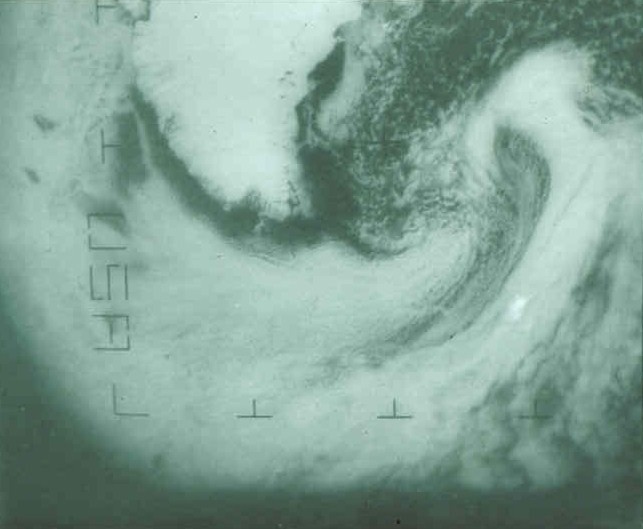
The publication of the Mars halo on this site stimulates me to dig in history. On 27 April 1975, I saw by change a picture of a subsun taken from space ( 1 ). It is here on the frontal system on the right of Greenland. It was taken by the satellite ESSA 8, which was the last weather satellite that took real pictures of the Earth rather than being a scanning platform. Only a few months later, ESSA 8 was lost, so I had been very lucky. The discovery of the subsun on a satellite picture gave me the same sensation as the discovery of the subsun on Mars, 31 years later.
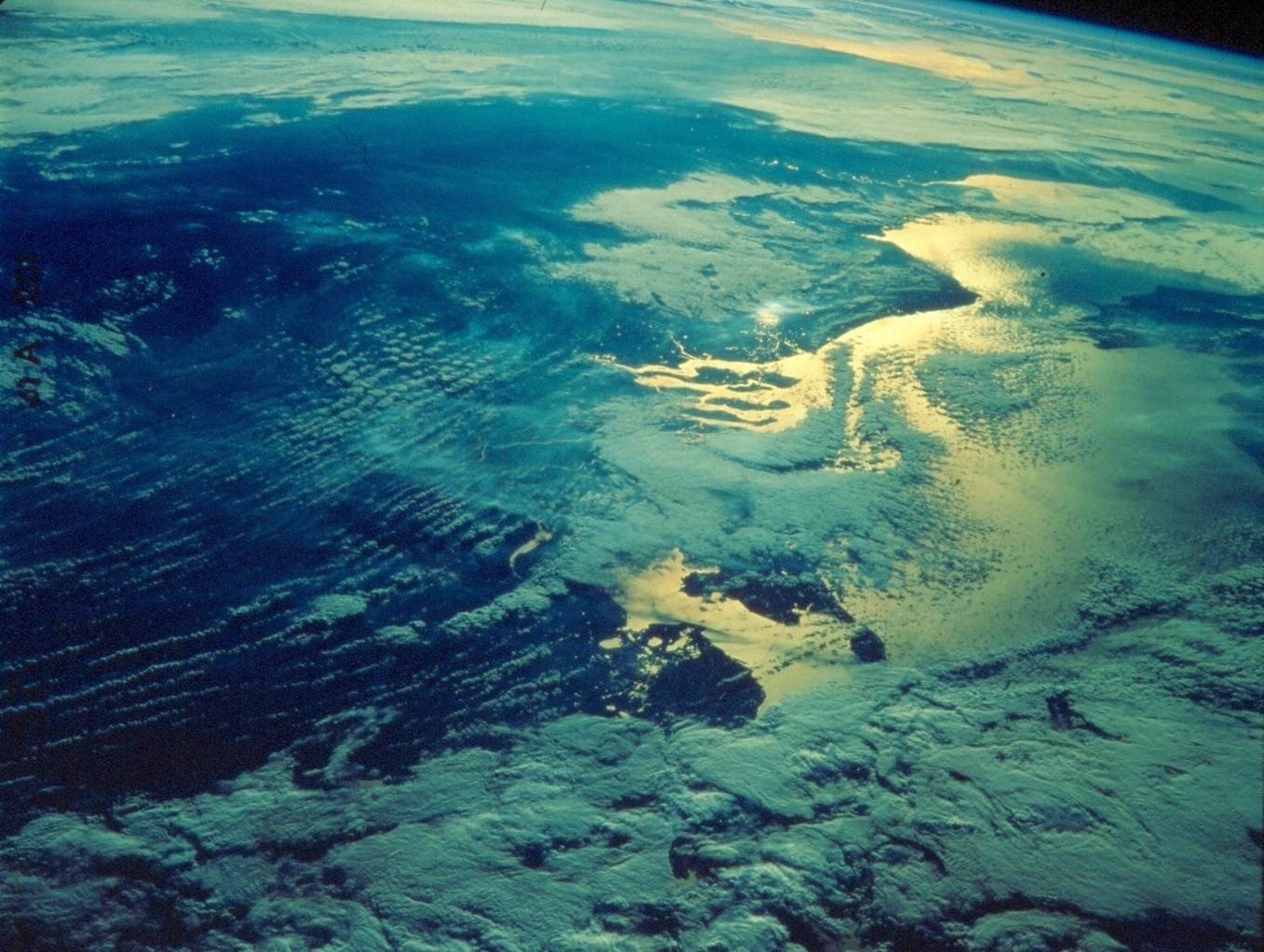
In 1985, I got another subsun taken from space (see photo on top), taken by the Dutch astronaut Ockels from the Challenger space shuttle during its last flight before the crash. The subsun is visible over the Netherlands, viewed upside down. Interestingly, the astronaut had overlooked the subsun despite the fact that I had prepared him for this possibility. He only saw the thing when he gave a slide show and I put his attention to it. Note its white colour compared to the sun’s reflection in the sea. Contrary to the ESSA 8 subsun on which I wrote a short paper in Weather, I did not publish this one.
Text: Günther Können
In 1985, I got another subsun taken from space (see photo on top), taken by the Dutch astronaut Ockels from the Challenger space shuttle during its last flight before the crash. The subsun is visible over the Netherlands, viewed upside down. Interestingly, the astronaut had overlooked the subsun despite the fact that I had prepared him for this possibility. He only saw the thing when he gave a slide show and I put his attention to it. Note its white colour compared to the sun’s reflection in the sea. Contrary to the ESSA 8 subsun on which I wrote a short paper in Weather, I did not publish this one.
Text: Günther Können
Feliratkozás:
Bejegyzések (Atom)