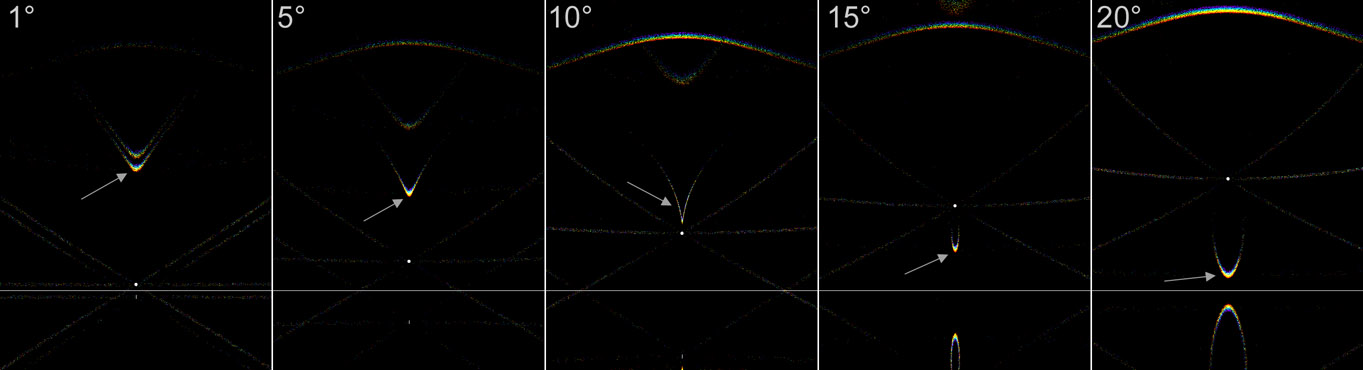
To supplement Les's posting, here is the behaviour of the reflected Parry as a function of sun elevation. At sun elevations higher than about 11 degrees, the halo arc is below the sun. The halo is perhaps easiest understood by thinking of it as a Parry arc of the subsun. At the solar elevations given in these simulations, it stays all the time at 22 degrees above the subsun. So if you know solar elevation, you know also where it is located relative to the sun.
In simulations for 15 and 20 degrees sun elevation also the normal lower sunvex Parry is seen, being as much below the horizon as the reflected Parry is above the horizon. Simulations are made with Jukka Ruoskanen's software.
2008. december 6., szombat
2008. december 5., péntek
A peculiar halo on 6 November in Rovaniemi
In the image on the left is Moilanen arc among other halos. On the right is similar looking halo (arrow), but its V is more pointed and it is also closer to the sun, about 7 degrees above it. These are stacked images, the inset image is a single frame showing the same arc (and also a weak Moilanen arc above it).
This halo seems to be what could be called a "reflected lower sunvex Parry arc". It was Walt Tape who suggested this kind of explanation for the arc. I will later add a post with simulations, crystal figures and raypaths. Pictures of the halo were published today in Tähdet ja avaruus magazine in Finland.
*** addition 5 December: see the upcoming posting on Les Cowley's site ( 1 ), which lights up the formation of this arc ***
This halo seems to be what could be called a "reflected lower sunvex Parry arc". It was Walt Tape who suggested this kind of explanation for the arc. I will later add a post with simulations, crystal figures and raypaths. Pictures of the halo were published today in Tähdet ja avaruus magazine in Finland.
*** addition 5 December: see the upcoming posting on Les Cowley's site ( 1 ), which lights up the formation of this arc ***
2008. december 4., csütörtök
Lascar display V
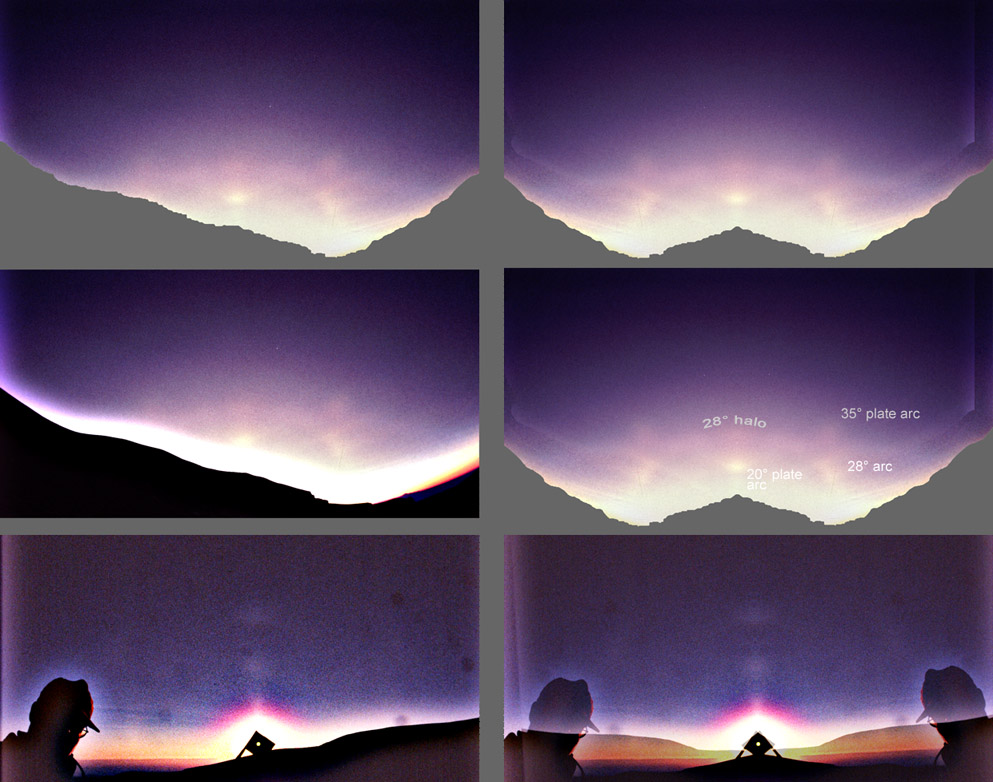
For the very lowest sun elevations there are only two photos, both shown here. Four uppermost images are versions of the same photo, which was the last one taken that day. Because halos have turned reddish, I suspect the sun was already below horizon.
Again a new feature has appeared, the 35° plate arcs. Others are familiar from previous postings.
To avoid wash-out from unsharp masking, ground was removed. For comparison, in the image on the middle left, the ground has not been removed. Same amount of unsharp mask and levels has been applied to both versions.
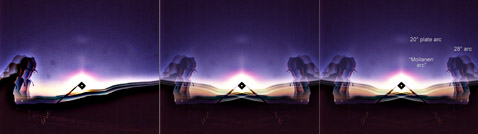
Photos at the bottom are from 1.6 degrees sun elevation (not to scale with upper photos). Two arcs directly above the sun are 20° upper plate arc and "Moilanen arc". From this slide the latter was measured to be 12 degrees from the sun.
Again a new feature has appeared, the 35° plate arcs. Others are familiar from previous postings.
To avoid wash-out from unsharp masking, ground was removed. For comparison, in the image on the middle left, the ground has not been removed. Same amount of unsharp mask and levels has been applied to both versions.
Photos at the bottom are from 1.6 degrees sun elevation (not to scale with upper photos). Two arcs directly above the sun are 20° upper plate arc and "Moilanen arc". From this slide the latter was measured to be 12 degrees from the sun.
2008. december 3., szerda
Lascar display IV
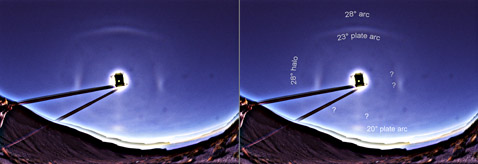
Now the sun elevation at Lascar is 2-3 degrees. The image is four frame stack. 20° upper plate arc is well visible. New feature, "Moilanen arc", has appeared. We observed it visually, it was V-shaped, not like the light mass seen in this photo. Photographing this arc was difficult, because it appeared and disappeared in seconds intervals. Measurements from two slides placed the arc at 10.5° from the sun, which is less than for Moilanen arc. But of course there is uncertainty in that value.
Lascar display III
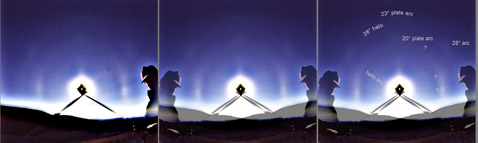
Continuing the Lascar halos tour. This image gives situation for sun elevation range of 11° to 9°. Image is stacked from four photos and also mirrored version is provided. 23° plate arc is already disappearing high up above the sun, but 20° upper plate arc on the other hand is appearing.
10 years ago we simulated the display with octahedral crystals of cubic ice and traditional pydamidal crystals. Octahedral crystal gives halos only at 28° and 19° from the sun. It was a good candidate for simulating because many features in photos from different solar elevations fell in place with it.
Among other things these simulations predicted that the 20° upper plate arc would be actually composed of two arcs, the other one being 19° upper arc... But there are still too many unexplained features in the display to trust our model, one being the fake 18° plate arcs.
2008. december 2., kedd
Lascar display II
Another phase of the Lascar display. Three photos are stacked from sun elevation range of about 32° to 30°. Familiar halos are 23° and 20° plate arcs. Other halos are not so familiar.
2008. december 1., hétfő
Lascar display
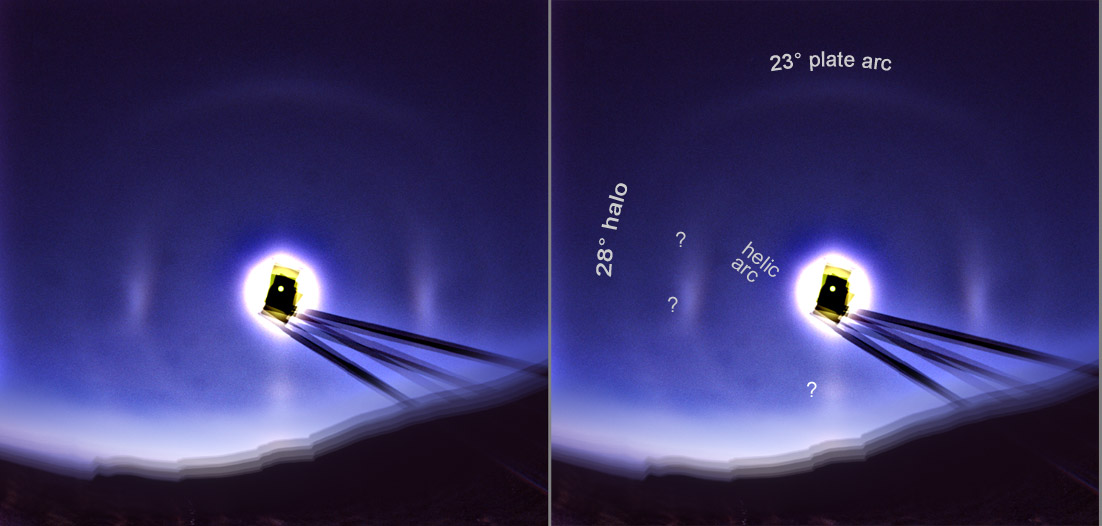
This was seen on 27 November 1997 in Chile, on the foot of Lascar volcano, where Leena Virta and I photographed it. The image - that is stacked from nine slides - presents only one stage of the display. The photos were taken in 10 minutes interval, during which sun elevation change was from 25.5° to 23.5°.
The display contained some exotic halos, such as 28° halo. There seem to be also traditional pyramidal crystal halos, in this image 23° plate arc and pyramidal helic arc. However, what looks as 18° plate arcs are actually below the level of the sun (this was pointed out by Walt Tape years ago).
Feliratkozás:
Bejegyzések (Atom)