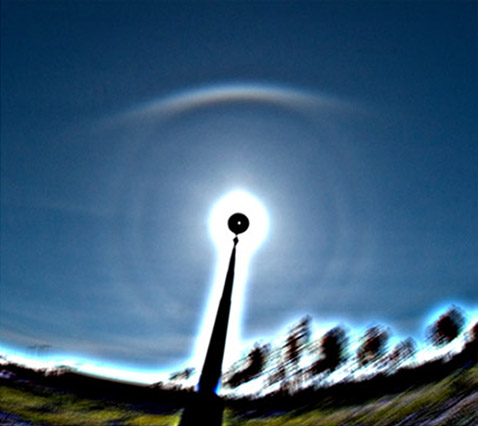
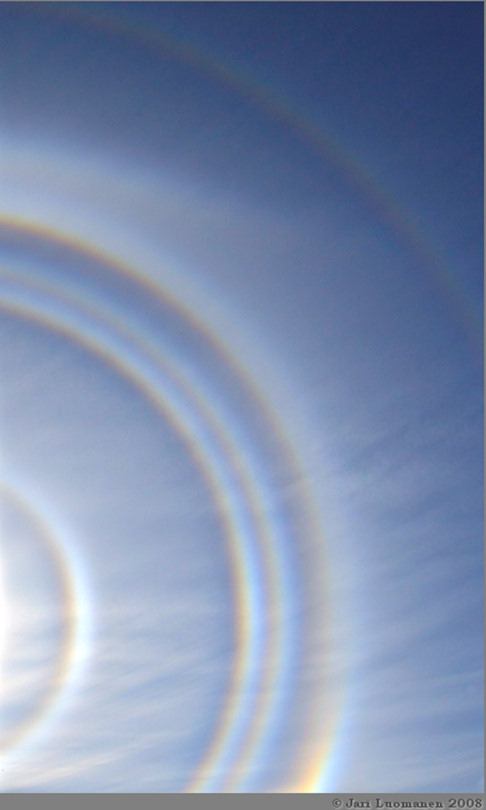
A major pyramidal crystal display was observed on 5 June in Southern Finland. The center of the action was located in Tampere, where the photo above was taken by Jari Luomanen.
Several people noticed the display and photographic documentation is extensive. For more photos, browse the messages of our mailing list ( 1 ), starting from 05.06.2008.
2008. június 9., hétfő
2008. június 4., szerda
Reign of Pyramids
Photograph above by Marko Riikonen on 1st June 2008.
A noteworthy streak of pyramid crystal halos in Europe started with a display on 27th May in Stavanger, Norway, where two Hungarian observers took photos in the evening: András Uhrin ( 1 - 2 ) and Éva Bora ( 3 - 4 ). Their photos show 9° halo, 18° halo, 18° plate arcs and a hint of an upper 23° plate arc.
Next day, on 28th May, Jarmo Moilanen captured a subhelic arc in Oulu, Finland ( 5 ). Meantime in Kokkola, Finland, the odd-radius halo streak was marginally kept alive by a short-lived appearence of 9° halo ( 6 ).
On 30th May in Turku, Finland, observers were alert in the afternoon. The 23° upper plate arc and halo rings with radii of 9°, 18°, 20° and 23° were photographed by Joni Tahkoniemi ( 7 ) and Pertti Havia ( 8 ). A one day gap between pyramid crystal displays occured on 31st May, when as consolation a faint display with a long parhelic circle was seen in Riihimäki ( 9 ).
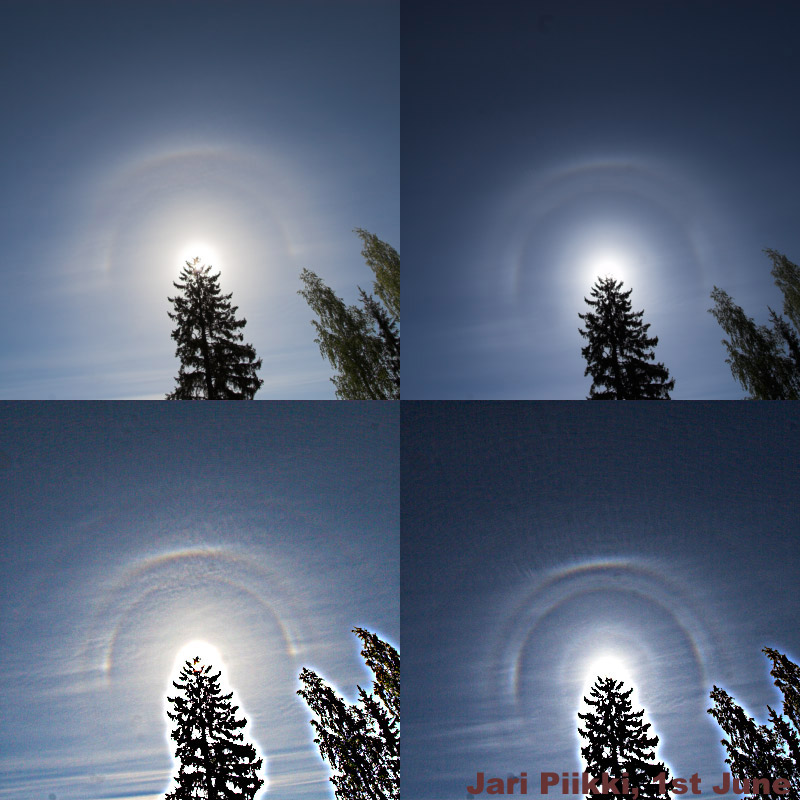
The morning of 1st June kept observers busy in Southern Finland. At around nine a.m. a very classy 23° upper plate arc was observed by Reima Eresmaa in Lammi, Jukka Ruoskanen in Riihimäki ( 10 ) and Marko Riikonen in Vantaa ( 11 ). Faint 18° plate arcs were in the sky as well. Later on photographs revealed also 20° and 23° halos. Marko was most alert, and was able to catch the maximum of the display. 9° and 35° halos and the pyramid helic arc appear in his photos. The pyramid helic arc was to be expected to show up because of the quality of the 23° upper plate arc. For further information see Marko's comments below the photos in his gallery.
Few moments after the maximum stage in Lammi, Riihimäki and Vantaa the halos striked Juva, where Jari Piikki photographed a magnificient set of pyramid crystal halos ( 12 ). Most distict features in Jari's photos are strong 20° and 35° halos.
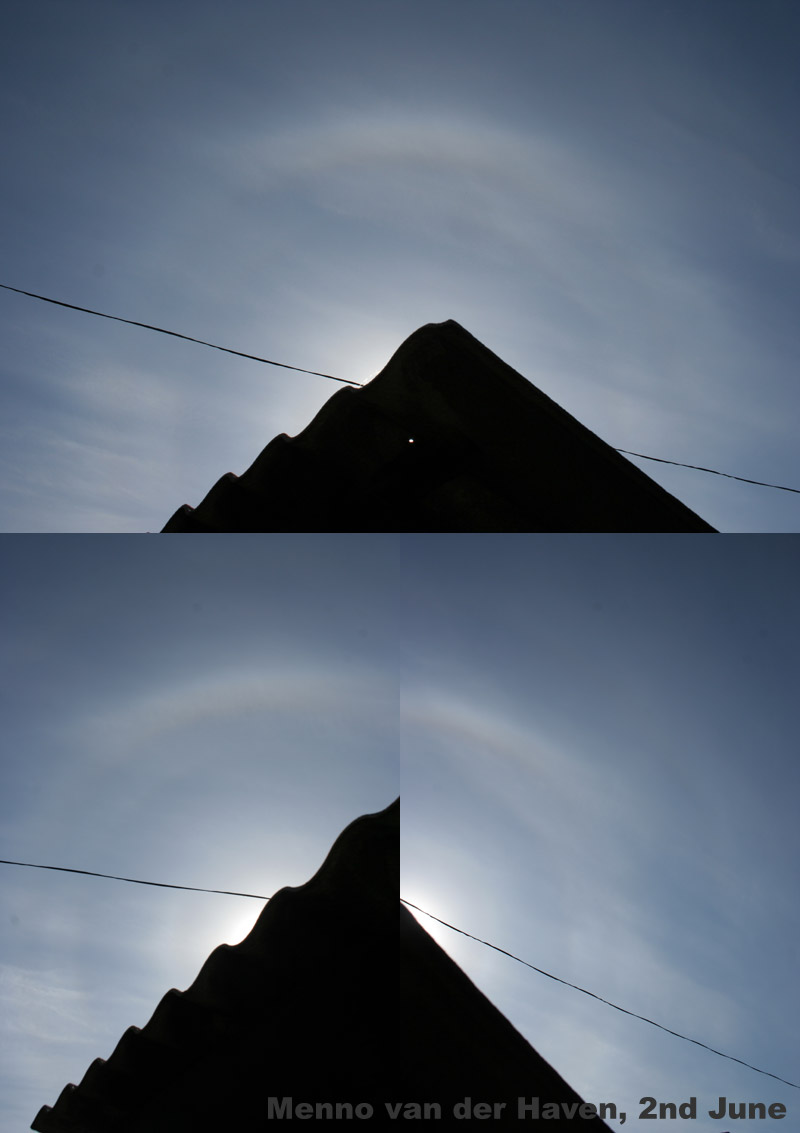
Next morning, on 2nd June, Menno van der Haven photographed a pyramid crystal halo in Curteni, Romania ( 13 ). The display is very similar to Jari Piikki's display the day before, except that the 23° upper plate arc is a bit stronger and the 20° halo is weaker. 35° halo is of the same caliber.
2008. június 2., hétfő
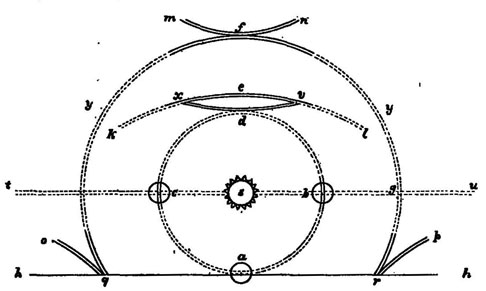
What's missing from Parry's drawing?

"r p, q o, arches of large circles, very strongly prismatic, which could
only be traced to p and o; but on that part of the horizontal circle
t u, which was directly opposite to the sun, there appeared a confused
white light, which had occasionally the appearance of being caused
by the intersection of large arches coinciding with a prolongation of
r p, and q o."
Possibly there were traces of the white arcs from column crystals, which caused the occasional impression of anthelion being caused by the extension of infralateral arcs (r p, q o). At least later these faint white arcs became so clear as to make further note of them:
"At 90° from the sun, on each side of it, and at an altitude of
30° to 50°, there now appeared also a very faint arch of white light,
which sometimes seemed to form a part of the circles q o, r p; and
sometimes we thought they turned the opposite way."
Subhelic arc coincides with 46° infralateral arc at the drawing's sun elevation. Most likely, however, there were other arcs as well, Wegener and helic arc, which added to the confusion. And finally, also 46° Parry arcs were observed:
"In the outer large circle, we now observed two opposite and
corresponding spotsonding spots y y, more strongly prismatic
than the rest..."
The halos were seen in Canada's Melville Island on 9 April 1820. The display was long lasting; from 1 at least until 6 pm. Observers paid also attention to sun elevation depended changes in the halos by noting the growing distance between upper tanget arc and Parry arc and the shape change in tangent arc. The excerpts of the observational account are taken from Hasting's "A general theory of halos" ( 1 )
2008. május 30., péntek
Subhelic arc in Finland
A halo display was observed on 28 May 2008 in Oulu, Finland. It was reported even by local newspaper Kaleva and some photos sent by readers were published - see 29.5.2008 photos ( 1 ). According to those photos, the display did have a very strong and colorful supralateral arc with great circumzenith arc in the earlier stage.
First photos were reported an hour earlier than I noticed the display. When I was outside the display was not very bright anymore ( 2 ).
Soon a faint white arc got my attention at atzimut around 100 degrees and high above horizon. It was first faint and hard to see and it also disappeared for a moment. Toward the end of the display, the arc got better intensity and lenght. The halo was a subhelic arc from column oriented ice crystals. An arc located this way could be also be a heliac arc, but no halos related to Parry orientation was seen. Subhelic arc was already visible as a faint and short arc in some photos which I took before I noticed the arc.
2008. május 29., csütörtök
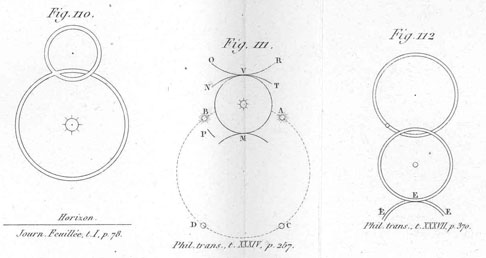
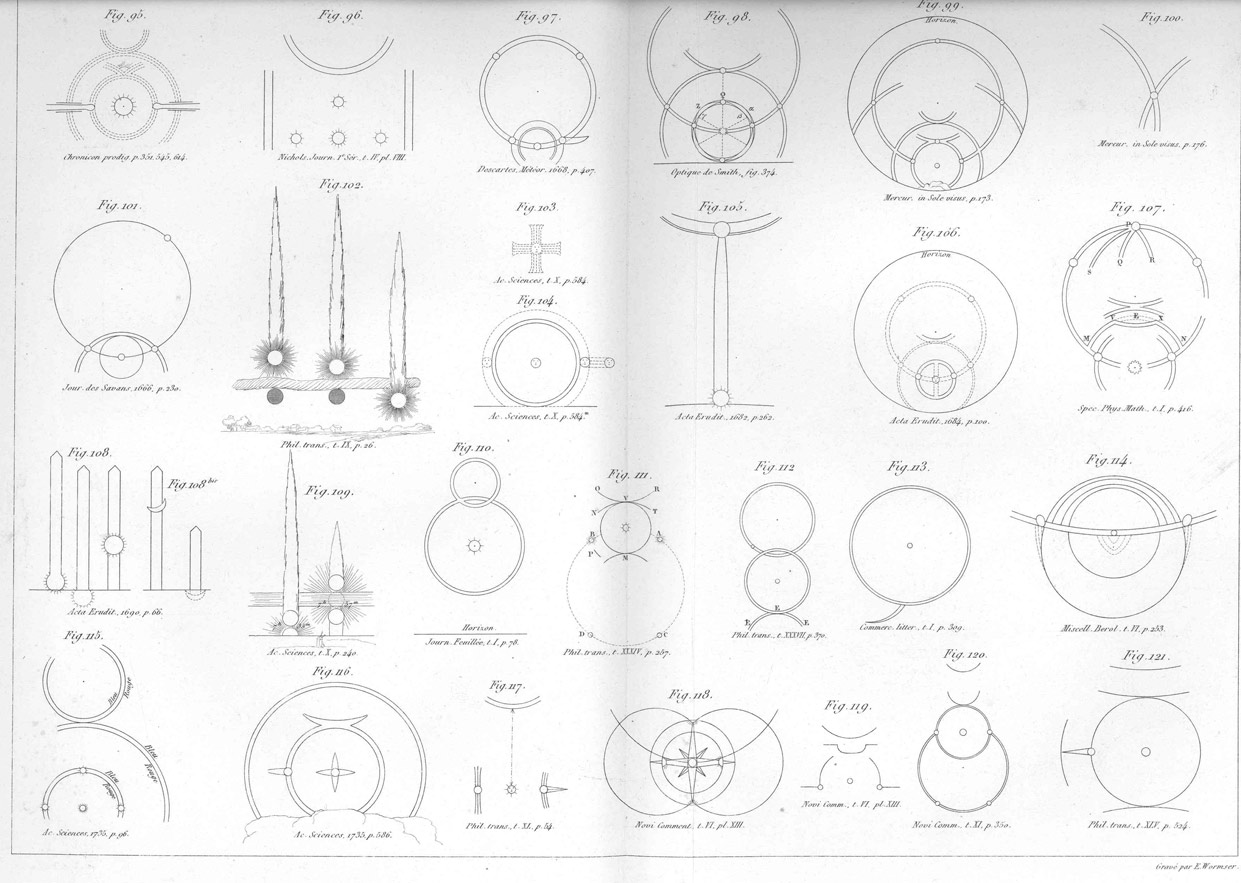
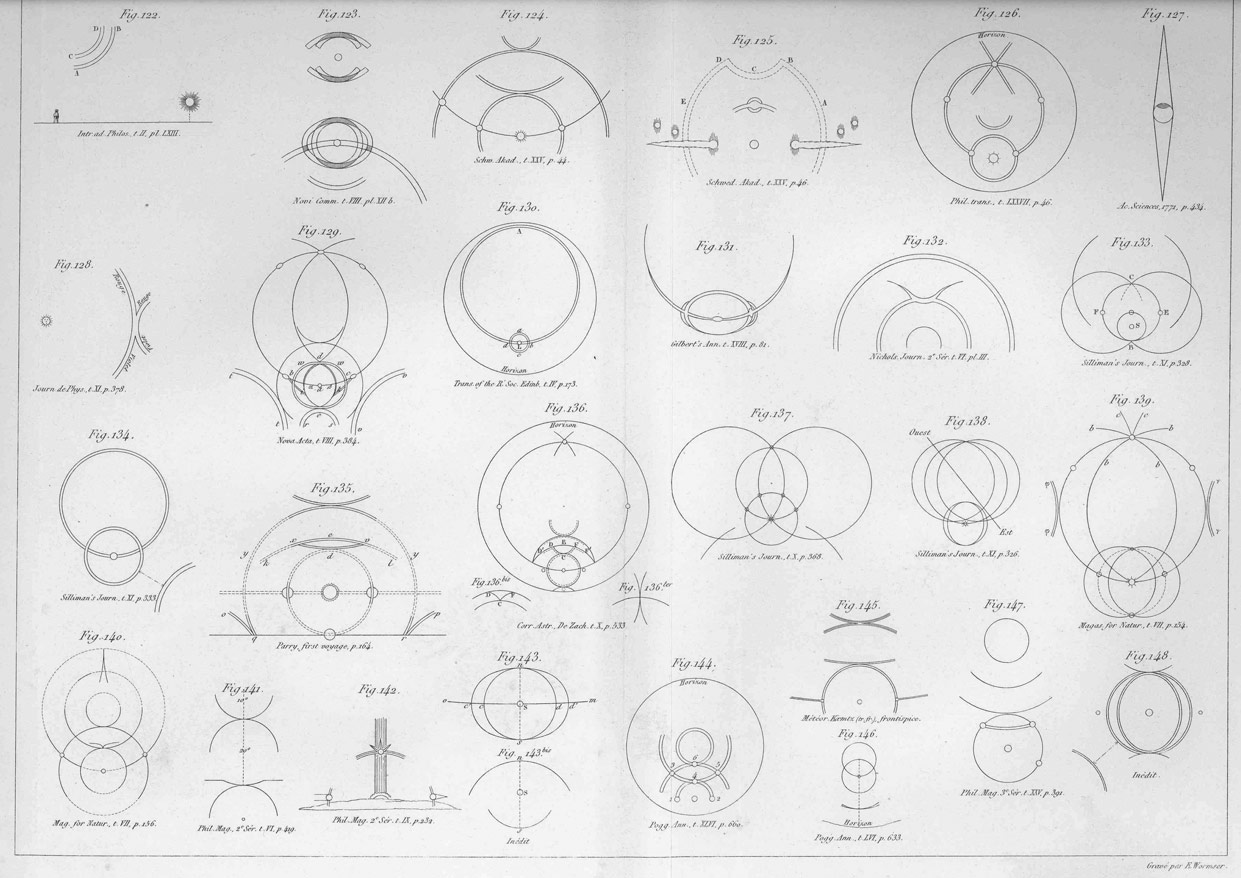
An old halo book available

The displays in the image above are from the book. On the left is the observation by Feuillee, from which the observer name for 35° halo was derived.
In the document are also two other articles by Bravais. First one, starting from pdf page 87 is of various parhelia and second one on page 105 seems to be about fogbow.
2008. május 27., kedd
Halo winter in Rovaniemi

Sun pillar Intensity threshold
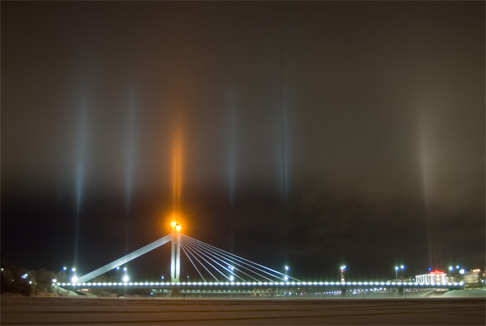
Halo displays created with a bright lamp seem to commonly exhibit a distinct intensity treshold at the zenith. This treshold is especially prominent in the photo above, taken on 13 December 2007 in Pälkäne, Finland as well as in Jukka Ruoskanen's images from Hyvinkää during the same night ( 1 ). The effect is also seen in the photos from Rovaniemi in early November 2007 ( 2 ). In all these displays the crystal swarm originated from the snow guns of a nearby ski resort.
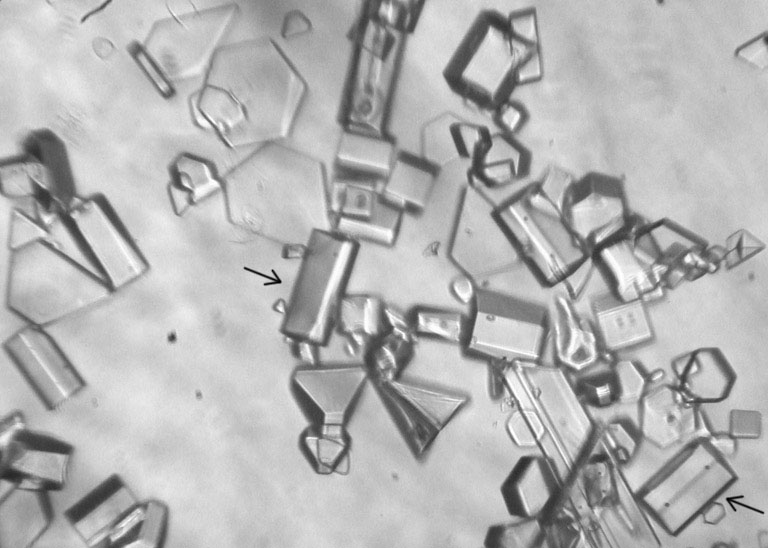
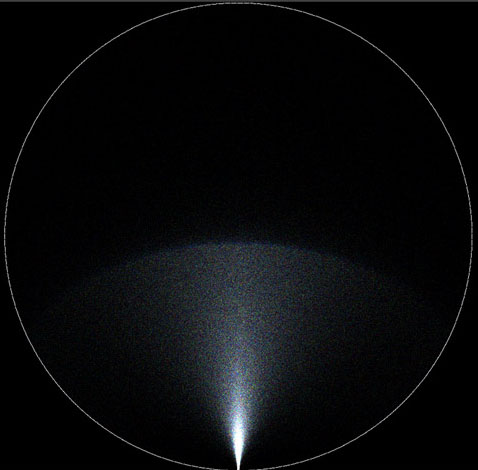
The intensity threshold cannot be adequately simulated using regular hexagonal crystals. However, when semi-triangular singly oriented columns ( 3 ) are used, the intensity threshold appears, as shown in the simulation above. Such crystals are common in snow gun displays, as is evident for example in the crystal samples of the Rovaniemi display ( 4 ). Two arrows point to almost completely triangular columns.
The simulation as well as the crystal image are made with software developed by Jukka Ruoskanen. In the simulation also random crystals were used to create the 22° halo.
The raypath for the intensity threshold is 3-5-7, which, in fact, makes it a sun pillar. A filtered simulation reveals how this sun pillar forms a huge fan shaped effect with sharp outer boundary ( 5 ). This simulation was done with a program by Mika Sillanpää and Jarmo Moilanen.
Text: Jari Luomanen and Marko Riikonen
The intensity threshold cannot be adequately simulated using regular hexagonal crystals. However, when semi-triangular singly oriented columns ( 3 ) are used, the intensity threshold appears, as shown in the simulation above. Such crystals are common in snow gun displays, as is evident for example in the crystal samples of the Rovaniemi display ( 4 ). Two arrows point to almost completely triangular columns.
The simulation as well as the crystal image are made with software developed by Jukka Ruoskanen. In the simulation also random crystals were used to create the 22° halo.
The raypath for the intensity threshold is 3-5-7, which, in fact, makes it a sun pillar. A filtered simulation reveals how this sun pillar forms a huge fan shaped effect with sharp outer boundary ( 5 ). This simulation was done with a program by Mika Sillanpää and Jarmo Moilanen.
Text: Jari Luomanen and Marko Riikonen
Feliratkozás:
Bejegyzések (Atom)