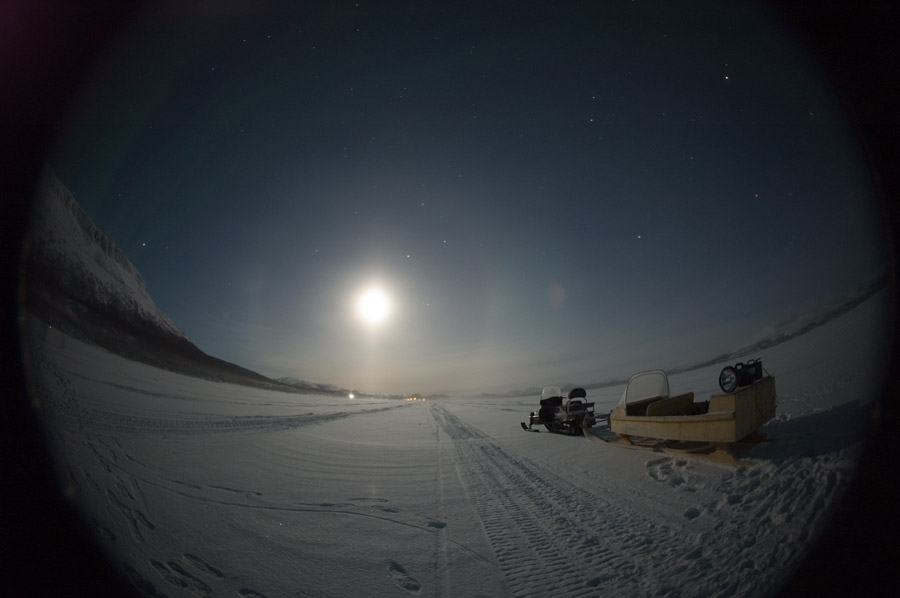
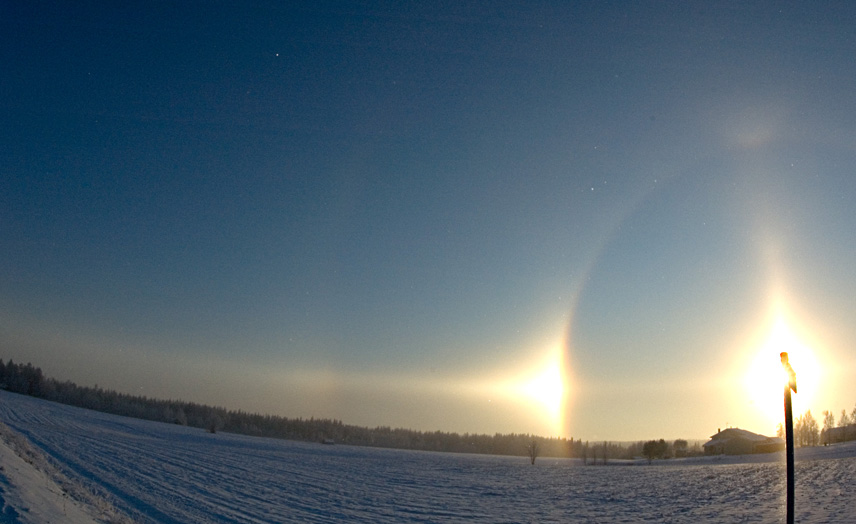
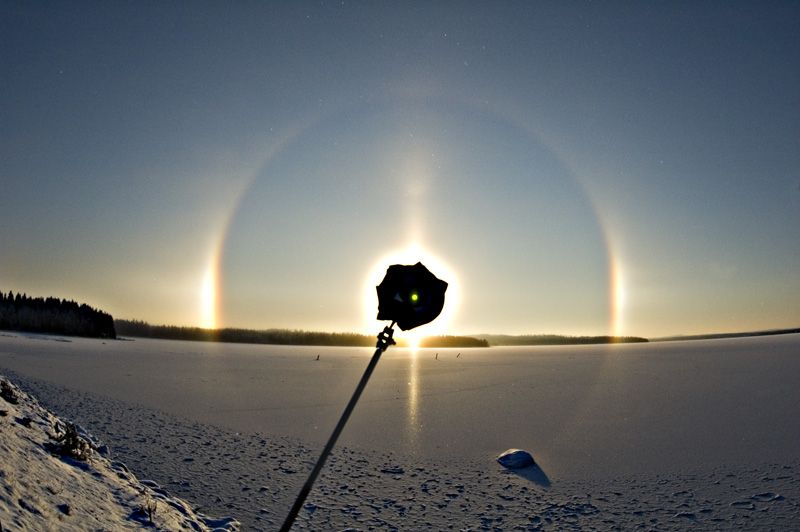
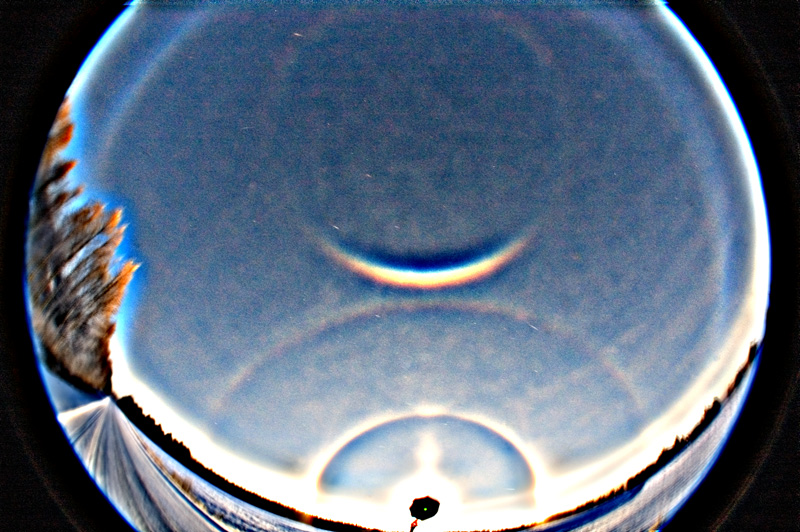
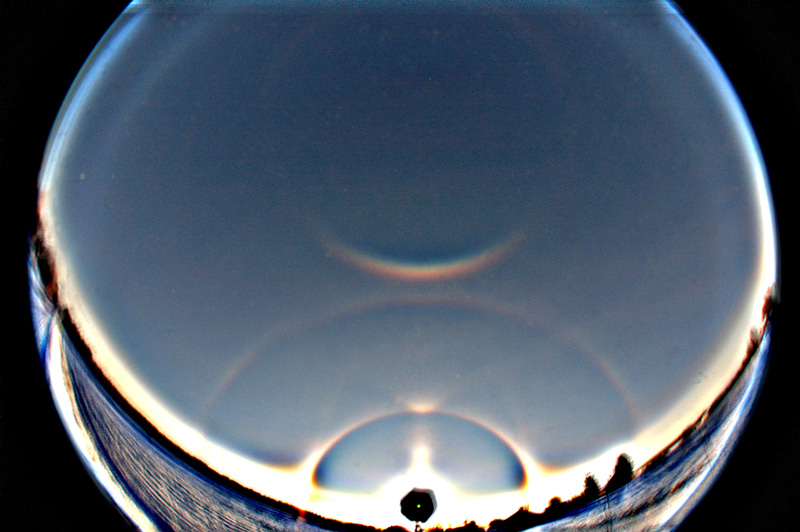
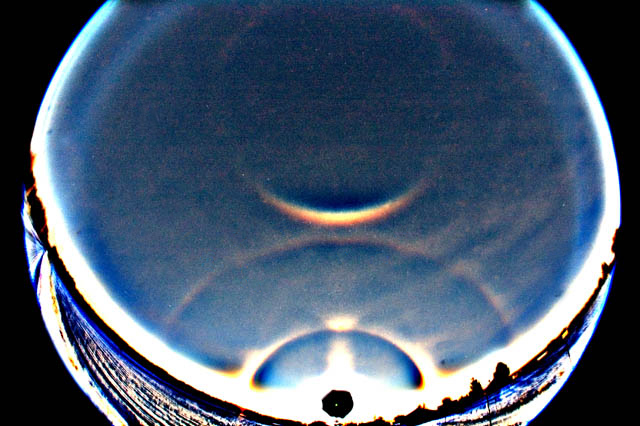
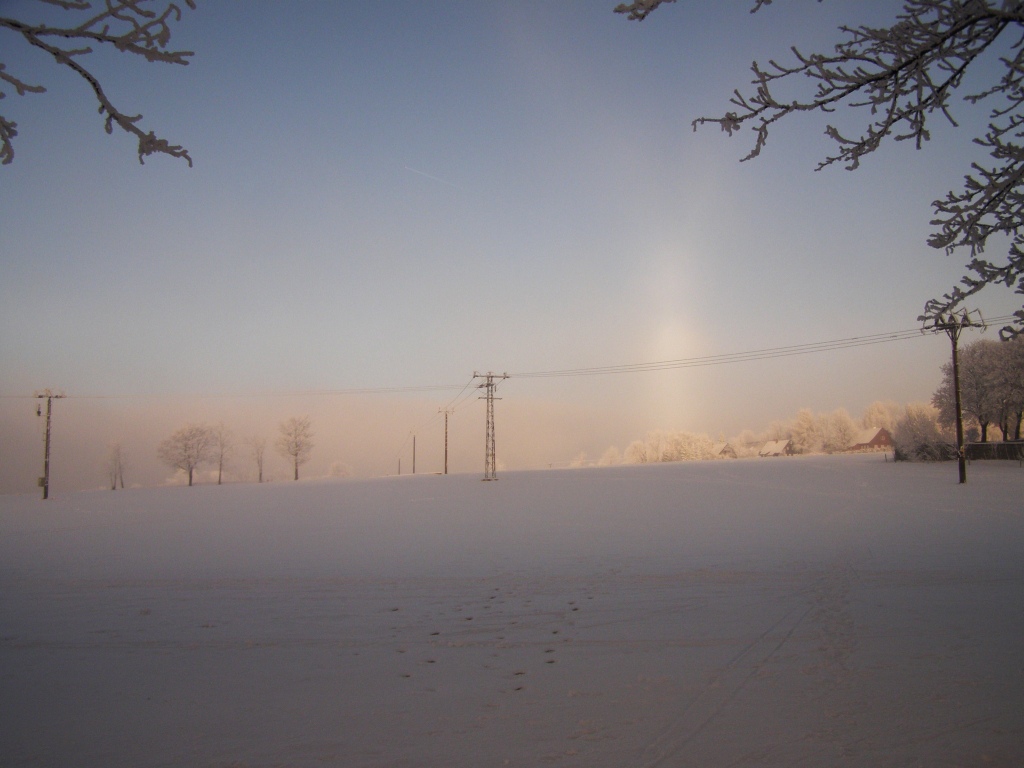
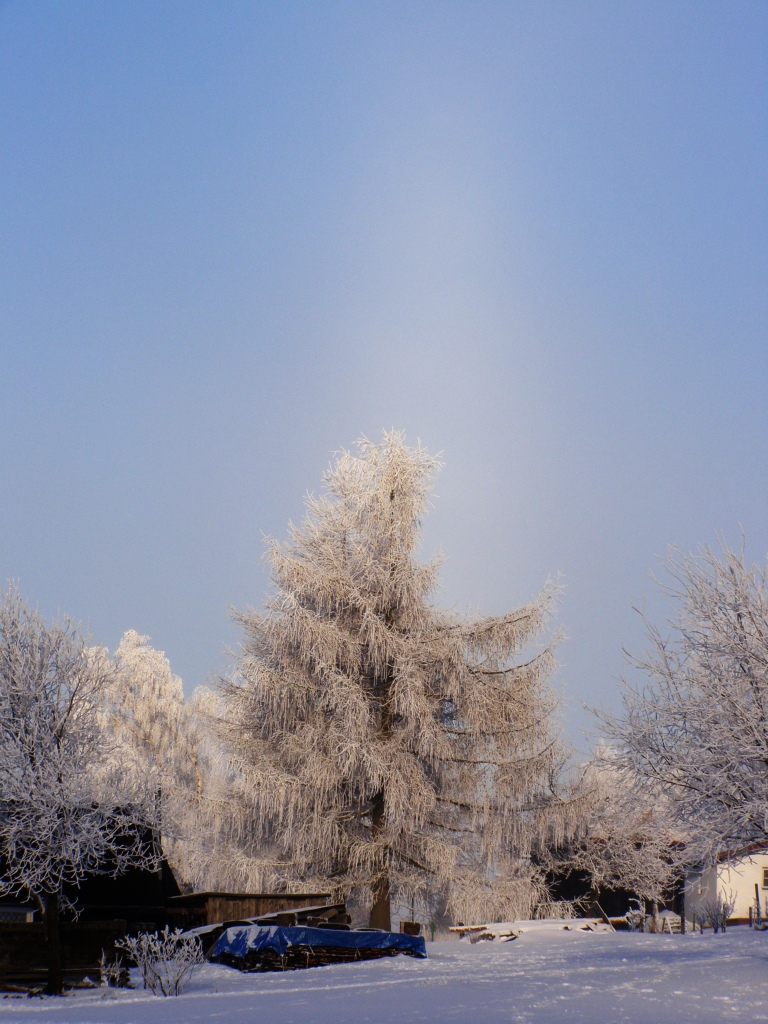
Sometimes it happens that when first photos of some halo are taken, more start piling up in the wake. This was the case for example with elliptical halos.
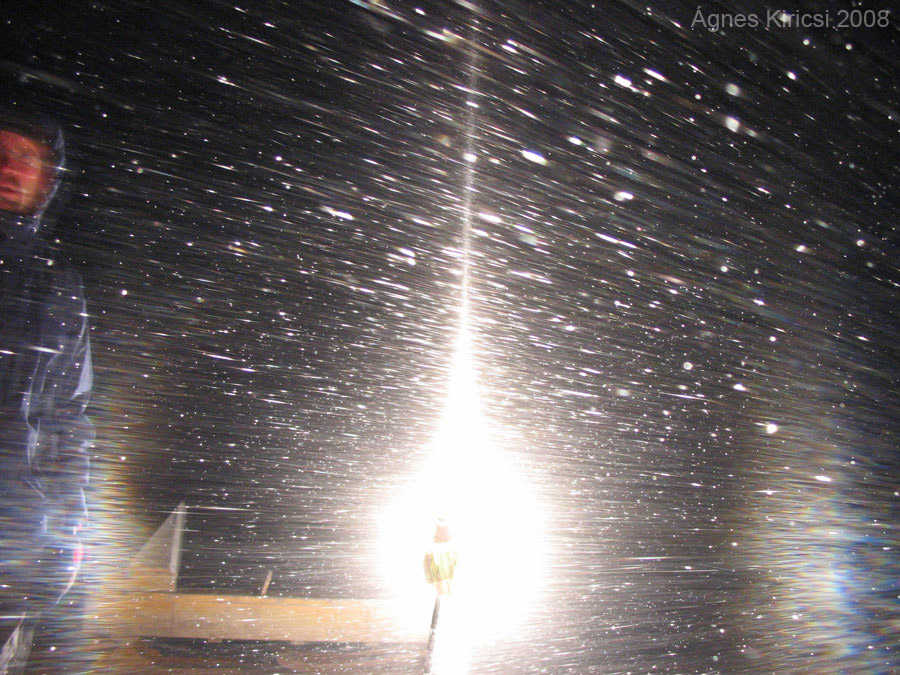
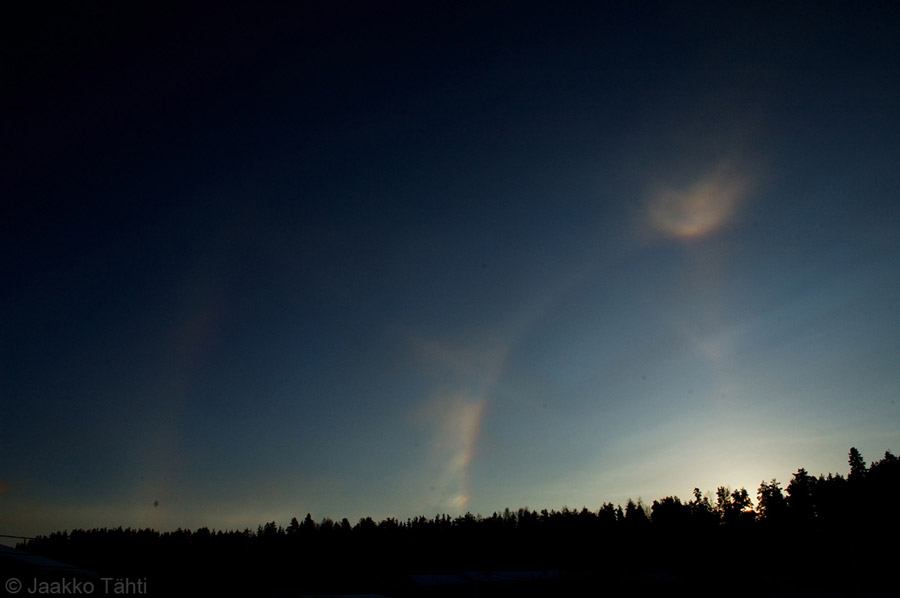
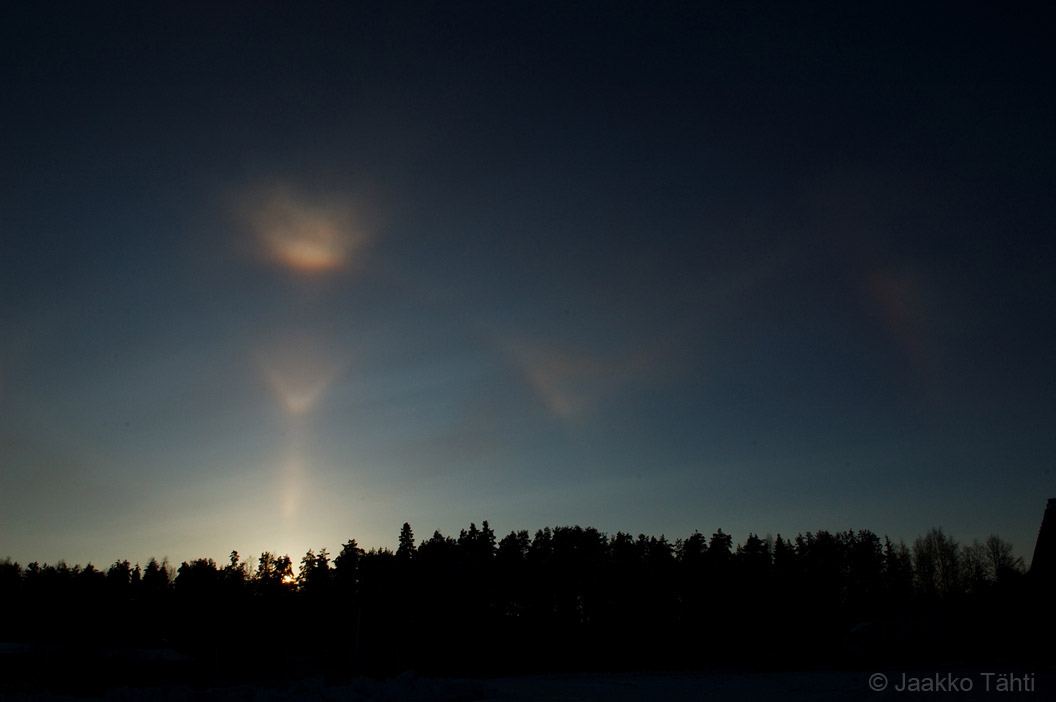
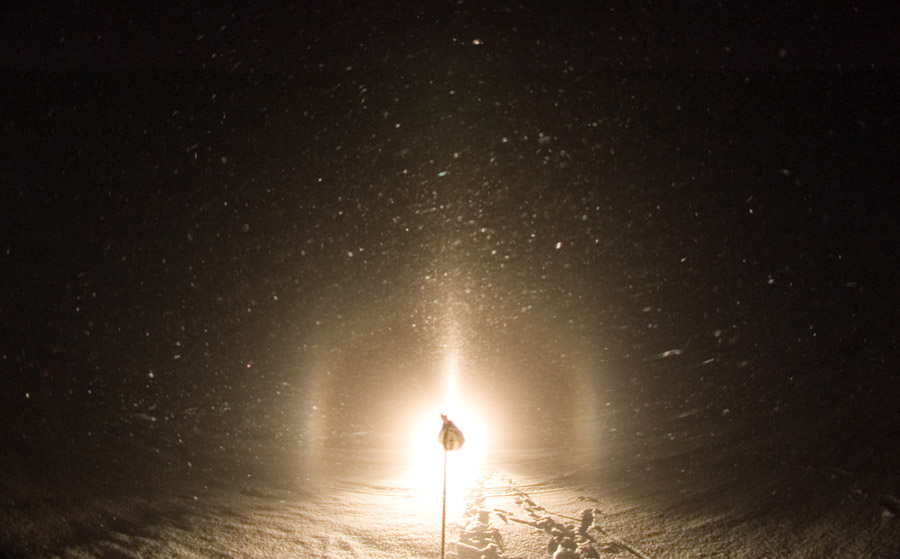
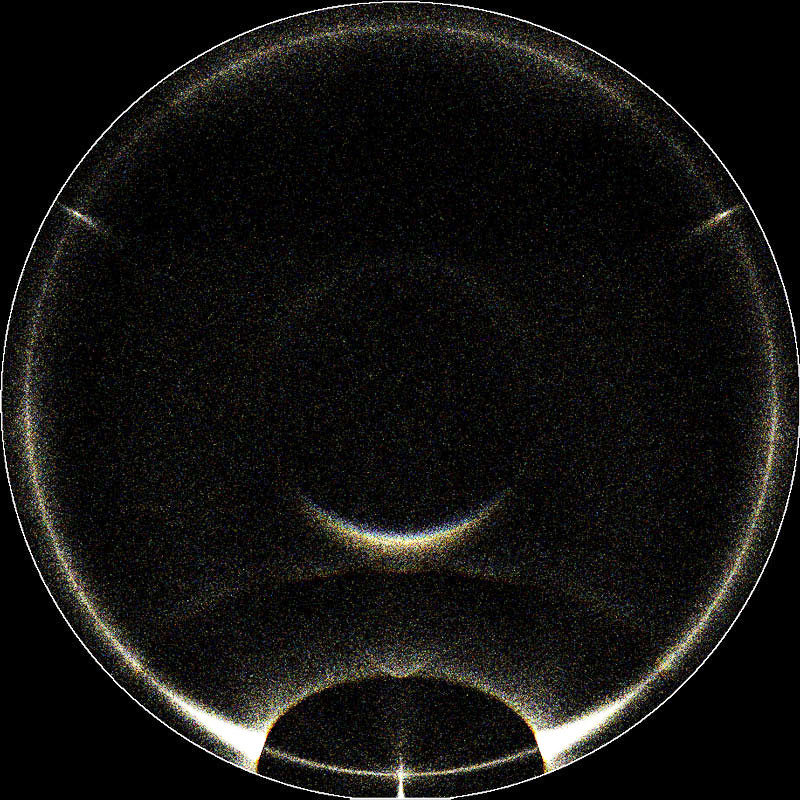
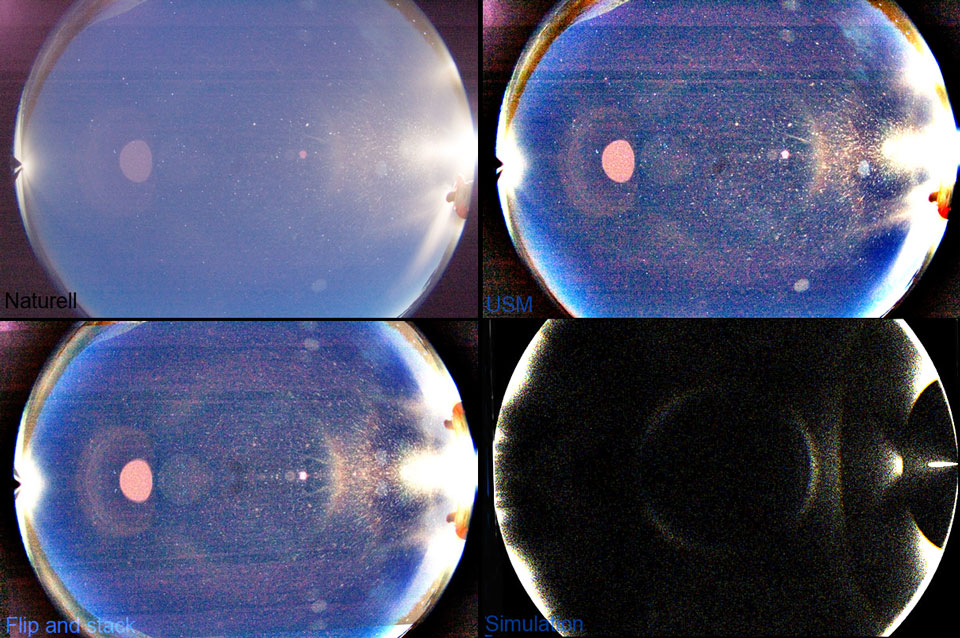
Now the Kilpisjärvi halo expedition seems to have resulted in second Kern photo, this time the light source being Cyclops X-15 spotlight instead of sun. In the images above - which are just versions of one photo - there seem to be two short arcs that match the location of the Kern arc as shown by the simulation.
The simulation (Jukka Ruoskanen's simulation software) is made for light source elevation of 0° which must be very close to the real situation. Thick h/d 0.6-1.0 regular hexagonal plates with tilts of 2° were used for the Kern arc. Thinner plates made also good Kern, but they produced additional circumzenith arc which is not seen in the photos.
In the first days and nights of diamond dust making in Kilpisjärvi we practically encountered every possible mishap. This was one of those nights. For one thing the blocker was not properly in place which resulted in lens reflections. Even worse, the lamp suddenly dimmed when the photo was taken: the battery that was supposed to be full had failed us.
So I had to increase exposure heavily afterwards in photo editing software to light up the dark photo. This resulted in excess noise and horizontal lines. To reduce the noise, mirror images of the photo were stacked ("flip and stack"). More natural versions are also given.
Upon experimenting with various crystal tilts and aspect ratios in the simulation program it became clear that Kern arc was always prominently accompanying the circumzenith arc around 0° light source elevations. From that point of view there is nothing special in Kern showing up in the photo: it must be there.
2008. január 30., szerda
Complex halo display in Destne
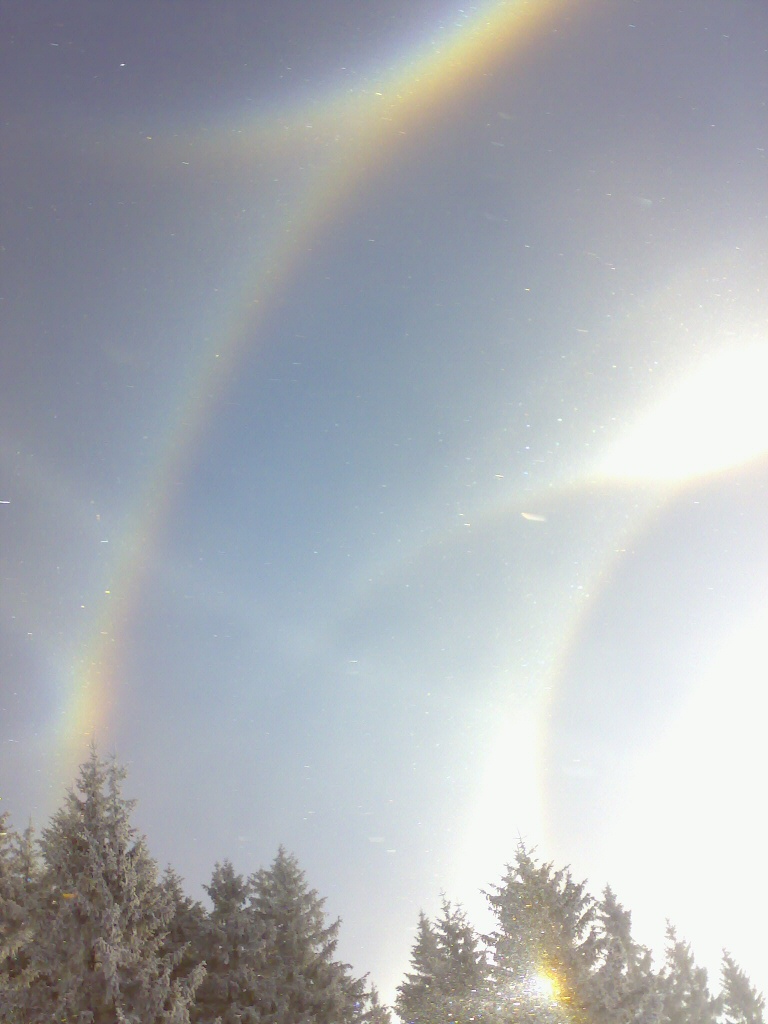
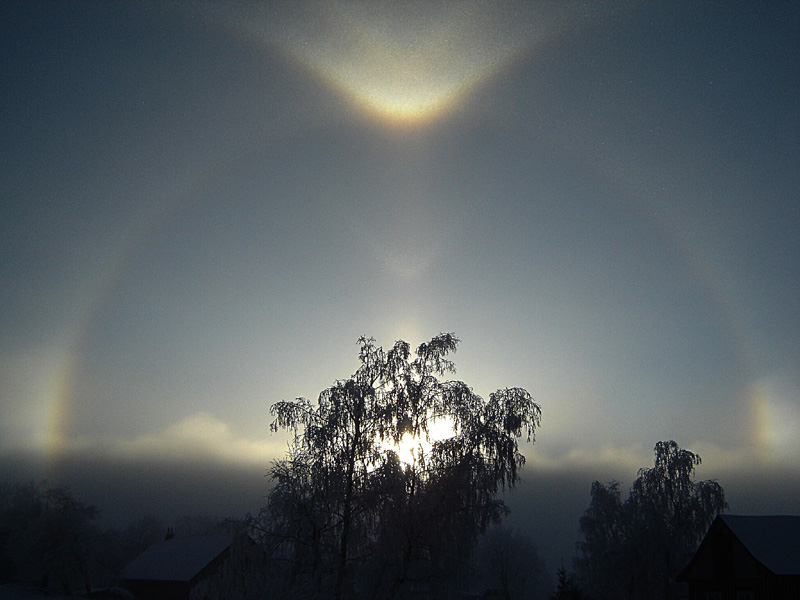
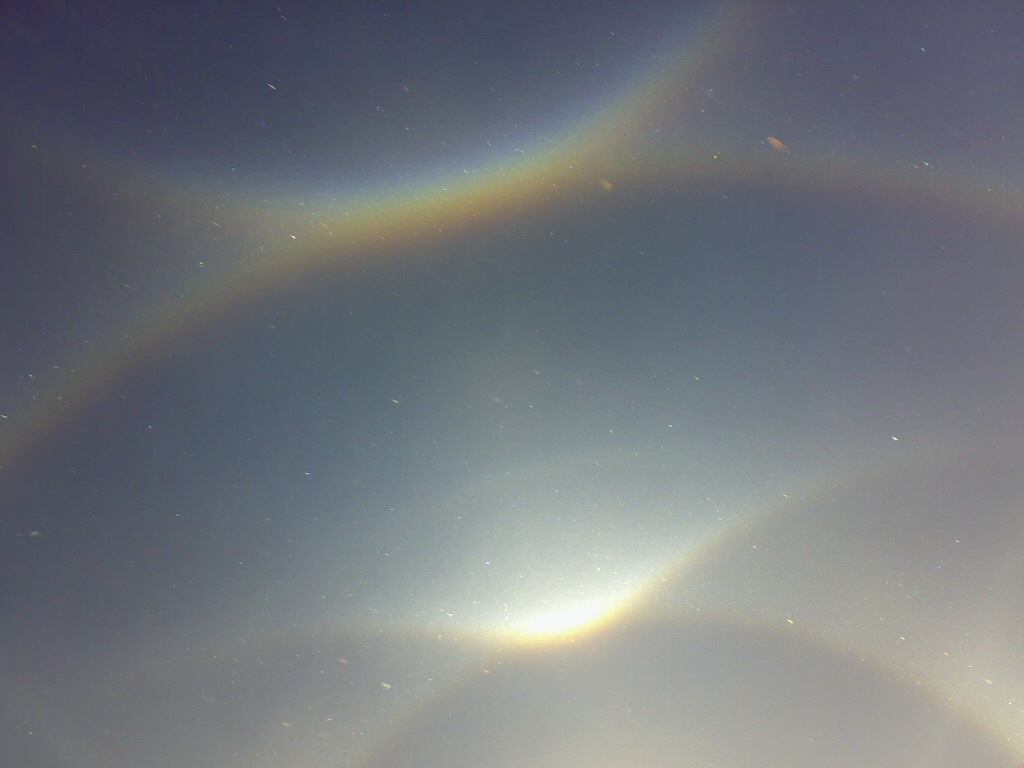
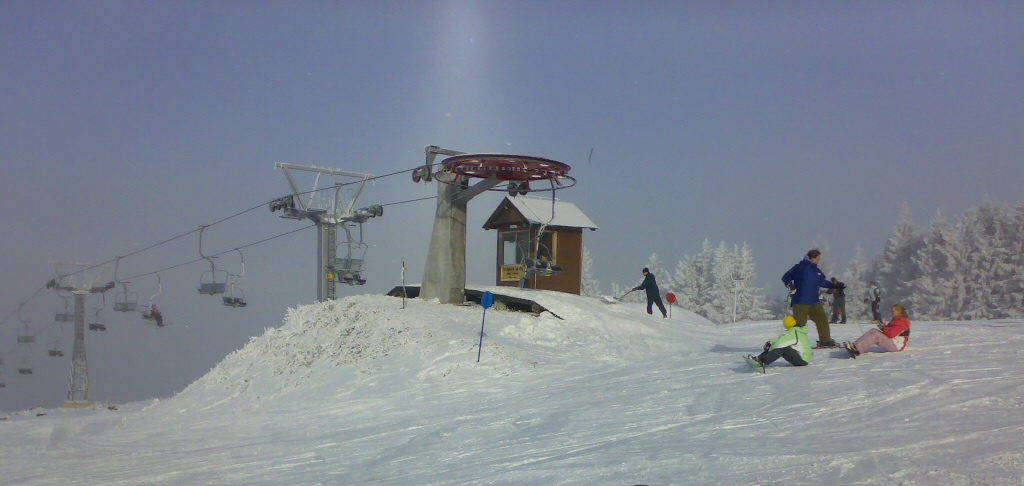
One of the most striking halo displays of recent years in the Czech Republic was observed on December 25, 2007 in Destne in the Orlicke Mountains. Diamond dust halo phenomena highlighted the sky shortly after 12 local time (CET) and lasted until sunset.
While skiing, Radek Svoboda took several shots with his cell phone camera and captured a variety of halos including ones like Tape arc (Parry supralateral arc) and heliac arc, as shown by the photo beside. See also another image.
After the inspection of rest of the photos, even diffuse arcs turned up.
Some of the images are featured in the gallery, other uploaded halo photographs of Czech observers can be instantly browsed on the latest uploads page.
Text: Tomas Trzicky
While skiing, Radek Svoboda took several shots with his cell phone camera and captured a variety of halos including ones like Tape arc (Parry supralateral arc) and heliac arc, as shown by the photo beside. See also another image.
After the inspection of rest of the photos, even diffuse arcs turned up.
Some of the images are featured in the gallery, other uploaded halo photographs of Czech observers can be instantly browsed on the latest uploads page.
Text: Tomas Trzicky
2008. január 29., kedd
Well defined Moilanen arc in Viitasaari
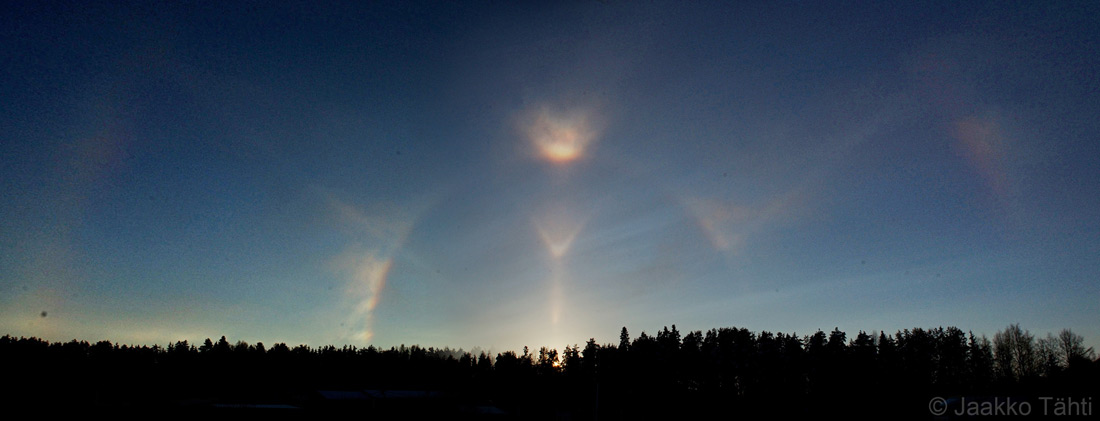
On 23 January Jaakko Tähti was doing product photography in a factory in Viitasaari when he got a phonecall that there was a good halo display in the sky. He could not get outside but had a look at the display from factory window. An hour later, at 13:45, Tähti finally got a chance to go out and took photos from which the above panorama was made.
The halos in the display are the usual ones for snow gun generated displays (ski center was nearby), but the razor sharp form of the Moilanen arc is of a better class. Crystal samples from these kind of appearances could be useful in unveiling the mystery that shrouds the Moilanen arc formation.
Here are four single photos of the display ( 1 - 2 - 3 - 4 ).
The halos in the display are the usual ones for snow gun generated displays (ski center was nearby), but the razor sharp form of the Moilanen arc is of a better class. Crystal samples from these kind of appearances could be useful in unveiling the mystery that shrouds the Moilanen arc formation.
Here are four single photos of the display ( 1 - 2 - 3 - 4 ).
2008. január 28., hétfő
Making halos in Kilpisjärvi
On 19th January the four of us, Jukka Ruoskanen, Marko Mikkilä, Ágnes Kiricsi and Marko Riikonen gathered at the Kilpisjärvi biological station in northern Finland to make halos. We had got some evidence that weather conditions in the Kilpisjärvi area might be favourable for ice crystal formation as long as the nuclei are provided. At his home, Marko Mikkilä had already done successful initial experiments of creating halos with a mixture of kaolin and water sprayed in the air, and this time we wanted to do more tests on the system.
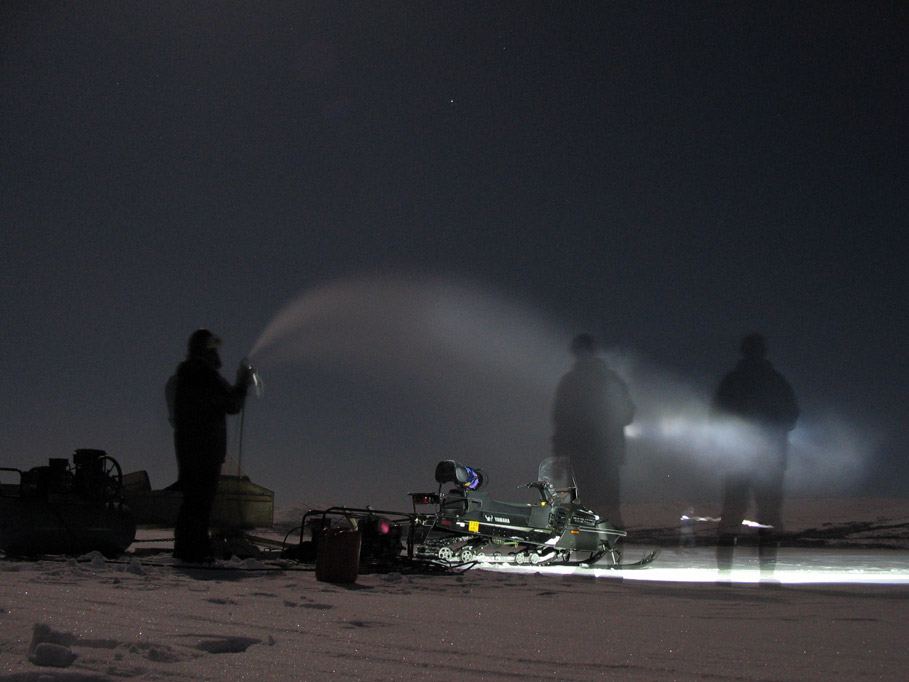
During our one-week stay, we were able to create displays on two days and three nights, the temperatures being around -20 °C. The diamond dust cloud that developed seemed to be kilometres wide. This was accomplished with only about 10 litres of water and two spoonfuls of kaolin. The crystal swarm usually lasted about half an hour and then it was time to go back to spray more ( 1 – 2 ). On one night we succeeded in making halos 12 hours continuously.
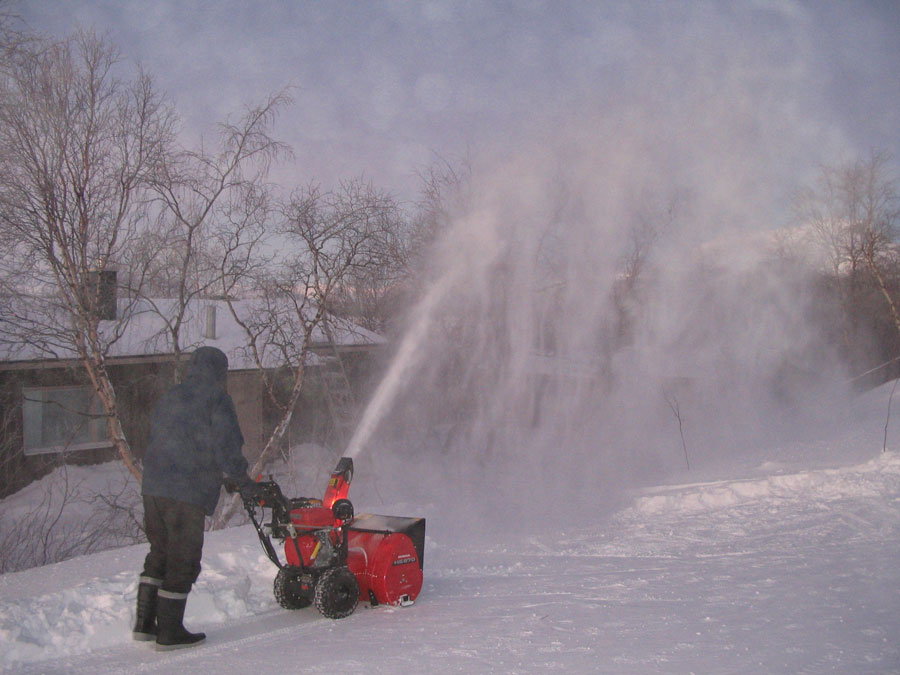
We also tested a snow blower. A good display had been observed ten years ago in Resolute Bay created by such a machine (see drawings in Sivuaurinko 3/98 on pages 9 and 10). Our impression was, however, that it was not nearly as good as kaolin, and we eventually quit using it.
Mostly we had plate displays ( 1 - 2 ), but on two nights at the beginning of the favourable conditions there were also halos from column and Parry oriented crystals. Diffuse arcs and upper sunvex Parry arc were seen. Moilanen arc was present only on one night for a short while.
We also tried spraying water mixed with montmorillonite (also known as bentonite) on one day and managed to create a weak plate display. This clay mineral is referred to be an even better nucleator than kaolin, but we found its use problematic because of its clumping habit.
After each spraying round photographing the halos was sort of a hassle, there was not much time for fine tuning. The next step in halo making is to have a continuous automated feed of the nucleating mixture. Then the real fun can start.
Text: Ágnes Kiricsi, Marko Riikonen
During our one-week stay, we were able to create displays on two days and three nights, the temperatures being around -20 °C. The diamond dust cloud that developed seemed to be kilometres wide. This was accomplished with only about 10 litres of water and two spoonfuls of kaolin. The crystal swarm usually lasted about half an hour and then it was time to go back to spray more ( 1 – 2 ). On one night we succeeded in making halos 12 hours continuously.
We also tested a snow blower. A good display had been observed ten years ago in Resolute Bay created by such a machine (see drawings in Sivuaurinko 3/98 on pages 9 and 10). Our impression was, however, that it was not nearly as good as kaolin, and we eventually quit using it.
Mostly we had plate displays ( 1 - 2 ), but on two nights at the beginning of the favourable conditions there were also halos from column and Parry oriented crystals. Diffuse arcs and upper sunvex Parry arc were seen. Moilanen arc was present only on one night for a short while.
We also tried spraying water mixed with montmorillonite (also known as bentonite) on one day and managed to create a weak plate display. This clay mineral is referred to be an even better nucleator than kaolin, but we found its use problematic because of its clumping habit.
After each spraying round photographing the halos was sort of a hassle, there was not much time for fine tuning. The next step in halo making is to have a continuous automated feed of the nucleating mixture. Then the real fun can start.
Text: Ágnes Kiricsi, Marko Riikonen
2008. január 27., vasárnap
Kern arc photographed in Finland
On the 17th November I drove 250 kilometers to the town of Sotkamo to check if there were any diamond dust halos. Two weeks earlier I had made the same trip, but the snowguns hadn't produced any halos. This time, however, the ski resort was surrounded by a thick fog cloud in which diffuse halos were visible.
I started searching for a better spot and after a while of driving the cloud started thinning. 22º halo, parhelia and M-arc were present and I took ice crystal samples before continuing the search. Several kilometers later it started looking really good and I stopped the car by a field where the view was unobstructed.
The parhelia were extremely strong, and I made my first observation of 44º parhelia. Other halos were 22º halo, sunpillar, subsun, subparhelia, upper tangent arc, circumzenith arc, 120º parhelia, 46º halo, parhelic circle and M-arc. The 120º parhelia looked like fuzzy pillars.
I took several hundred photos and ran out of memorycard. Luckily I had an old camera with slide film, but as it also ended pretty fast, the only solution was to get a new memorycard from the local town over 10 kilometers away. When I was back, the display was still going on, but the new card also got filled up in half an hour. So it was time to get home.
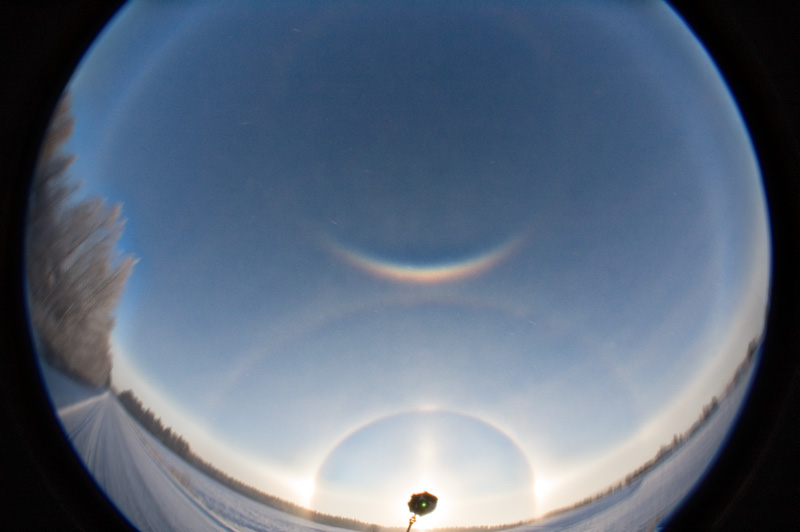
Next day, as I was having a closer look at the photos I couldn't believe my eyes what appeared on the screen. The circumzenith arc had a faint extension going all around the zenith: the Kern arc. See this photo, which also shows reflected Lowitz arcs. In some of the photos the 46º halo has an angular appearance revealing the 46º contact arcs , which were first photographed in Muonio a year ago ( 1 - 2 ).
Although readily appears in simulations, the Kern arc has been controversial because of the lack of photos. It was first reported by H.F.A Kern in 1895 in the Netherlands and at least six subsequent reports are known. As an explanation for Kern arc formation, raypath 1-3-5 in plate crystals as well as multiple scattering has been suggested. In the Sotkamo display there were 44º parhelia indicative of the latter, but it is not certain whether this mechanism is applicable higher up in the sky where the crystal cloud is optically much thinner.
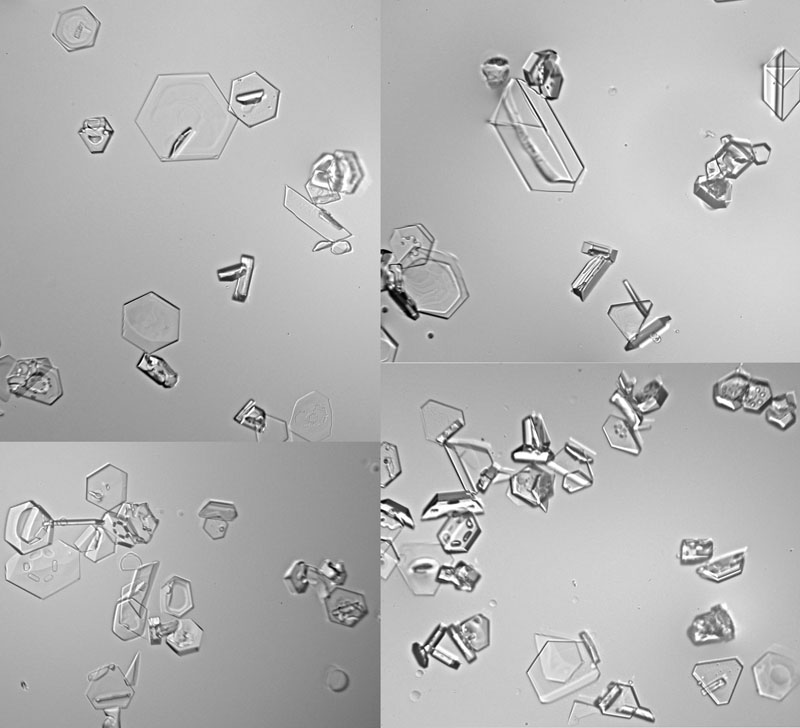
Single scattering raypath 1-3-5 produces Kern arc easily, especially when the crystals are towards triangular shape and the sun is low. Both of these circumstances were realized in the Sotkamo display where the sun elevation was six degrees and a considerable number of crystals were semitriangular. As for crystal aspect ratio, it is thick plates that are favourable for Kern arc formation. The crystals in the photos seem to be below optimum thickness, but it should be noted that the crystal samples were collected before the peak of the display when Kern arc was not yet occurring and thus the sample may not fully representative.
The simulation of the display was made with populations of plate, Lowitz and column crystals. Fixed multiple scattering probability (0.15) was applied for all populations. Plates were semitriangular and the Kern arc in the simulation is primarily from single scattering 1-3-5 raypaths. Multiple scattering makes the 44º parhelia. Poorly oriented spinning Lowitz crystals made the 46º contact arcs and Lowitz arcs. It is noteworthy that the apparent 22º halo in the simulation is actually made of Lowitz arcs, which may also have been the case in the display. Columns made the weak 22º upper tangent arc. The simulation was made with a program by Jukka Ruoskanen
During recent years we have seen photographs of numerous displays with very bright parhelia. It is probable that at least some of them involved the Kern arc. This might be worth keeping in mind when the next bright plate crystal display comes along.
I started searching for a better spot and after a while of driving the cloud started thinning. 22º halo, parhelia and M-arc were present and I took ice crystal samples before continuing the search. Several kilometers later it started looking really good and I stopped the car by a field where the view was unobstructed.
The parhelia were extremely strong, and I made my first observation of 44º parhelia. Other halos were 22º halo, sunpillar, subsun, subparhelia, upper tangent arc, circumzenith arc, 120º parhelia, 46º halo, parhelic circle and M-arc. The 120º parhelia looked like fuzzy pillars.
I took several hundred photos and ran out of memorycard. Luckily I had an old camera with slide film, but as it also ended pretty fast, the only solution was to get a new memorycard from the local town over 10 kilometers away. When I was back, the display was still going on, but the new card also got filled up in half an hour. So it was time to get home.
Next day, as I was having a closer look at the photos I couldn't believe my eyes what appeared on the screen. The circumzenith arc had a faint extension going all around the zenith: the Kern arc. See this photo, which also shows reflected Lowitz arcs. In some of the photos the 46º halo has an angular appearance revealing the 46º contact arcs , which were first photographed in Muonio a year ago ( 1 - 2 ).
Although readily appears in simulations, the Kern arc has been controversial because of the lack of photos. It was first reported by H.F.A Kern in 1895 in the Netherlands and at least six subsequent reports are known. As an explanation for Kern arc formation, raypath 1-3-5 in plate crystals as well as multiple scattering has been suggested. In the Sotkamo display there were 44º parhelia indicative of the latter, but it is not certain whether this mechanism is applicable higher up in the sky where the crystal cloud is optically much thinner.
Single scattering raypath 1-3-5 produces Kern arc easily, especially when the crystals are towards triangular shape and the sun is low. Both of these circumstances were realized in the Sotkamo display where the sun elevation was six degrees and a considerable number of crystals were semitriangular. As for crystal aspect ratio, it is thick plates that are favourable for Kern arc formation. The crystals in the photos seem to be below optimum thickness, but it should be noted that the crystal samples were collected before the peak of the display when Kern arc was not yet occurring and thus the sample may not fully representative.
The simulation of the display was made with populations of plate, Lowitz and column crystals. Fixed multiple scattering probability (0.15) was applied for all populations. Plates were semitriangular and the Kern arc in the simulation is primarily from single scattering 1-3-5 raypaths. Multiple scattering makes the 44º parhelia. Poorly oriented spinning Lowitz crystals made the 46º contact arcs and Lowitz arcs. It is noteworthy that the apparent 22º halo in the simulation is actually made of Lowitz arcs, which may also have been the case in the display. Columns made the weak 22º upper tangent arc. The simulation was made with a program by Jukka Ruoskanen
During recent years we have seen photographs of numerous displays with very bright parhelia. It is probable that at least some of them involved the Kern arc. This might be worth keeping in mind when the next bright plate crystal display comes along.
2008. január 24., csütörtök
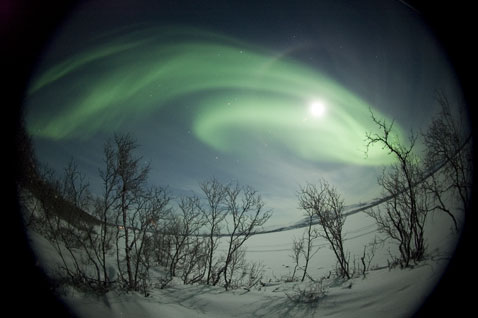
Halo and northern lights
Some ten years ago or so my friends and I went though Finnish Meteorological Institute automatic northern light camera films in search for moon halos. At that time I considered the northern lights as unnecessary noise that disturbed the distinction of halos on those low resolution 8 mm films.
Last Thursday I was photographing a moon halo display in Kilpisjärvi biological station, when suddenly green northern lights moved fast across the halos. It was a rather nice treat and above is one photo of those moments.
Also a 9° halo was in the sky on that night, as shown by this photo. Two nights later the 9° halo reappeared, but the display was much poorer.
Last Thursday I was photographing a moon halo display in Kilpisjärvi biological station, when suddenly green northern lights moved fast across the halos. It was a rather nice treat and above is one photo of those moments.
Also a 9° halo was in the sky on that night, as shown by this photo. Two nights later the 9° halo reappeared, but the display was much poorer.
2008. január 23., szerda
Moilanen arc and diffuse anthelic arcs in Prichovice
A superb halo complex was observed by Petr Kousal on December 25, 2007 in community of Prichovice. He observed 22° halo, parhelia, pillar and also bright upper tangent arc with sunvex Parry arc. Except for these quite frequent phenomena he observed also Moilanen arc, which tips almost touched the 22° halo ( 1 - 2 - 3 - 4 ).
The best event came when he looked towards anthelion point, where diffuse arcs were clearly visible. This observation of diffuse arcs is the first in the Czech Republic ( 1 - 2 - 3 ).
This display was also captured by Martina Pistorova during her afternoon walk to the outlook-tower Stepanka in Prichovice ( 1 ). Analogous halo complex with Moilanen arc was also observed and photographed by Frantisek Kovarik in community Prichovice ( 1 ).
Also Hana Koukalova observed halo complex in the same community. Faint heliac arc is maybe displayed in one of her pictures ( 1 - 2 ). And finally, also Julia Vachkova observed a few halos together with infralateral arc ( 1 - 2 )
Text: Martin Popek, Lukas Shrbeny
The best event came when he looked towards anthelion point, where diffuse arcs were clearly visible. This observation of diffuse arcs is the first in the Czech Republic ( 1 - 2 - 3 ).
This display was also captured by Martina Pistorova during her afternoon walk to the outlook-tower Stepanka in Prichovice ( 1 ). Analogous halo complex with Moilanen arc was also observed and photographed by Frantisek Kovarik in community Prichovice ( 1 ).
Also Hana Koukalova observed halo complex in the same community. Faint heliac arc is maybe displayed in one of her pictures ( 1 - 2 ). And finally, also Julia Vachkova observed a few halos together with infralateral arc ( 1 - 2 )
Text: Martin Popek, Lukas Shrbeny
Feliratkozás:
Bejegyzések (Atom)